- Type
- Lesson plan
- Ages
- Ages 8-13
- Duration
- 1 hour
- Level
- Beginner
How do lily-trotter fathers adapt their nesting behaviors and physical traits to keep their young safe from predators in the Okavango Delta?
Overview
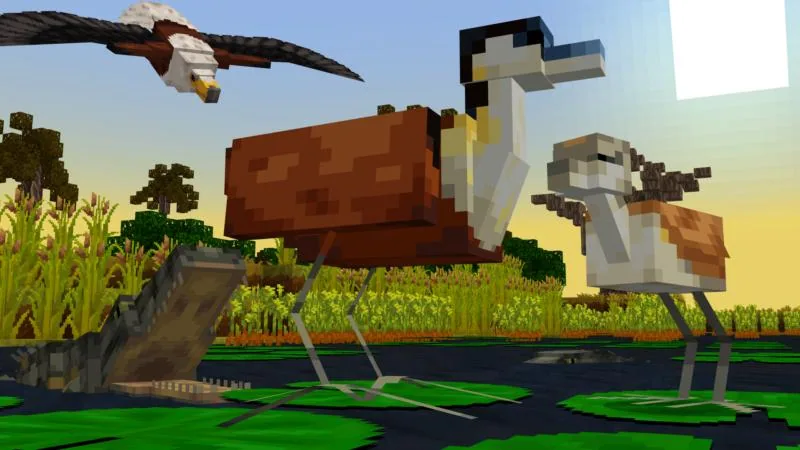
In the Okavango Delta, the African jacana—commonly known as the lily-trotter—uses exceptionally long toes and sharp claws to stride across floating vegetation. Unlike many bird species, the father assumes the full responsibility of building a floating nest, incubating eggs, and shielding newly hatched chicks from predators such as Nile crocodiles and African fish eagles.
Through a Minecraft simulation, students experience survival from both the father's and chick's perspectives by navigating lily pads without alerting predators. Students then transfer these ecological insights to an unplugged engineering activity where they design, build, and test floating nests using sustainable materials.
Learning objectives
By the end of this lesson students will be able to:
- Explain how the physical adaptations of lily-trotters allow them to walk across floating water vegetation.
- Describe the distinct role of the father lily-trotter in nest building, egg incubation, and chick protection.
- Identify how changing delta conditions and predators like Nile crocodiles and African fish eagles impact lily-trotter survival.
- Design and test a floating nest model using sustainable materials that supports weighted eggs without sinking.
Blocks and items used in this lesson
 Lily Pad
 Water Bucket
 Egg
Key vocabulary
- Jacana
- Another name for the lily-trotter bird, known for walking across floating wetland plants.
- Delta
- A wetland ecosystem formed by spreading water, such as the Okavango interior delta.
- Ecosystem
- A community of interacting organisms and their physical environment.
- Bedraggled
- Wet, limp, or disheveled, such as feathers exposed to open water.
Before class
Lesson sequence
Suggested timing: about 60 minutes in total.
- Ecosystem Introduction10 min
Begin by asking students if they have heard of the African jacana or the Okavango Delta. Display the presentation slides, help students locate the Okavango Delta on a map, and explain that it is an inland delta that expands significantly during the annual flood season without draining into a sea or ocean.
Introduce the name lily-trotter and discuss how their elongated toes and claws enable them to walk across lily pads, avoiding the need to swim in predator-filled water.
- Minecraft Survival Simulation15 min
Students enter the Minecraft world to experience the challenges faced by these birds in two roles:
- Father Lily-trotter: Guide chicks across the water to safety while scanning for African fish eagles and Nile crocodiles.
- Lily-trotter Chick: Hop across water lilies to reach the father, moving carefully to avoid water splashes that alert crocodiles.
- Nest Engineering Challenge20 min
Gather students to reflect on their in-game experience. Explain how lily-trotter fathers gather stems and leaves to construct floating nests, balancing the need for concealment with the threat of Nile crocodiles. Note that while chicks can walk, swim, and dive shortly after hatching, eggs require a stable, dry platform.
Working in small teams, students use sustainable materials (twigs, craft sticks, yarn, shredded paper) to engineer a buoyant nest that rests on simulated floating vegetation.
- Float Testing and Ecosystem Modeling10 min
Teams place their nests on floating vegetation inside water containers and test them by loading two to three weighted eggs. The goal is to keep the eggs dry and prevent the nest from sinking.
After testing, groups create a small-scale representation (drawing, physical model, or digital scene) showing how water, vegetation, lily-trotters, and Nile crocodiles interact in the Okavango habitat, accompanied by a short written explanation.
- Group Presentations and Wrap-up5 min
Have teams present their nests and ecosystem scenes to the class. Students explain their design choices, material selection, and how their structure protects eggs from sinking and predators.
Assessment: success criteria
- Student identifies the physical traits that enable lily-trotters to traverse water vegetation.
- Student explains how the father's parenting duties differ from typical parenting roles in other animal species.
- Student successfully builds and tests a nest model that supports weighted eggs above water.
- Student creates an accurate ecosystem representation showing the relationship between lily-trotters, water, vegetation, and predators.
Differentiation
Provide a pre-assembled buoyant base and assist students with material balancing before adding weighted eggs.
Have students modify their nest design to stay stable and afloat under simulated water disturbances or light currents.
Knowledge check
5 questions to check understanding after the lesson. Tap an answer to see if it is right; the score appears at the end.
1Why are African jacanas commonly referred to as lily-trotters?
Answer: B. Elongated toes and sharp claws allow lily-trotters to balance and walk over floating vegetation.
2What is unique about the family role of a lily-trotter father?
Answer: A. Unlike many animal species where females provide primary care, the father lily-trotter performs all key parenting duties.
3What makes the Okavango Delta a unique wetland system?
Answer: C. The Okavango Delta is an interior wetland that swells during the flood season rather than flowing out to sea.
4Which two predators do lily-trotter fathers need to protect their chicks from in the lesson?
Answer: D. The lesson focuses on African fish eagles attacking from above and Nile crocodiles lurking in the water.
5What was the main success condition during the nest testing challenge?
Answer: C. A sinking nest endangers the eggs, so the challenge requires the nest to float steadily with weighted eggs inside.
Resources
- Lesson package (.zip)Everything the author attached to this lesson in one download.
- Lily-trotter and Crocodiles PPTLily-trotter and Nile Crocodiles Class Presentation
- The Lily-trotter FactsThe Lily-trotter Fact Sheet
- The Nile Crocodile FactsThe Nile Crocodile Fact Sheet
- Lesson worldOpens the world page in Minecraft Education (sign-in with a school account may be needed).
Part of the Planet Earth III curriculum
This is lesson 3 of 5 in Planet Earth III.
- An Ecosystem Jigsaw
- Fur Seal-Great White Shark Showdown
- Lily-trotter Nest Challenge
- Mutualistic Vibes
- The Arctic Wolf – Musk Ox Challenge
Frequently Asked Questions
Can this lesson work if devices or internet access are limited?
Yes. The Minecraft component can be demonstrated by the teacher or completed in small group rotations, while the hands-on nest building and testing challenge can be conducted entirely offline.
What items make suitable weighted eggs for testing?
Small stones, glass marbles, or small balls of clay provide enough realistic weight to test whether the floating nest can hold its load without sinking.
How can teachers connect this activity to broader science topics?
Teachers can use the activity to explore broader concepts of structural animal adaptations, wetland ecosystems, animal parenting behaviors, and predator-prey relationships.
Adapted from Lily-trotter Nest Challenge by Minecraft Education on Minecraft Education, last updated Jul 21, 2025. This classroom version, the timings and the quiz were written by 9Minecraft Education.