- Type
- Lesson plan
- Subject
- Math
- Topics
- Math & Economics
- Grade
- Primary (Grades 3-5)
- Ages
- Ages 8-10
- Duration
- about 2 hours (suggested)
How can we use metric measurement and unit conversion to design and build a functioning 120-meter game?
Overview
In this mathematics lesson, students explore linear measurement and unit conversions using both the metric and customary systems. Learners analyze how game developers use spatial dimensions and learn the advantages of the metric system when converting lengths between meters, centimeters, and kilometers.
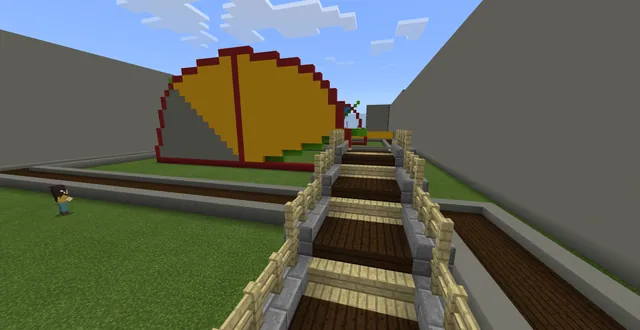
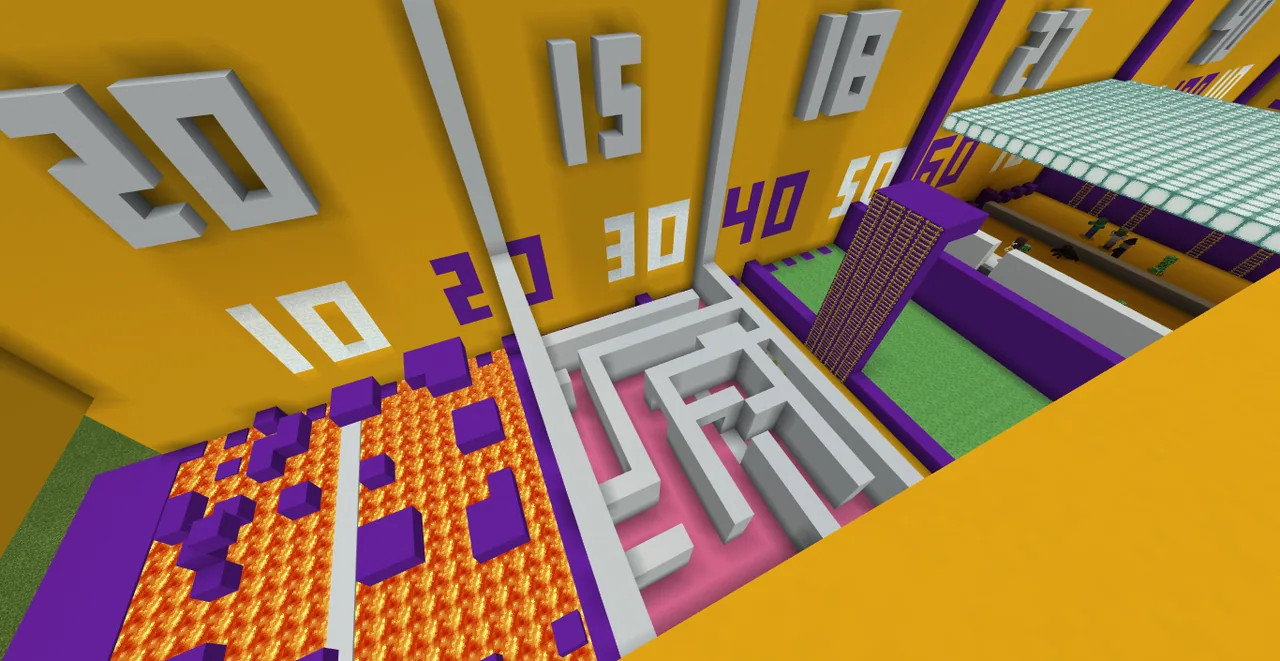
Students begin by testing a pre-built 120-meter course in Minecraft, evaluate an impossible blueprint proposed by a fictional character, and then work in small teams to draft their own viable five-level game. After calculating level lengths that total exactly 120 meters, teams enter an open build area to construct, test, and playtest their creations.
Learning objectives
By the end of this lesson students will be able to:
- Convert measurements between centimeters, meters, and kilometers using two-column conversion tables.
- Evaluate a sample game design blueprint to identify mathematical errors in total distance.
- Design a five-level course layout that totals exactly 120 meters in length.
- Collaborate in a team of five to construct and playtest a complete mini-game in Minecraft.
Blocks and items used in this lesson


Key vocabulary
- Meter
- A standard base unit of length in the metric system equal to 100 centimeters.
- Centimeter
- A metric unit of length equal to one hundredth of a meter.
- Kilometer
- A metric unit of length equal to 1,000 meters.
- Blueprint
- A detailed technical drawing or plan used to map out dimensions before building.
- Conversion Table
- A chart showing equivalent measurements across different units of length.
Before class
Lesson sequence
Suggested timing: about 120 minutes in total.
- Warm-Up: Unit Conversions15 min
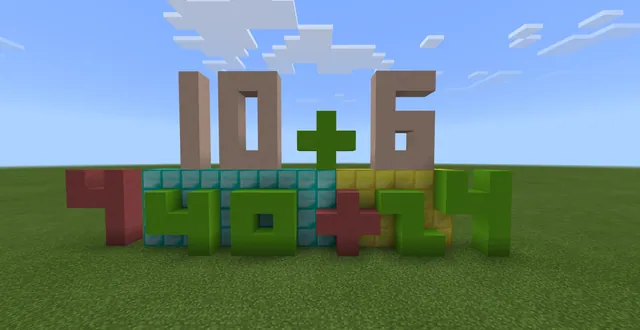
Lead a class discussion on converting units of measurement and the structural benefits of the metric system. Practice recording conversions on tables, converting meters to centimeters and kilometers, as well as inches to feet.
- Example Game and Video20 min
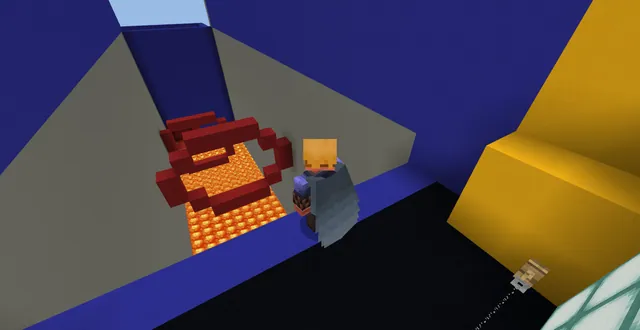
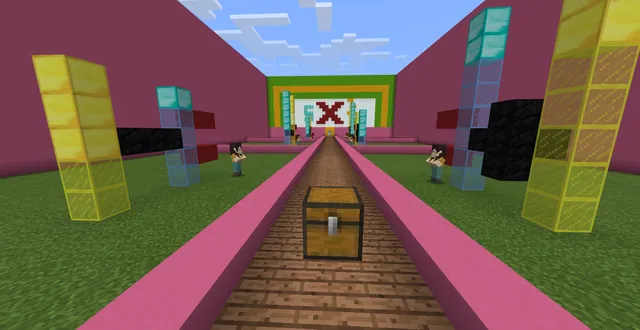
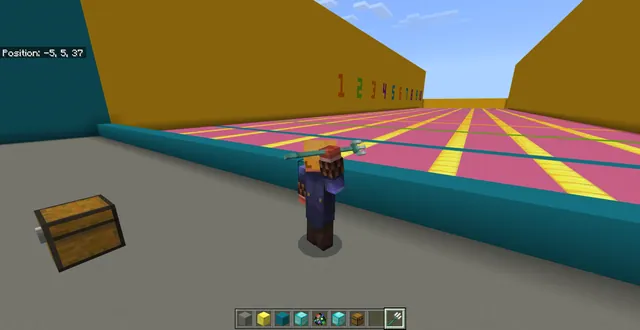
Have students load the world file and play through the sample 120-meter mini-game. Afterward, show the video demonstrating how measurements and distances were applied during the construction of the game.
- Game Design Blueprint30 min
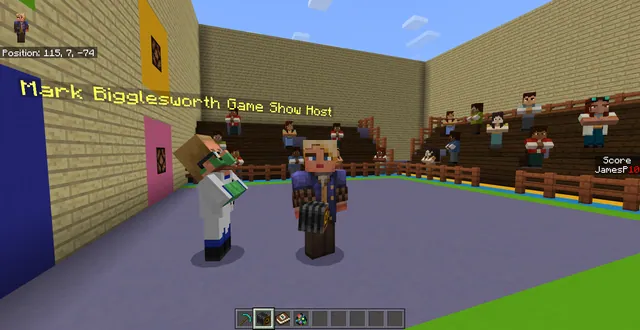
Distribute the Game Design Blueprint packet. Students inspect a fictional character's plan, calculate that its level lengths exceed 120 meters, and draft a corrected plan with five levels totaling exactly 120 meters. They then map out their levels and convert all level lengths into centimeters and kilometers.
- Team Planning and Construction40 min
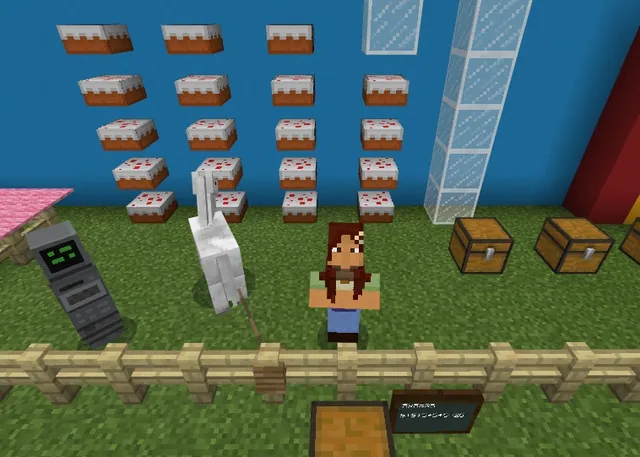
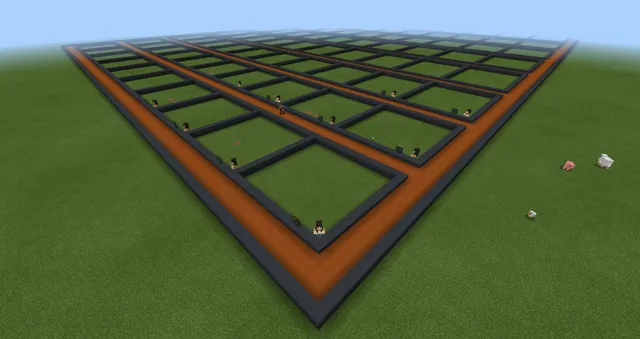
Organize students into groups of five to peer-review their blueprints and agree on a single design to build. The teacher grants building permissions using the command /ability @a worldbuilder. Teams select an empty plot, assign building responsibilities, and construct the five levels.
- Playtesting and Feedback15 min
Teams playtest their own courses to ensure every member can complete them, then swap courses with other groups. Students give constructive feedback focusing on design strengths and areas for improvement.
Assessment: success criteria
- Student accurately identifies mathematical flaws in the fictional character's blueprint by calculating total length.
- Student produces an individual blueprint where five distinct levels add up to precisely 120 meters.
- Student completes conversion tables correctly translating meters into centimeters and kilometers.
- Student collaborates within a team of five to construct an operational 120-meter game that players can beat.
Differentiation
Provide partially filled two-column conversion charts and baseline meter partitions to help students calculate five segments totaling 120 meters.
Challenge students to convert their game level measurements into fractional or decimal parts of kilometers and include customary conversion comparisons.
Knowledge check
5 questions to check understanding after the lesson. Tap an answer to see if it is right; the score appears at the end.
1What is the total required length of the mini-game course?
Answer: B. The lesson specifically requires all course plans and builds to measure exactly 120 meters.
2What flaw do students find when reviewing the fictional character's blueprint?
Answer: C. Students discover the character's proposed segments exceed the 120-meter limit, making the plan impossible in the allocated space.
3How many distinct levels must students design into their game blueprint?
Answer: C. The assignment specifies designing a game layout containing exactly five levels.
4Which in-game command must the teacher run so students can build and code their levels?
Answer: C. The lesson instructions specify using /ability @a worldbuilder to give the class building capability.
5When is a team's mini-game considered complete?
Answer: A. The source notes the game is complete once all sections are built and all players can beat it.
Resources
- Game Design Blueprint
- Lesson worldOpens the world page in Minecraft Education (sign-in with a school account may be needed).
Part of the Grade 4 Math curriculum
This is lesson 12 of 19 in Grade 4 Math.
- Angles and Building Bridges
- Base Ten Puzzles
- Build a Two-Step Word Problem
- Build a Word Problem
- Elytra Flight Rounding
- Finding Factors
- Fractions in Minecraft
- Javelin Line Plots
- Lines, Angles & Architecture
- Long Division in Minecraft
- Math Bed Wars!
- Measurement Mini Game
- Multi Digit Multiplication
- Number Pattern Architecture
- Points, Lines, Rays & Droppers
- Regrouping Obstacle Course
- Subtraction + Regrouping
- Symmetry in Pixel Art
- Wither Battle Regrouping
Frequently Asked Questions
Why is the metric system highlighted in the warm-up discussion?
The metric system uses powers of ten, which allows students to easily convert between meters, centimeters, and kilometers using simple multiplication or division before applying those numbers to their game maps.
What should I do if students cannot place blocks in their selected build plot?
Make sure you have executed the teacher command /ability @a worldbuilder in the chat console so that all students receive builder permissions.
Adapted from Measurement Mini Game by Minecraft Education on Minecraft Education, last updated Sep 16, 2023. This classroom version, the timings and the quiz were written by 9Minecraft Education.