- Type
- Lesson plan
- Ages
- Ages 8-18
- Duration
- about 11.5 hours (suggested)
How can you design, budget, build, and market a theme park that operates profitably?
Overview
This unit connects mathematics, economics, and design by tasking learners with developing a financially sustainable theme park. Students begin by researching real-world theme parks, budgeting ride spaces, and analyzing running costs versus visitor revenue to determine profit and loss through spreadsheet formulas.Learning objectives
By the end of this lesson students will be able to:
- Compare features of existing theme parks using a Venn diagram.
- Calculate running costs, projected revenue, and net profit or loss using spreadsheet formulas.
- Design a scaled park layout using defined attraction dimensions and a color-coded key.
- Construct an accurate 3D representation of the planned park in Minecraft.
- Produce a persuasive promotional website to advertise the theme park to prospective visitors.
Blocks and items used in this lesson


Key vocabulary
- Running Costs
- The regular ongoing expenses required to keep a facility operating daily.
- Profit
- The financial gain remaining after total operating expenses are subtracted from total income.
- Loss
- A financial deficit that occurs when operating expenses exceed incoming revenue.
- Amenities
- Support facilities provided for guest comfort, such as restrooms, shops, and dining areas.
- Persuasive Writing
- Writing focused on convincing an audience to take a specific action or visit an attraction.
Before class
Lesson sequence
Suggested timing: about 690 minutes in total.
- Theme Park Research90 min
Students visit two commercial theme park websites to examine common attractions, guest services, and visitor navigation. They record their findings in a Venn diagram to identify standard requirements such as restrooms, shops, and food vendors.
- Layout and Area Planning120 min
Learners map out their proposed theme park footprint using a color-coded key. They ensure the area occupied by rides and amenities fits strictly within provided spatial parameters and financial limits.
- Running Costs and Profit Modeling120 min
Using spreadsheet software, students calculate their park daily running costs. They project revenue based on expected visitor counts and apply sum formulas to evaluate overall profit or loss.
- Minecraft Park Construction210 min
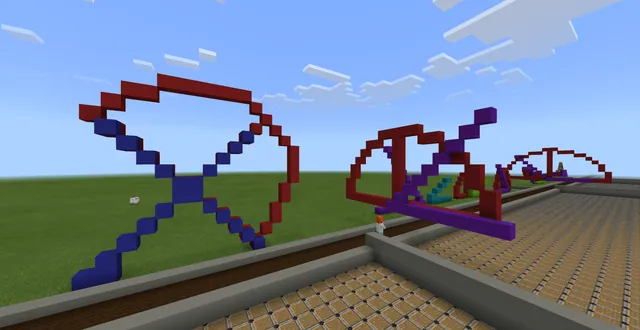
Students enter Minecraft: Education Edition to translate their 2D spreadsheet layout into a working 3D park. They construct rides, pathways, and guest facilities while tackling geometric challenges in ride structures.
- Park Promotion and Web Design150 min
Students create a promotional website for their park. They employ persuasive writing techniques to highlight signature rides, amenities, and entry details to prospective customers.
Assessment: success criteria
- Venn diagram clearly identifies unique and shared features across researched theme parks.
- Spreadsheet contains accurate area measurements, running cost calculations, and profit or loss formulas.
- Minecraft build matches the spatial allocations and color-coded zones from the planning stage.
- Promotional website uses clear persuasive language to market the park features.
Differentiation
Provide pre-formatted spreadsheet templates with guided sum formulas and a structured grid for ride dimensions.
Challenge students to model complex curved ride geometry and integrate custom pricing tiers to maximize profit.
Knowledge check
5 questions to check understanding after the lesson. Tap an answer to see if it is right; the score appears at the end.
1Why do students analyze two existing theme park websites at the start of the project?
Answer: B. Students research two theme park websites to identify standard park features and organize them using a Venn diagram.
2Which spreadsheet function is highlighted in the source to determine overall financial balances?
Answer: A. The source specifies using knowledge of the sum function to calculate running costs, profit, and loss.
3What must students follow when designing the layout for their attractions during the planning stage?
Answer: C. Students are required to use a color-coded key, respect a budget, and adhere to specific area instructions for attractions.
4How do students project the income generated by their theme park?
Answer: B. The project requires learners to calculate income based on an assigned or estimated number of park visitors.
5What final task do students complete to advertise their finished park?
Answer: D. The culminating activity asks learners to build a persuasive website to market their park to potential visitors.
Resources
- Lesson package (.zip)Everything the author attached to this lesson in one download.
- Theme Park SoW and Lesson SupportThe Scheme of Work (SoW) provides an overarching view of the project and each Lesson Support document provides the granularity for each stage.
- Theme Park Supporting ResourceAdditional resources to support various lessons/stages
Frequently Asked Questions
Is there a custom downloadable Minecraft world provided for this unit?
No. Students build their parks from scratch in an open or standard Minecraft: Education Edition world following their own planned spreadsheet blueprints.
What software tools are needed to complete all phases of the project?
In addition to Minecraft: Education Edition, students need access to spreadsheet software such as Excel for cost modeling and a web-authoring or presentation tool for marketing.
Adapted from Theme Park by Hwb MLCs on Minecraft Education, last updated Apr 27, 2021. This classroom version, the timings and the quiz were written by 9Minecraft Education.