- Type
- Lesson plan
- Ages
- Ages 8-18
- Duration
- 2 hours
- Level
- Beginner
How do traditional Anishinaabe stewardship practices maintain ecological balance and sustain community life in the boreal forest?
Overview
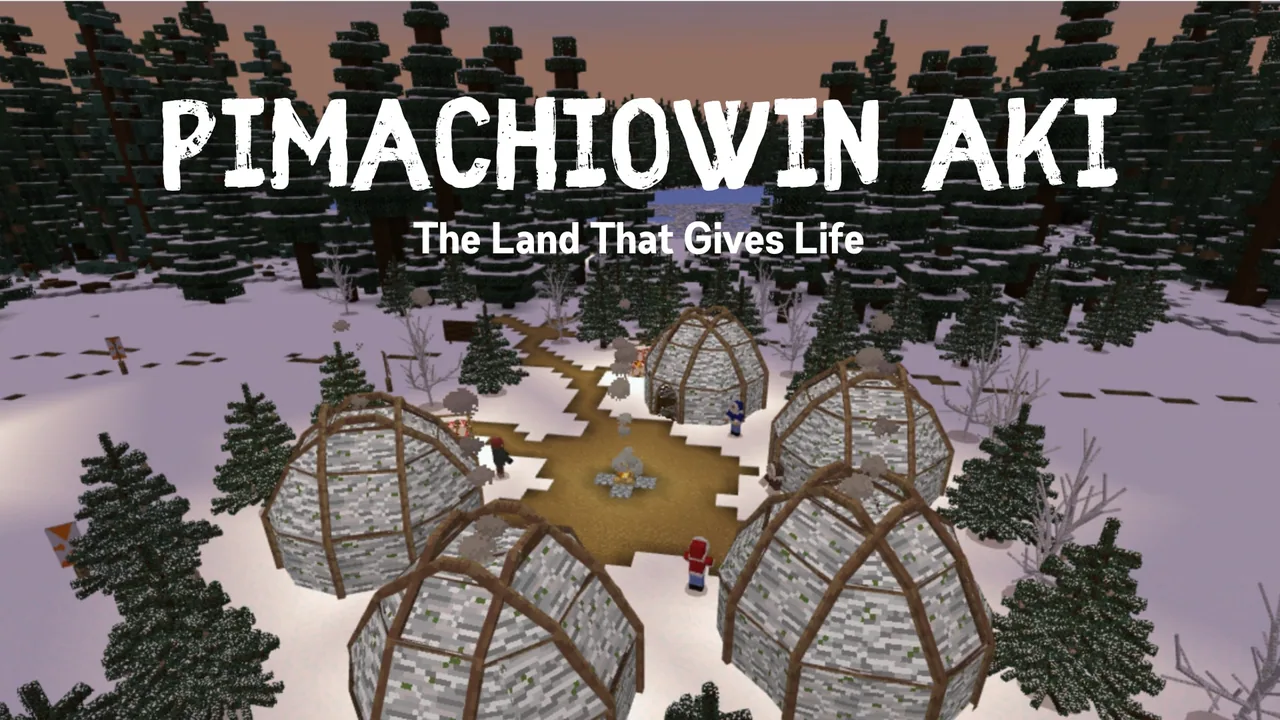
Pimachiowin Aki, meaning 'The Land That Gives Life', is a UNESCO World Heritage Site where the Anishinaabe people practice sustainable land stewardship. Through traditional knowledge shared by Knowledge Keepers, this lesson highlights the cultural and ecological connections between human survival, animal care, and the preservation of the boreal forest ecosystem.
Within a Minecraft simulation of the Bloodvein River campsite, students step into the role of community guests. Across three structured activities, learners craft dog sleds, construct shelters, track wildlife, drill into river ice for native fish, document historical pictographs, and take part in a respectful, sustainable moose hunt.
Learning objectives
By the end of this lesson students will be able to:
- Identify key plant and animal species that contribute to the biodiversity and balance of the boreal forest ecosystem.
- Construct traditional survival equipment and animal shelters using guidance from community Knowledge Keepers.
- Demonstrate sustainable harvesting methods through ice fishing, trapping, and a guided moose hunt.
- Document ecological observations, native fish species, and riverbank pictographs using in-game cameras and journals.
Blocks and items used in this lesson


Key vocabulary
- Pimachiowin Aki
- An Anishinaabe name meaning 'The Land That Gives Life', designating a protected boreal forest UNESCO World Heritage Site.
- Knowledge Keeper
- An Anishinaabe community leader or elder who preserves and teaches traditional wisdom, culture, and environmental practices.
- Wigwam
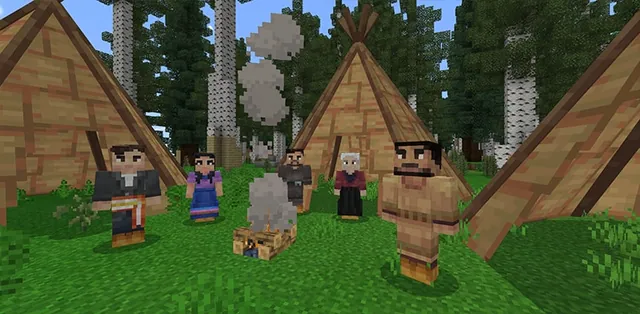
- A traditional Indigenous dwelling built with bent saplings and designed to provide shelter and warmth during cold winters.
- Land Stewardship
- The responsible management and care of natural environments to support long-term ecological balance and community survival.
- Pictograph
- Historical Indigenous markings and illustrations painted on natural rock faces along riverbanks.
Before class
Lesson sequence
Suggested timing: about 120 minutes in total.
- Introduction and Community Welcome20 min
Introduce learners to the Bloodvein River campsite within Pimachiowin Aki. Students join the world to meet community Knowledge Keepers, receive their cameras, book and quill journals, and portfolios, and discuss the core ideas of Anishinaabe land stewardship.
- Dog Sledding, Tracking, and Trapping35 min
Students gather materials to help an elder craft a traditional dog sled and learn about the importance of sled dogs. Next, learners build a warm shelter for the dogs near camp before venturing into the snow to identify animal tracks, place traps along a trap line, and collect resources for the community.
- Wigwam Exploration and Ice Fishing35 min
Learners investigate the construction of a sapling wigwam and its central hearth. Afterwards, they move onto the frozen Bloodvein River to cut fishing holes, capture and photograph native fish including pickerel, jackfish, and sturgeon, and locate historical rock pictographs along the riverbanks.
- Sustainable Moose Hunt and Reflection30 min
Guided by Knowledge Keepers, students practice with bows and follow tracks and broken branches to locate a moose. Following a respectful harvest, students honor the animal by hanging its beard, discuss the cultural requirement to use every part without waste, and review their portfolio entries.
Assessment: success criteria
- Complete portfolio records containing photographs and notes of river fish species and historical pictographs.
- Construction of a functional, warm shelter for sled dogs near the campsite fire.
- Demonstration of sustainable harvesting techniques during the trapping, fishing, and moose hunting activities.
- Active participation in discussions comparing traditional Indigenous management with modern land practices.
Differentiation
Pair students together to navigate wilderness paths and locate tracking markers collaboratively.
Have advanced learners load the larger full-scale river map to explore expanded geography and propose additional conservation strategies.
Knowledge check
5 questions to check understanding after the lesson. Tap an answer to see if it is right; the score appears at the end.
1What is the meaning of the Anishinaabe phrase 'Pimachiowin Aki'?
Answer: A. The source defines Pimachiowin Aki as 'The Land That Gives Life'.
2What project do students complete to care for their working animals after crafting sleds?
Answer: C. Students are instructed to construct a warm, dry shelter near the camp campfire to keep their sled dogs safe and comfortable.
3Which native fish species are students asked to identify and photograph on the Bloodvein River?
Answer: B. The lesson lists pickerel, jackfish, and sturgeon as the local fish species to document on the frozen river.
4What traditional structure constructed from saplings do students explore to study winter survival?
Answer: C. The source identifies the wigwam as the traditional shelter built from saplings that provides warmth and protection.
5How do students show cultural respect to the moose following a successful hunt?
Answer: B. According to the lesson activities, students honor the moose and its gifts to the community by hanging its beard.
Resources
- Lesson package (.zip)Everything the author attached to this lesson in one download.
- Pimachiowin Aki Educator GuideThis larger document has the educator guide and curriculum connections combined
- Pimachiowin Aki Student GuideThis document can help strong readers advance through the experience quicker.
- Pimachiowin Aki Educator Guide Short VersionNo curriculum at the end of this document. Better for everyday use.
- Pimachiowin Aki Canadian Curriculum ConnectionsAll provinces and territories will find relevant connections to their curriculum in this Pimachiowin Aki experience document.
- Pimachiowin Aki Title ImageTitle image for promotional use
Part of the Indigenous Culture curriculum
This is lesson 6 of 6 in Indigenous Culture.
- A Pacific Northwest Coast Experience: Part 2
- A Pacific Northwest Coast Experience
- Indigenous Stories
- Manito Ahbee Aki
- NGĀ MOTU - THE ISLANDS
- Pimachiowin Aki - The Land That Gives Life
Frequently Asked Questions
Which world download should I select for my classroom?
Teachers can choose between two files: a compact world focusing solely on the Bloodvein River campsite and Phase 1 activities for faster loading on standard machines, or an expansive full-scale river map for capable devices and broader exploration.
What recording tools do students receive in the game?
At the beginning of the lesson, learners receive an in-game camera, a book and quill journal, and a portfolio to capture images and record reflections throughout their tasks.
Adapted from Pimachiowin Aki - The Land That Gives Life by Logics Academy on Minecraft Education, last updated May 22, 2025. This classroom version, the timings and the quiz were written by 9Minecraft Education.