How do traditional ecological knowledge and respectful harvesting practices allow coastal communities to thrive sustainably across generations?
Overview
Indigenous traditional ecological knowledge emphasizes the deep, reciprocal relationship between living communities and their natural environments. For millennia, Pacific Northwest Coast Peoples have applied sustainable harvesting and land stewardship practices, observing seasonal patterns to support the well-being of the land, ancestors, and future generations.
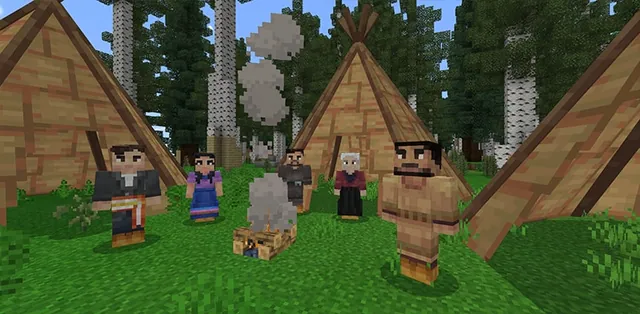
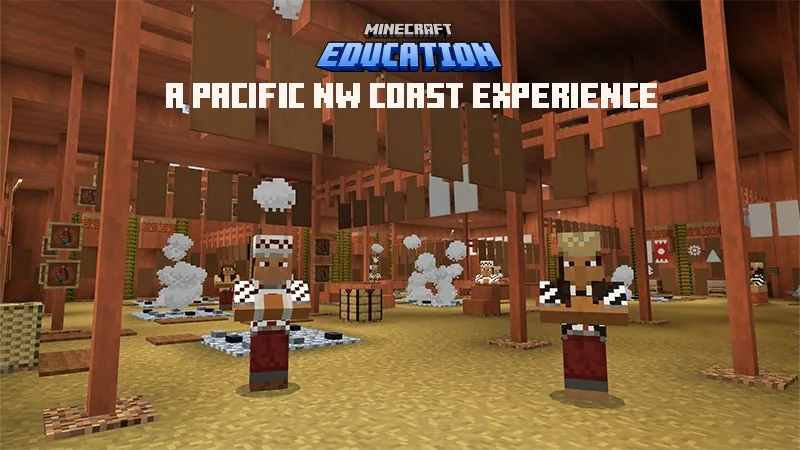
In this lesson, students travel back in time to a coastal village to learn directly from elders and knowledge keepers. Using in-game tools such as the camera, portfolio, and book and quill, students observe coastal biodiversity, carry out essential winter preparation tasks—including harvesting cedar, gillnetting salmon, and collecting native plants—and apply these principles to build a self-sustaining settlement further along the coast.
Learning objectives
By the end of this lesson students will be able to:
- Explain how Pacific Northwest Coast Peoples sustainably utilize land and marine resources to prepare for winter.
- Document coastal landforms, flora, and fauna using the in-game camera, portfolio, and book and quill.
- Carry out traditional harvest tasks including gathering cedar bark and planks, gillnetting salmon, and collecting camas and salmonberries.
- Apply First Peoples Principles of Learning by designing a self-sustaining coastal community further up the shoreline.
Blocks and items used in this lesson


Key vocabulary
- Traditional Ecological Knowledge
- Cumulative indigenous knowledge and beliefs regarding the relationship of living beings with one another and their environment.
- Tree of Life
- A cultural term for the cedar tree, honoring its essential role in providing bark for weaving and timber for construction.
- Gillnetting
- A traditional fishing method using structured netting to sustainably catch salmon.
- Camas
- A native perennial flowering plant with edible bulbs gathered as an important seasonal food source.
Before class
Lesson sequence
Suggested timing: about 200 minutes in total.
- Arrival and Community Protocol50 min
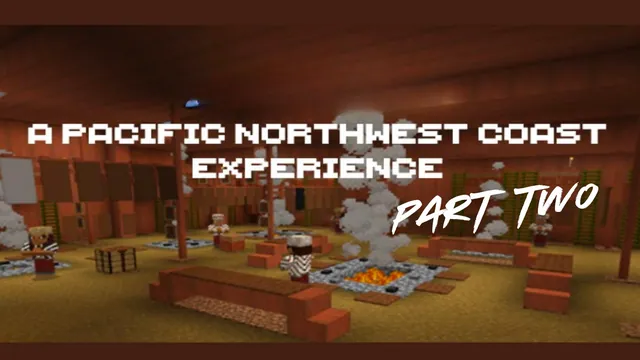
Students arrive at the coastal big house, reading landing signs to understand local protocols. They explore the settlement, ocean, and surrounding terrain while meeting village elders and knowledge keepers to understand the community's seasonal winter preparations.
- Document and Classify50 min
Using the camera, portfolio, and book and quill, students explore the local environment to photograph animals, sea life, plant species, and land features. Students export their journals and collaborate as a class to classify their observations into organized environmental categories.
- Showcased Learning Tasks60 min
Students undertake three core winter preparation activities under the guidance of knowledge keepers:
- Cedar: Learn why cedar is called the Tree of Life while harvesting bark for weaving and planks for construction.
- Salmon: Construct and use a gill net to harvest salmon while examining the reverential practices surrounding this resource.
- Plants: Gather seasonal salmonberries and harvest camas bulbs.
- Sustainable Village Build and Reflection40 min
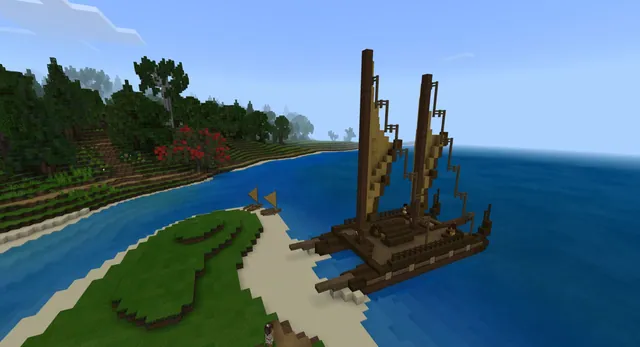
Students travel further up the coast to construct a self-sustaining village using the traditional ecological concepts practiced during the harvest. The class debriefs by reflecting on First Peoples Principles of Learning, focusing on interconnectedness and generational responsibilities.
Assessment: success criteria
- Student successfully creates and exports a book and quill containing photographs and reflections of coastal features.
- Student completes traditional tasks (cedar harvesting, salmon gillnetting, and plant gathering) in alignment with guided protocols.
- Student contributes to the construction of a self-sustaining coastal settlement using harvested materials.
- Student articulates how seasonal harvesting reflects the interconnectedness of people, land, and water.
Differentiation
Pair students during the documentation phase to share camera and journal duties while providing a checklist of required features to photograph.
Challenge advanced students to expand their new settlement build by designing traditional long-term storage and processing facilities for seasonal foods.
Knowledge check
5 questions to check understanding after the lesson. Tap an answer to see if it is right; the score appears at the end.
1What is the primary community goal students assist with during the lesson?
Answer: B. The lesson places students in a historical coastal community to assist knowledge keepers and elders in preparing for winter.
2Which resource is referred to as the 'Tree of Life' in this Pacific Northwest experience?
Answer: C. Cedar is recognized as the Tree of Life because it provides essential bark for weaving and planks for building.
3What traditional method do students learn to harvest salmon respectfully?
Answer: A. The salmon task specifically guides students to construct and use a gill net for harvesting.
4Which two native plants are specifically gathered during the plant harvesting task?
Answer: D. The source notes that students gather salmonberries and harvest camas as part of traditional plant gathering.
5Which in-game tools are used by students to document and reflect upon their environmental discoveries?
Answer: B. The student activity explicitly directs learners to document features using the camera, portfolio, and book and quill.
Resources
- Lesson package (.zip)Everything the author attached to this lesson in one download.
- Educator Guide
- Technical Guide
- Lesson worldOpens the world page in Minecraft Education (sign-in with a school account may be needed).
Part of the Indigenous Culture curriculum
This is lesson 2 of 6 in Indigenous Culture.
- A Pacific Northwest Coast Experience: Part 2
- A Pacific Northwest Coast Experience
- Indigenous Stories
- Manito Ahbee Aki
- NGĀ MOTU - THE ISLANDS
- Pimachiowin Aki - The Land That Gives Life
Frequently Asked Questions
How long does this lesson take to complete in the classroom?
The entire learning unit takes more than 3 hours, divided across multiple 40- to 60-minute segments covering arrival, environmental documentation, traditional tasks, and an open-ended build challenge.
What should students do when they first arrive in the world?
Students arrive at the big house, read the welcoming and protocol signs, and follow teacher guidance to observe and document community and environmental features without altering the village.
Adapted from A Pacific Northwest Coast Experience by Minecraft Education on Minecraft Education, last updated May 22, 2025. This classroom version, the timings and the quiz were written by 9Minecraft Education.