- Type
- Lesson plan
- Topics
- World LanguagesHistory
- Ages
- Ages 8-13
How did Anishinaabe communities collaborate, navigate the land, and maintain food sovereignty prior to European contact?
Overview
Developed in collaboration with Knowledge Keepers and the Louis Riel School Division Indigenous Education team, this lesson guides students through Anishinaabe history, culture, and worldview prior to European arrival in North America. Learners explore key cultural concepts, navigation, and the historic importance of community collaboration.
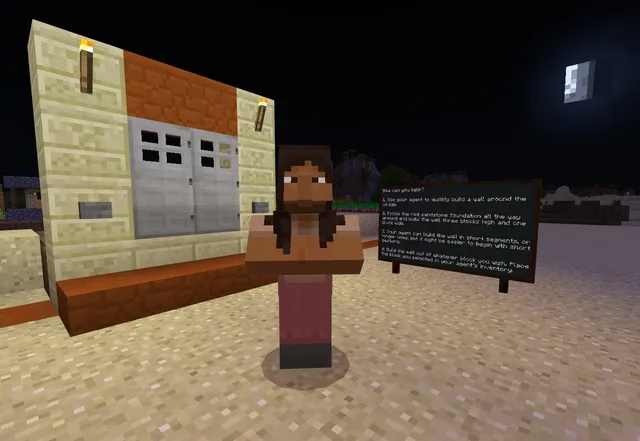
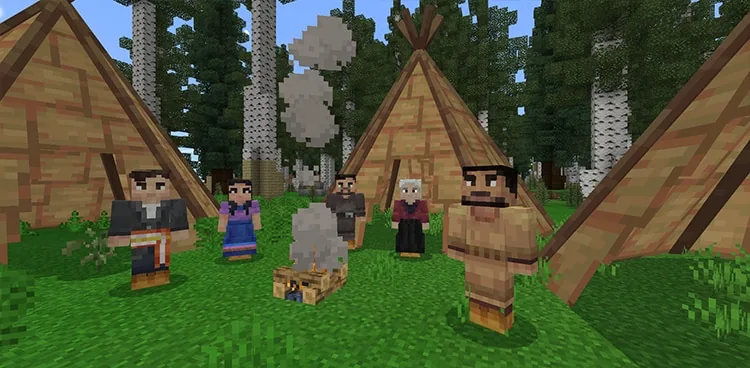
Using a dedicated Minecraft world, students start at the Forks to examine traditional trading practices, locate ancient petroforms to discover their cultural meanings, and work together to establish a village. Activities such as tipi building, a bison hunt, and crop cultivation demonstrate how early communities achieved food sovereignty.
Learning objectives
By the end of this lesson students will be able to:
- Explain the historic importance of the Forks as a meeting place for trade and collaboration.
- Identify how the sun and stars were used to determine cardinal directions along with the cultural significance of Fire and Water.
- Investigate the Manito Ahbee petroforms and describe the animals and cultural figures they depict.
- Demonstrate cooperation by setting up a settlement, building tipis, and exploring traditional food sovereignty through hunting and farming.
Blocks and items used in this lesson


Key vocabulary
- The Forks
- The historic confluence of the Red and Assiniboine rivers used by Indigenous peoples to gather, trade, and collaborate.
- Petroforms
- Ancient rock formations laid out in the shapes of animals and cultural figures representing Anishinaabe teachings and history.
- Food Sovereignty
- A community ability to feed itself independently through sustainable traditional methods like farming and hunting.
Before class
Lesson sequence
- Arrival at the Forks
Students spawn at the Forks, the confluence of the Red and Assiniboine rivers. Have students explore the gathering grounds to understand its role in regional trade and study how cardinal directions, the sun, stars, Fire, and Water guided travelers.
- Discovering the Petroforms
Direct students to locate and examine the Manito Ahbee petroforms. Learners explore each stone arrangement, record observations about the represented animals or figures, and note the accompanying historical teachings.
- Building Community and Food Sovereignty
Learners collaborate to choose an appropriate settlement site. Working as a team, they build tipis, participate in a bison hunt, and cultivate crops to establish food sovereignty for their village.
- Documentation and Reflection
Students use their in-game tools to capture their work and reflect on the lessons shared by Knowledge Keepers regarding community teamwork and Anishinaabe worldview.
Assessment: success criteria
- Student Portfolio or Book and Quill contains documented evidence and notes on the petroforms.
- Constructed village shows cooperative tipi building and appropriate site selection.
- Student reflections demonstrate understanding of the Forks as an ancient trade and gathering hub.
Differentiation
Allow students to work in pairs while exploring petroforms and recording notes in their Book and Quill.
Have advanced learners consult the Educator Guide extension activities to research the Seven Teachings, Four Medicines, or Anishinaabemowin vocabulary.
Knowledge check
5 questions to check understanding after the lesson. Tap an answer to see if it is right; the score appears at the end.
1Which two rivers meet at the historic gathering place known as the Forks?
Answer: B. The lesson notes that the Forks is the meeting place of the Red and Assiniboine rivers.
2What are the Manito Ahbee petroforms made of?
Answer: D. Petroforms are ancient rock formations depicting animals and characters from Anishinaabe history.
3How did Anishinaabe travelers identify cardinal directions according to the lesson?
Answer: A. Students learn how cardinal directions were determined using the sun and stars.
4Which activities in the lesson allow students to practice food sovereignty?
Answer: C. Students establish food sovereignty through a bison hunt, trade, and farming.
5Which in-game tools does the Educator Guide suggest using to assess learning?
Answer: B. The performance expectations state to assess student learning using the Camera, Portfolio, and Book and Quill.
Resources
- Educator + Student Guides - EnglishSupporting materials including three educator and student guides, extension activities, and a vocabulary list. English language materials.
- Lesson worldOpens the world page in Minecraft Education (sign-in with a school account may be needed).
Part of the Indigenous Culture curriculum
This is lesson 4 of 6 in Indigenous Culture.
- A Pacific Northwest Coast Experience: Part 2
- A Pacific Northwest Coast Experience
- Indigenous Stories
- Manito Ahbee Aki
- NGĀ MOTU - THE ISLANDS
- Pimachiowin Aki - The Land That Gives Life
Frequently Asked Questions
What grade levels are suitable for this world?
The lesson source identifies target age brackets of 8 to 10 and 11 to 13, making it adaptable for upper elementary through middle school classrooms.
Where can educators find extension topics like the Four Medicines?
Extension materials covering the Seven Teachings, Four Medicines, and Anishinaabemowin vocabulary are provided in the supporting Educator Guide files.
Adapted from Manito Ahbee Aki by Minecraft Education on Minecraft Education, last updated May 22, 2025. This classroom version, the timings and the quiz were written by 9Minecraft Education.