- Type
- Lesson plan
- Ages
- Ages 6-10
- Includes
- Quiz: 5 questions
How can working together in a virtual world help us understand and improve our real community?
Overview
Communities thrive when members work cooperatively to build places that meet shared needs. In this lesson, learners investigate what makes up their local area, identifying essential services, shared recreation areas, and recognizable landmarks before working together to construct their own virtual settlement.
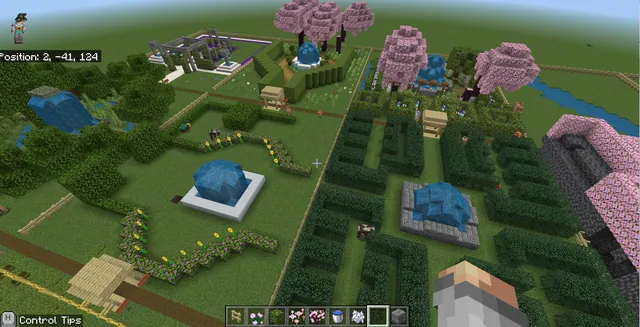
Using a shared creative Minecraft world, students experience the dynamics of both classroom collaboration and in-game teamwork. Learners can either build as one large class group across a single town or divide into small teams responsible for interconnected neighborhoods, concluding with reflections on group work and community development.
Learning objectives
By the end of this lesson students will be able to:
- Identify key physical landmarks, services, and shared spaces found in a local community.
- Practice positive collaboration skills while cooperating both face-to-face and inside a digital environment.
- Construct recognizable community buildings and spaces inside a shared Minecraft creative world.
- Compare the advantages and challenges of face-to-face group work versus virtual group work using reflection charts.
Blocks and items used in this lesson


Key vocabulary
- Community
- A group of people living in the same area or sharing common spaces, services, and interests.
- Landmark
- A recognizable building or geographic feature that helps people identify where they are.
- Collaboration
- Working together cooperatively with others to achieve a shared goal.
- Virtual Group
- A team of people who interact, communicate, and cooperate inside an online or digital environment.
Before class
Lesson sequence
- Hook and Community Brainstorm
Show a short video hook illustrating the benefits of teamwork and what happens when people do not collaborate effectively. Lead a whole-class brainstorming session on local community features, recording ideas for local landmarks, emergency services like fire stations, shops, and recreational parks.
- Group Work Discussion
Introduce the features and benefits of positive group collaboration. Discuss expectations for how students will communicate face-to-face while navigating a shared virtual space, and assign either individual builds across one shared town or distinct small-group neighborhoods.
- Collaborative Build Session
Students log into the shared creative world and begin constructing community spaces modeled after their neighborhood or state. As they build, students practice cooperative communication both at their desks and within the virtual environment.
- Documentation and Reflection
Learners capture screenshots or recorded video walkthroughs of their completed areas. To finish, students complete written or spoken reflections and fill out T-charts comparing face-to-face teamwork with virtual teamwork, as well as evaluating what succeeded and what proved challenging during construction.
Assessment: success criteria
- Student Minecraft builds include recognizable community locations, such as parks, grocery stores, or fire stations.
- Learners demonstrate active cooperation both verbally in class and within the virtual Minecraft space.
- Student reflections or T-charts accurately contrast in-person collaboration with virtual group work.
- Learners articulate at least one challenge and one success encountered during the group construction process.
Differentiation
Take students on a short walking tour around the school or neighborhood first to record sketches and notes of buildings to copy into Minecraft.
Read The Little House by Virginia Lee Burton to discuss urban versus rural growth, then modify the Minecraft build to reflect how communities change over time.
Knowledge check
5 questions to check understanding after the lesson. Tap an answer to see if it is right; the score appears at the end.
1What is one main focus of this lesson besides building community landmarks?
Answer: A. The lesson explicitly aims for students to practice cooperative group skills both in the classroom and virtually.
2Which type of world is used for this collaborative activity?
Answer: B. The student activities specify that students develop their community places in a new creative world.
3What is one recommended way students can document their completed builds?
Answer: C. The assessment section lists screenshots or screencasts of the Minecraft community as evidence of learning.
4Which tool do students use to compare in-person group work with virtual group work?
Answer: D. The lesson assessment directs students to create a T-chart showing differences and similarities between group work types.
5Which book can be introduced as an extension activity to discuss how communities change?
Answer: B. The extension activities suggest reading The Little House to discuss community types and changes over time.
Frequently Asked Questions
Do I need to download a specific custom map to teach this lesson?
No special world download is required. Students work inside a newly generated creative world where they can build their own community landmarks from scratch.
How can I organize student building groups?
You can choose between having the entire class build together on one unified town layout or dividing students into small teams responsible for interconnected neighborhood districts.
What subjects does this community lesson connect to?
This lesson integrates Art and Design, Business and Entrepreneurship, and History through community planning, teamwork, and reflection.
Adapted from Creating a Virtual Community by Minecraft Education on Minecraft Education, last updated Dec 19, 2022. This classroom version, the timings and the quiz were written by 9Minecraft Education.