- Type
- Lesson plan
- Ages
- Ages 11-18
- Includes
- Quiz: 5 questionsLesson files
How can cities in the future be designed and built to be more sustainable while meeting global development goals?
Overview
Modern urban environments face critical challenges regarding resource consumption, environmental impact, and long-term livability. In this project-based unit, students investigate the United Nations Sustainable Development Goals (SDGs) to understand why international sustainability benchmarks are vital and how future communities can be planned to meet human and ecological needs.
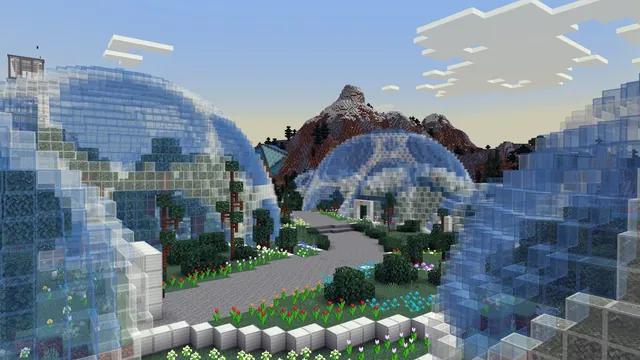
Using Minecraft Education, learners translate their research into practical designs. After drafting a labeled paper blueprint complete with transport infrastructure, students build their futuristic city, label sustainable features using signs and boards, gather peer and teacher feedback, and refine their virtual environments to demonstrate responsible urban innovation.
Learning objectives
By the end of this lesson students will be able to:
- Select four to five United Nations Sustainable Development Goals to guide urban planning.
- Draft a detailed paper map sketch detailing zoning, planned builds, and a transit network.
- Construct a sustainable city in a Creative Minecraft world, highlighting green features using in-game signs and boards.
- Gather structured feedback from peers and the teacher to test and refine the city build.
- Critically reflect on the design process, peer feedback, and how the final city addresses global sustainability.
Blocks and items used in this lesson


Key vocabulary
- Sustainable Development Goals (SDGs)
- A collection of global objectives set by the United Nations to address environmental, economic, and social challenges.
- Transport Network
- An interconnected system of transit pathways and infrastructure used to move people and goods efficiently.
- Self-Managed Learning
- An instructional process where learners guide their own progress using provided project checklists and planners.
Before class
Lesson sequence
- Introduction & Goal Selection
Introduce the project planner and have students watch the Sustainable Development Goals video. Individually or in small groups, students discuss the global targets and agree on four to five specific SDGs to address within their future city layout.
- Paper Blueprint & Transit Planning
Students create a new Creative world titled City of the Future and inspect their starting terrain. Before placing blocks, they sketch an outline on paper, draw and label every planned structure, design a complete transport network, and establish team roles and group rules if collaborating.
- Minecraft City Construction
Working from their paper blueprints, students construct their city inside Minecraft. They must place signs and boards throughout the build to label and explain the specific sustainable innovations that address their selected SDGs.
- Survey, Feedback & Re-Testing
Learners design a feedback questionnaire and invite at least three peers and the teacher to tour their city. Students analyze the responses, make adjustments to their world file to address weaknesses, and conduct a re-test with peers.
- Critical Reflection & Submission
Using the reflection prompts in their planner, students evaluate their design choices, peer input, emotional process, and SDG integration. Students then export their finished Minecraft world file and submit both the file and written reflection to Google Classroom.
Assessment: success criteria
- City build clearly incorporates features addressing four to five chosen Sustainable Development Goals.
- Paper map sketch is fully drawn and labeled, including a functional transport network plan.
- In-game signs and boards effectively communicate the purpose of sustainable city features.
- Feedback from at least three peers and the teacher was collected and used to revise the world file.
- Final reflection answers all evaluation questions regarding surprises, peer feedback, and future improvements.
Differentiation
Provide a pre-selected set of four SDGs and a simplified blueprint graphic organizer to assist with the initial paper planning phase.
Challenge students to design a multi-tiered transport network and analyze how their chosen SDGs positively or negatively influence one another in the urban layout.
Knowledge check
5 questions to check understanding after the lesson. Tap an answer to see if it is right; the score appears at the end.
1How many Sustainable Development Goals are students instructed to focus on for their city?
Answer: C. The project instructions require students to discuss and select 4 to 5 goals to address in their city.
2What planning step must students complete on paper before building in Minecraft?
Answer: A. Students must sketch their map on paper, label everything they will create, and include a planned transport network.
3How are students expected to point out sustainable innovations within their virtual city?
Answer: D. The lesson directs students to use signs and boards in Minecraft to highlight sustainable features.
4Who must review each student's city during the feedback stage?
Answer: B. Students are instructed to request feedback from at least three peers in addition to their teacher.
5Where do students upload their critical reflection and exported world file?
Answer: C. The final step asks students to upload their critical reflection and world file to Google Classroom.
Resources
Frequently Asked Questions
Is there a pre-made Minecraft world file required for this lesson?
No custom world download is needed. Students open Minecraft Education, press Play, and create a brand new Creative world named City of the Future to start their build.
Can students work in groups for this project?
Yes. The project can be run individually or in small teams. If students collaborate, they must assign building roles on their paper map and agree on shared group rules before building.
Adapted from City of the Future by Victorian Minecraft Innovators on Minecraft Education, last updated Apr 27, 2021. This classroom version, the timings and the quiz were written by 9Minecraft Education.