How do historical and cultural design choices influence the materials, shapes, and structures of different architectural styles?
Overview
Architecture reflects the culture, engineering, and resources of distinct eras and societies. By examining the characteristic forms, materials, and palettes of historical and modern building movements, learners develop an appreciation for how design shapes the human environment.
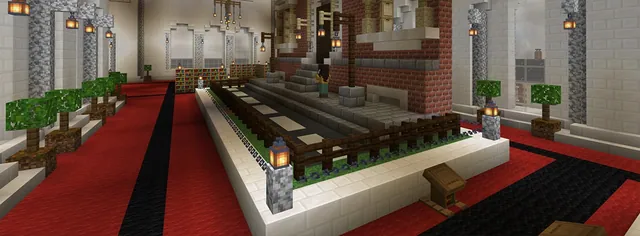
In this project, students select an architectural style, plan their layout on paper or digitally, and recreate authentic structural features within Minecraft. Peer reviews using in-game signs foster constructive critique and guide final revisions.
Learning objectives
By the end of this lesson students will be able to:
- Identify distinct structural elements, colors, and materials characteristic of a chosen architectural period.
- Draft a preliminary floor plan that maps out room layouts and proportions.
- Construct a Minecraft building that emulates key features of a selected architectural style.
- Evaluate peer structures by writing constructive feedback signs that note strengths and suggested improvements.
Blocks and items used in this lesson


Key vocabulary
- Classical
- An architectural tradition originating in ancient Greece and Rome, recognized for symmetry, columns, and stone construction.
- Medieval
- Building styles from the Middle Ages characterized by heavy stone walls, arches, and defensive towers.
- Arcology
- A design concept combining architecture and ecology into hyper-dense, self-contained living structures.
- Floor plan
- A scaled overhead drawing illustrating the arrangement of rooms, walls, and spaces in a building.
- Glow and grow
- A peer review strategy where a glow highlights a success and a grow identifies an opportunity for refinement.
Before class
Lesson sequence
- Research and Style Selection
Introduce the architectural challenge and group students individually or into pairs. Learners select an architectural style from options such as Classical, Medieval, Asian, Modern, or Arcology, then analyze visual references to identify common shapes, colors, and building materials.
- Floor Plan Drafting
Students translate their research into an initial layout by drawing a floor plan on graph paper or laying outline markers in-game. They identify which Minecraft blocks best represent the authentic materials of their chosen period.
- Minecraft Construction
Learners join the downloadable world and find adequate build sites with reasonable spacing from neighboring classmates. As students build, circulate to guide block selection and remind them to place an identifying title and name sign near the entrance.
- Peer Feedback Gallery Walk
Students visit neighboring plots to observe different architectural styles. Using in-game signs, each visitor posts at least one glow noting a successful design choice and one grow suggesting a detail to improve.
- Revision and Documentation
Builders return to their sites, read the feedback left by peers, and make final structural adjustments. Students capture screenshots of their finished builds to document their design process and final outcome.
Assessment: success criteria
- The building incorporates identifiable shapes, colors, and materials representative of the chosen architectural style.
- The student completed a preliminary floor plan before finishing the virtual build.
- In-game signs display the project title, author name, and constructive peer feedback.
- Screenshots show intentional revisions made in response to peer suggestions.
Differentiation
Provide pre-printed reference cards and limit the build to a single-room Classical or Medieval structure using a small set of block types.
Challenge advanced students to construct multi-story complexes or design a self-contained Arcology structure with mixed-use functional zones.
Knowledge check
5 questions to check understanding after the lesson. Tap an answer to see if it is right; the score appears at the end.
1Which architectural movement draws direct inspiration from ancient Greek and Roman structural forms?
Answer: B. Classical architecture is defined by the building traditions, symmetry, and stonework of ancient Greece and Rome.
2Why do students draw a floor plan on graph paper before constructing their Minecraft model?
Answer: A. Creating a floor plan helps students map room layouts, spatial scale, and materials before placing blocks in the world.
3During the gallery walk, what information does a peer leave on a 'grow' sign?
Answer: D. A grow sign communicates constructive critique highlighting an area that would benefit from revision.
4Which architectural concept merges structural design with ecological systems into a compact, self-contained habitat?
Answer: C. Arcology combines architecture and ecology into dense, self-sustaining building designs.
5What should students do after reading the feedback signs placed on their plots?
Answer: B. Learners use the feedback to make final modifications to their build and document the result with screenshots.
Resources
Part of the Game-based Learning curriculum
This is lesson 2 of 7 in Game-based Learning.
- Build a Sculpture Garden
- Building Architecture
- Creating a Theme Park
- Design a Labyrinth
- Machinima / Comics
- Pixel Selfies
- Replicating Landmarks
Frequently Asked Questions
Should students complete this project individually or in partners?
The lesson supports both options; teachers can assign partners, allow students to pick a peer, or let students work independently based on classroom management preferences.
Where in the game world do students create their structures?
Students join the provided downloadable world and locate an open plot that offers enough space to build comfortably without crowding their neighbors.
How can teachers capture student work for final grading?
Students take in-game screenshots of their finalized structures and feedback signs after completing their peer-directed revisions.
Adapted from Building Architecture by Institute of Play on Minecraft Education, last updated Jul 16, 2025. This classroom version, the timings and the quiz were written by 9Minecraft Education.