- Type
- Lesson plan
- Ages
- Ages 8-13
- Duration
- about 70 min (suggested)
How can deliberate design choices and cohesive styling unify independent attractions into a single theme park?
Overview
Designing an amusement park requires thoughtful planning, visual consistency, and creative teamwork. In this lesson, students explore the concept of theme and mood by selecting an overarching aesthetic and tailoring every detail of an attraction—including color palettes, structures, and decorative elements—to support that central idea.
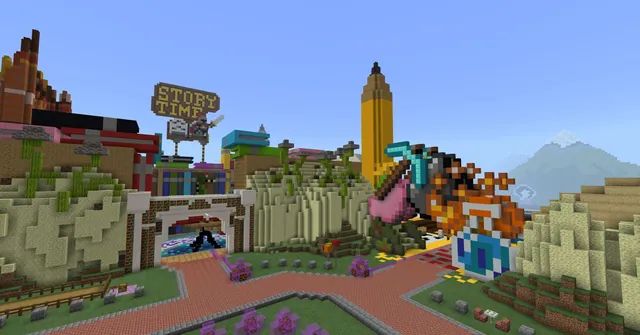
Using a shared Minecraft environment, student pairs construct various park elements, such as roller coasters, water slides, or vendor booths. As attractions take shape, students connect their individual builds with pathways and park signage before touring the completed park to provide peer feedback through glows and grows.
Learning objectives
By the end of this lesson students will be able to:
- Select an attraction category and design it around a cohesive theme or mood.
- Choose appropriate blocks, shapes, and colors that reflect the chosen theme.
- Collaborate with peers to integrate individual attractions using signs and pathways.
- Evaluate peer builds by leaving constructive feedback signs noting areas of strength and potential growth.
Blocks and items used in this lesson


Key vocabulary
- Theme
- A unifying idea, style, or mood that gives an entire space or design a consistent look and feel.
- Attraction
- A ride, game, vendor, or interactive feature built to entertain visitors.
- Glow
- A piece of positive feedback highlighting something that was designed or executed well.
- Grow
- A constructive suggestion identifying something that could be developed or improved.
Before class
Lesson sequence
Suggested timing: about 70 minutes in total.
- Introduction and Brainstorming15 min
Introduce the challenge to the class and present examples of different attraction types, including roller coasters, water slides, slow rides, carnival games, and vendor stalls. Share potential themes such as Spooky, Romantic, Playful, Fantasy, or Sci-fi.
Have an experienced student demonstrate how to lay tracks and operate Minecarts. Form student pairs, instruct each team to choose a theme and attraction, and encourage them to brainstorm specific blocks, colors, and shapes that match their mood.
- Prototyping and Construction30 min
Have students join the multiplayer world and claim build locations that stay near the starting point while maintaining comfortable spacing from neighbors. Circulate around the room to offer support as pairs construct their attractions.
Remind students to name their attraction and place signs displaying their titles and creator names. Encourage early finishers to lay pathways and add directional signage to link neighboring attractions together.
- Park Tour and Peer Feedback15 min
Invite students to explore the completed theme park and test out each other's rides and stalls. Require every pair to visit other builds and place feedback signs.
Students must write at least one glow detailing what worked well and one grow offering a thoughtful idea for improvement.
- Refinement and Documentation10 min
Students return to their attractions to read the feedback left by peers. Allow time for pairs to make final adjustments to their builds.
Conclude by having students capture in-game screenshots to document their finished attraction and its thematic details.
Assessment: success criteria
- The completed attraction matches the chosen theme through deliberate block selection, color choice, and decoration.
- The build includes a visible title and author credit on signs.
- Students worked collaboratively within reasonable proximity to neighbor builds.
- Students placed signs containing both a glow and a grow on peer attractions.
- Screenshots were taken to document the finished creation.
Differentiation
Guide students toward building a simpler attraction, such as a vendor stall or slow ride, using a limited palette of blocks that clearly match their theme.
Challenge advanced students to construct complex rail systems or connect multiple areas of the park using themed walkways, landscaping, and park signage.
Knowledge check
5 questions to check understanding after the lesson. Tap an answer to see if it is right; the score appears at the end.
1Which theme is explicitly suggested as an option in the lesson plan?
Answer: B. The source explicitly lists Spooky, Romantic, Playful, Fantasy, and Sci-fi as suggested themes.
2What should a student write when leaving a 'grow' on a classmate's project?
Answer: C. The source explains that a grow is something the reviewer thinks could be improved.
3How can an experienced student contribute during the lesson introduction?
Answer: B. The guiding ideas suggest offering an expert student the chance to show the class how to use Minecarts and tracks.
4What is recommended to help tie separate attractions together into a complete park?
Answer: C. Towards the end of building, students can tie attractions together into a park by adding pathways, signage, or other features.
5How do students document what they achieved at the end of the lesson?
Answer: A. During reflection, students review feedback, make final adjustments, and take screenshots to document what they achieved.
Part of the Game-based Learning curriculum
This is lesson 3 of 7 in Game-based Learning.
- Build a Sculpture Garden
- Building Architecture
- Creating a Theme Park
- Design a Labyrinth
- Machinima / Comics
- Pixel Selfies
- Replicating Landmarks
Frequently Asked Questions
Does this lesson require a special downloadable map?
No, the lesson does not use a downloadable world. You can load a standard open multiplayer world, as students will build the park attractions and connecting paths directly from scratch.
How should students give feedback to each other?
Students leave feedback using in-game signs placed near peer projects. Each review should feature a glow, which highlights something done well, and a grow, which suggests a specific improvement.
How can I prevent students from building too far away from each other?
Instruct pairs to establish their build plots within sight of the initial spawn area so that everyone has adequate building room while still forming a connected, walkable park layout.
Adapted from Creating a Theme Park by Institute of Play on Minecraft Education, last updated Jul 16, 2025. This classroom version, the timings and the quiz were written by 9Minecraft Education.