- Type
- Lesson plan
- Subject
- Science
- Topics
- Science
- Ages
- Ages 11-18
- Skills
- Critical thinking
- Includes
- Quiz: 5 questionsLesson files
How does the balance of attractive and repulsive forces between particles determine the shape and volume of solids, liquids, and gases?
Overview
Matter exists in distinct physical states governed by the balance between attractive and repulsive forces acting among particles. As heat is applied, particles vibrate more vigorously and bump into one another, elevating repulsive forces. In solids, strong attraction binds particles in place; in liquids, increasing repulsion allows particles to flow while keeping a constant volume; in gases, repulsive forces dominate, dispersing particles to fill any available container.
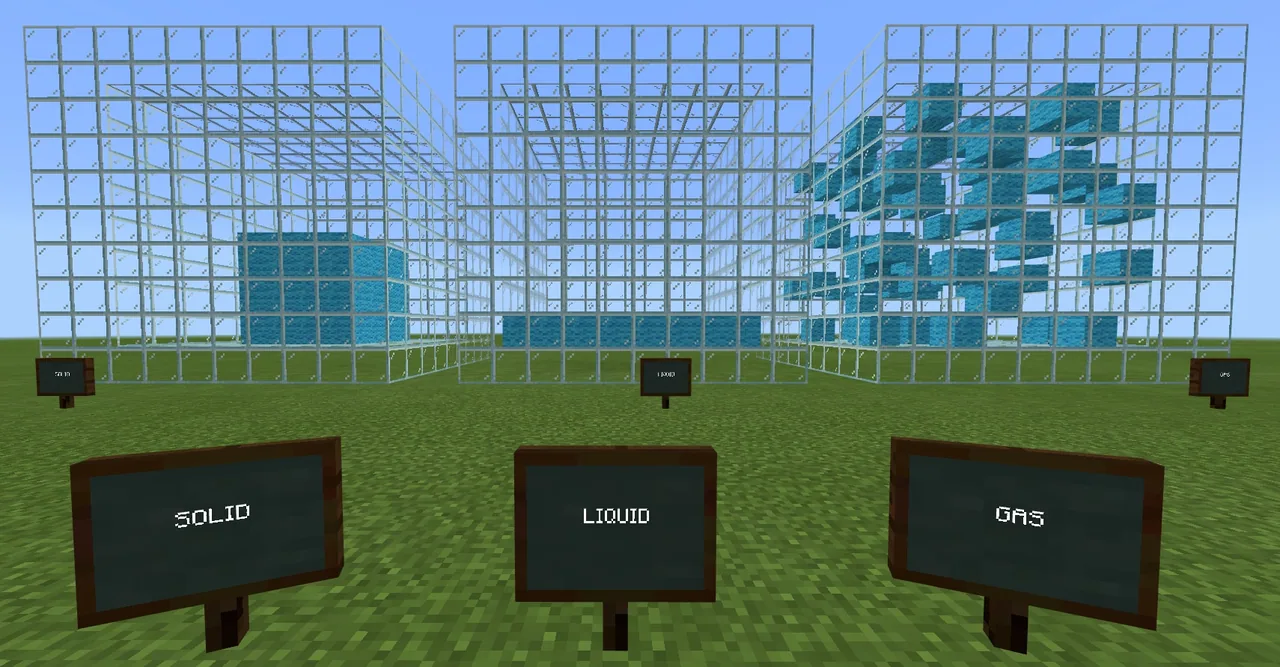
Students demonstrate these atomic-level interactions by constructing closed glass containers in Minecraft and modeling each state using an identical quantity of the same block. By assembling a compact cube for ice, a flat bottom layer for liquid water, and a scattered cloud for steam, learners visually connect microscopic particle arrangements to macroscopic properties such as fixed volume, container conformity, and compressibility.
Learning objectives
By the end of this lesson students will be able to:
- Build three-dimensional particle models representing a solid, liquid, and gas inside sealed containers.
- Demonstrate conservation of matter by using sixty-four identical blocks across each physical state.
- Explain the relationship between particle spacing, forces, and physical properties using in-game boards.
- Document and export particle models using the in-game camera and portfolio tool.
Blocks and items used in this lesson


Key vocabulary
- Particle model
- A scientific concept stating that all matter is composed of tiny, continuously moving particles.
- Attractive forces
- Forces that pull particles toward one another, remaining strongest in solids.
- Repulsive forces
- Forces created when vibrating particles bump into one another, increasing as heat is added.
- Compressibility
- The ability of a substance to be pressed into a smaller space, made possible in gases due to large gaps between particles.
Before class
Lesson sequence
- Concept Introduction
Introduce the particle model of matter. Discuss how heat causes particles to vibrate and collide at an atomic level, creating repulsive forces that compete with attractive forces.
- Solid: Attractive forces overpower repulsive forces, locking particles tightly into a set shape and volume.
- Liquid: Added heat increases repulsive forces, allowing particles to shift and fit their container while remaining touching.
- Gas: Higher heat allows repulsive forces to dominate, scattering particles across the entire volume of the container.
- Container Construction
Students create three separate sealed containers either manually or by executing the fill command:
/fill ~1 ~ ~ ~10 ~9 ~9 glass 0 hollow. Each glass container must form a hollow 10x10x10 cube. - Particle Modeling
Students select one type of block to represent their particles and use exactly sixty-four blocks per container:
- Solid (Ice): Construct a compact 4x4x4 cube resting on the bottom of the container.
- Liquid (Water): Arrange an 8x8 flat layer on the container floor with all blocks touching.
- Gas (Steam): Position sixty-four blocks randomly throughout the container, leaving open spaces between them.
- Analysis and Documentation
Students label each container using signs or slates and place an in-game board to explain how particle forces dictate the properties of each state. They photograph each model and board using the camera, compile the images into the portfolio, and export the work as a PDF.
Assessment: success criteria
- Three separate closed containers each contain exactly sixty-four identical blocks representing particles.
- The solid model forms a compact, touching shape with fixed volume and shape at the bottom of its container.
- The liquid model forms a flat layer conforming to the container base with all blocks touching.
- The gas model shows widely spaced, scattered blocks occupying the full volume of the container.
- Board explanations accurately describe the balance of attractive and repulsive forces for each state.
Differentiation
Provide the exact hollow container fill command and pre-calculated dimensions (4x4x4 cube and 8x8 sheet) to guide particle arrangement.
Have students execute the open-ended activity option where they determine their own container sizes and particle distributions without prescribed dimensions.
Knowledge check
5 questions to check understanding after the lesson. Tap an answer to see if it is right; the score appears at the end.
1Why do solids maintain a fixed shape and volume?
Answer: A. In solids, attractive forces greatly exceed repulsive forces, keeping the particles locked in a tightly packed structure.
2What happens at an atomic level as matter is heated?
Answer: B. Heating matter causes particles to vibrate and bump into one another, which creates repulsive forces.
3Why is it possible to compress a gas but not a solid?
Answer: D. Gases can be compressed because there are large empty spaces between the dispersed particles.
4Why does the structured lesson require students to use 64 identical blocks in every container?
Answer: B. Using the same number and type of block illustrates that the particles themselves remain unchanged across different physical states.
5In the structured lesson, how should the liquid particles be placed inside the container?
Answer: B. The liquid is modeled as an 8x8 layer of touching blocks on the bottom to show that it takes the shape of its container while remaining tightly packed.
Resources
Frequently Asked Questions
Can students work in groups for this lesson?
Yes, students can complete the modeling and explanation tasks either individually or in small teams of up to three.
How do students export their finished work for teacher grading?
Students capture photos of each container and their explanatory boards using the in-game camera, add them to their portfolio, and export the completed portfolio as a PDF.
What is the difference between the prescriptive and less prescriptive options?
The less prescriptive option lets students decide how to represent and contain the particles, whereas the prescriptive option specifies exact dimensions: 10x10x10 glass containers, a 4x4x4 solid cube, an 8x8 liquid base, and 64 scattered gas blocks.
Adapted from States of Matter by Shane Saxby on Minecraft Education, last updated Sep 11, 2019. This classroom version, the timings and the quiz were written by 9Minecraft Education.