- Type
- Lesson plan
- Topics
- ScienceClimate Science
- Ages
- Ages 11-13
- Duration
- 45 min
- Level
- Beginner
How do the specialized adaptations of mangrove trees help buffer coastlines and reduce atmospheric carbon?
Overview
Mangrove forests serve as vital ecological buffers in coastal intertidal zones. Adapted to high salinity, low-oxygen mud, and shifting tides, these trees provide essential environmental services, including stabilizing shorelines against storm surges, acting as nurseries for marine fisheries, and sequestering significant amounts of atmospheric carbon dioxide.
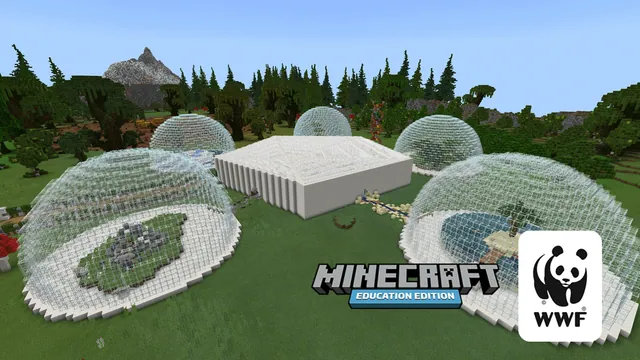
Using the Rooted Together world in Minecraft Education, students explore the structural adaptations of mangroves and evaluate their role in climate change mitigation. Through targeted discussions and game-based exploration, learners connect biological traits like prop roots and salt glands to real-world ecological resilience.
Learning objectives
By the end of this lesson students will be able to:
- Identify physical adaptations that allow mangroves to survive in saline, low-oxygen intertidal environments.
- Explain how mangrove forests capture and store carbon to help mitigate climate change.
- Describe the role of mangrove root systems in shoreline stabilization and coastal defense.
- Complete the Rooted Together Minecraft Education world to investigate mangrove ecosystems.
Blocks and items used in this lesson
 Mud
 Mangrove Log
 Mangrove Leaves
 Water Bucket
 Tropical Fish
 Frog
Key vocabulary
- Carbon Sequestration
- The capture and long-term storage of atmospheric carbon dioxide within plant tissues and soil.
- Pneumatophores
- Specialized aerial roots that grow upward out of waterlogged soil to supply oxygen to the plant.
- Prop Roots
- Above-ground root structures that anchor trees firmly into shifting intertidal mud and dissipate wave energy.
- Intertidal Zone
- The coastal area between high and low tide marks that experiences regular shifts in water coverage.
Before class
Lesson sequence
Suggested timing: about 45 minutes in total.
- Warm-Up and Habitats10 min
Begin by asking students what they know about mangroves. Introduce the intertidal zone, discussing how fluctuations in water levels, high salt concentrations, and waterlogged soil create challenging living conditions for coastal plants.
- Mangrove Adaptations and Climate Impact15 min
Present the primary adaptations of mangrove trees, including aerial pneumatophores for oxygen intake, prop roots for stability, and specialized leaf glands for excreting salt. Explain their role in climate mitigation through carbon sequestration, storm surge buffering, and nursery habitats for juvenile fish.
- Minecraft Gameplay: Rooted Together15 min
Direct students to launch the Rooted Together world in Minecraft Education. Students navigate the simulated mangrove environment to observe tree root formations, tidal interactions, and coastal wildlife.
- Review and Synthesis5 min
Gather the class to review key ideas. Ask students to state one major reason mangroves are critical for climate action, highlighting that these coastal forests can store up to five times more carbon per hectare than tropical rainforests.
Assessment: success criteria
- Students can name and describe at least two mangrove adaptations, such as prop roots, pneumatophores, or salt-excreting leaves.
- Students can explain how mangrove root networks prevent shoreline erosion during extreme weather.
- Students can state that mangroves store significantly more carbon per hectare than tropical rainforests.
Differentiation
Provide an illustrated reference chart identifying prop roots, aerial pneumatophores, and leaf glands for students to consult during gameplay.
Ask learners to write a brief explanation connecting mangrove root structures directly to the health of coastal fisheries.
Knowledge check
5 questions to check understanding after the lesson. Tap an answer to see if it is right; the score appears at the end.
1What is the primary function of mangrove aerial roots, or pneumatophores?
Answer: B. Pneumatophores grow above the soil surface to provide oxygen to the root system in oxygen-depleted mud.
2Compared to tropical rainforests, how much carbon can mangrove forests store per hectare?
Answer: C. Mangrove ecosystems are dense carbon sinks capable of holding up to five times more carbon per hectare than tropical rainforests.
3How do mangrove leaves help the plant maintain water and salt balance?
Answer: A. Mangroves have specialized leaf glands that excrete surplus salt to maintain proper tissue balance.
4Why are mangrove root systems important for coastal protection?
Answer: C. The dense root system anchors trees in muddy soil, stabilizing the coastline and diminishing wave impact.
5What critical role do mangroves play in supporting commercial marine fisheries?
Answer: B. Mangrove roots provide sheltered nursery grounds where juvenile fish can mature safely before migrating to open water.
Resources
- Lesson package (.zip)Everything the author attached to this lesson in one download.
- Educator Power Point PresentationTeacher information and class presentation slides.
- Lesson worldOpens the world page in Minecraft Education (sign-in with a school account may be needed).
Frequently Asked Questions
Do students need prior Minecraft gameplay experience to complete this lesson?
No previous gaming experience is necessary. The lesson is designed for beginners, and teachers can consult the introductory training resources and playthrough video provided in the lesson materials before class.
What licensing is needed to run the Rooted Together world?
A full, licensed version of Minecraft Education is required for student and educator devices. School IT administrators can verify active account licensing.
Adapted from Rooted Together by Minecraft Education on Minecraft Education, last updated May 23, 2025. This classroom version, the timings and the quiz were written by 9Minecraft Education.