- Type
- Lesson plan
- Subject
- Science
- Ages
- Ages 11-18
- Duration
- 45 min
- Level
- Beginner
How does the structure of the periodic table help us organize and understand the basic building blocks of matter?
Overview
Matter is built from fundamental substances known as elements, each defined by its atomic structure and positioned deliberately on the periodic table. By examining atomic numbers, atomic masses, and recurring chemical groupings, students discover how scientists categorize metals, nonmetals, and inert gases across families and periods.
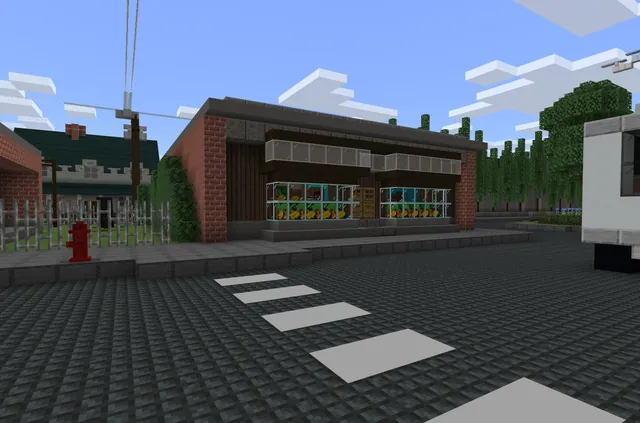
In this lesson, learners enter a Minecraft research station where a radiation storm has knocked out the power and disrupted ongoing scientific work. Students apply chemistry concepts and interpret element diagrams to help the facility scientists recover critical research data.
Learning objectives
By the end of this lesson students will be able to:
- Define atomic number and compare it with the atomic mass of an element.
- Identify elements as the basic building blocks of all matter.
- Describe the design of the periodic table in terms of periods, families, metals, nonmetals, and inert gases.
- Interpret diagrams that display data for specific chemical elements.
Blocks and items used in this lesson


Key vocabulary
- Atomic number
- The number of protons in an atom, which determines the element's identity and position on the periodic table.
- Atomic mass
- The total average mass of an atom, accounting for protons and neutrons in the nucleus.
- Element
- A pure substance made of only one kind of atom that serves as a basic building block of matter.
- Period
- A horizontal row on the periodic table that shows elements arranged by increasing atomic number.
- Family
- A vertical column on the periodic table grouping elements with similar chemical properties.
- Inert gas
- An unreactive element located in the far-right column of the periodic table.
Before class
Lesson sequence
Suggested timing: about 45 minutes in total.
- Mission Briefing10 min
Introduce the scenario: a radiation storm has cut power to a remote research station, endangering valuable scientific data. Review baseline chemistry concepts, including what defines an element, the meaning of atomic numbers, and how atomic mass relates to the nucleus.
- Station Investigation20 min
Students load the Periodic Rescue world and explore the research facility. Working through the challenges, they locate and read element diagrams, identify atomic numbers and masses, and categorize elements into metals, nonmetals, and inert gases to assist the station scientists.
- Data Verification10 min
Learners compare the data they extracted from the station diagrams with classmates, verifying that element groupings, families, and periods match the layout of the periodic table.
- Debrief and Wrap-Up5 min
Lead a short discussion reflecting on how understanding the periodic table allowed the team to restore the scientists' research and solve problems during the outage.
Assessment: success criteria
- Differentiate correctly between an element's atomic number and its atomic mass.
- Classify elements into correct categories including metals, nonmetals, and inert gases.
- Locate and interpret key details from an element information diagram.
Differentiation
Provide a printed periodic table reference sheet with highlighted regions for metals, nonmetals, and inert gases.
Ask students to explain how element properties shift predictably when moving across a period versus down a family.
Knowledge check
5 questions to check understanding after the lesson. Tap an answer to see if it is right; the score appears at the end.
1What does an element's atomic number represent?
Answer: B. The atomic number is strictly defined as the count of protons found in an atom of that element.
2Which substances are considered the basic building blocks of matter?
Answer: A. Elements are the pure, fundamental substances that make up all matter.
3How does atomic mass generally compare to atomic number for an element?
Answer: C. Atomic mass accounts for the combined weight of protons and neutrons, making it greater than the atomic number alone.
4What term describes the horizontal rows across the periodic table?
Answer: D. Horizontal rows on the periodic table are designated as periods.
5Which group on the periodic table is recognized for having inert gases?
Answer: B. Inert gases are grouped on the far right of the periodic table due to their stable, non-reactive nature.
Resources
- Periodic Rescue Teaching GuideUse this guide in conjunction with the Periodic Rescue world in Minecraft.
- Lesson worldOpens the world page in Minecraft Education (sign-in with a school account may be needed).
Frequently Asked Questions
Is this lesson suitable for students who have never studied chemistry?
Yes. The lesson is classified as beginner-level and introduces core concepts like atomic numbers, atomic mass, and periodic table regions directly through the activity.
What support materials come with this lesson?
The lesson includes a dedicated Periodic Rescue Teaching Guide alongside the downloadable Minecraft world file.
Adapted from Periodic Rescue by K12 Inc. on Minecraft Education, last updated Jul 21, 2025. This classroom version, the timings and the quiz were written by 9Minecraft Education.