How can understanding the connections between vectors, hosts, agents, and environments help us design effective disease control strategies?
Overview
Mosquito-borne illnesses represent significant public health challenges for humans and animals. In this lesson, students explore the fundamentals of epidemiology, One Health, and vector ecology by examining how disease agents, mosquito vectors, hosts, and environmental factors interact to transmit pathogens.
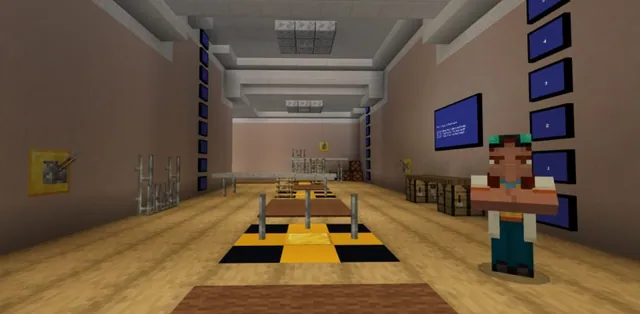
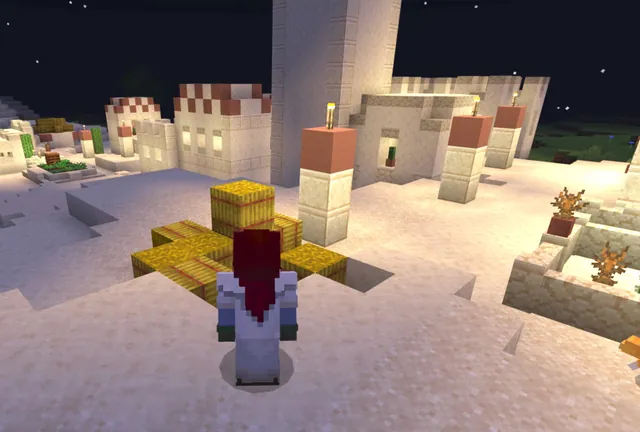
Using a custom Minecraft world, students tour six distinct field locations to diagnose different disease ecologies. Working in collaborative teams, students build an in-game epidemiological pyramid and remodel their assigned site to implement and evaluate targeted vector control measures.
Learning objectives
By the end of this lesson students will be able to:
- Identify the key components of the epidemiological triangle, including vectors, agents, hosts, and environments.
- Investigate six field sites in Minecraft to identify specific mosquito-borne diseases.
- Build an in-game epidemiological pyramid to model a specific disease system.
- Modify a Minecraft habitat to implement vector control measures and evaluate their potential impacts.
Blocks and items used in this lesson


Key vocabulary
- Epidemiology
- The study of how diseases spread, occur, and are managed in populations.
- Vector
- An organism, such as a mosquito, that transmits a disease agent to another living being.
- Host
- An organism that harbors or is infected by a disease agent.
- Reservoir
- A population, organism, or environment where a pathogen naturally lives and multiplies.
- One Health
- An approach that links the health of humans, animals, and their shared environments.
Before class
Lesson sequence
- Introduction and Discussion
Watch the introductory videos highlighting mosquitoes as dangerous disease vectors. Guide a class discussion on mosquito-borne diseases, exploring local risks, prevention strategies, and examples such as West Nile virus, Eastern Equine Encephalitis (EEE), Zika virus, and heartworm in pets.
- Deconstructing the Color Charts
Guide students through the reading materials and the color-coded epidemiological charts. Clarify how the red (vectors), blue (agents), yellow/orange (hosts and reservoirs), green (environment), and purple (disease components) charts fit together, followed by the black charts on control strategies.
- Minecraft World Site Tour
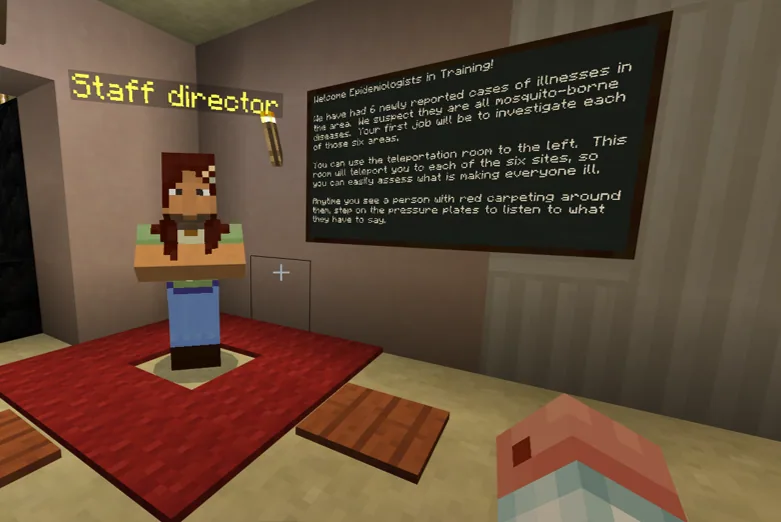
Students log into the Minecraft world and speak with the guide characters to teleport between all six stations. At each station, students inspect the disease ecology and complete Chart 1 by recording which disease is present, the supporting evidence, and initial control ideas.
- Team Strategy and Habitat Redesign
Divide students into six groups and assign each to one site. Before building, teams complete Chart 2 to plan their interventions. In Minecraft, students construct their epidemiological pyramid, capture before screenshots, modify the habitat to control the vector, and take after screenshots.
- Presentations and Evaluation
Teams report their findings through a structured presentation covering their disease components, the control methods used, before-and-after imagery, and an analysis of both the benefits and potential negative impacts of their interventions.
Assessment: success criteria
- Completion of Chart 1 identifying the correct disease ecology and evidence across all six Minecraft stations.
- Completion of Chart 2 detailing an intentional disease control plan prior to in-game construction.
- Accurate construction of an in-game epidemiological pyramid showing vectors, agents, hosts, and environment.
- Delivery of a final report or presentation detailing control strategies, before-and-after screenshots, and trade-offs.
Differentiation
Pair students for chart readings and provide a guided checklist of visual clues to look for at each Minecraft station.
Challenge students to propose additional vector control methods that were not included in the provided black charts and evaluate their ecological feasibility.
Knowledge check
5 questions to check understanding after the lesson. Tap an answer to see if it is right; the score appears at the end.
1According to the lesson materials, which creature is considered the most dangerous animal on the planet?
Answer: A. The guiding ideas emphasize that mosquitoes remain the number one most dangerous animal on Earth because one bite can transmit life-changing diseases.
2In the lesson's color-coded reference system, which chart color represents mosquito vectors?
Answer: C. The student activity guide specifies that the Red Chart represents mosquito vectors.
3What structure are students required to build inside Minecraft to represent their disease components?
Answer: B. Students are directed to construct their own epidemiological pyramid within the Minecraft world.
4How many distinct disease sites do students tour within the Minecraft world?
Answer: D. The lesson instructions specify that students tour through six different sites or stations.
5According to the lesson's discussion prompts, how do pets contract heartworm?
Answer: B. The source notes that the only way for pets to get heartworm is through the bite of a mosquito.
Resources
- Lesson package (.zip)Everything the author attached to this lesson in one download.
- Lesson plan handouts and worksheetsIn this pdf, you will find all the color charts, worksheets, and other lesson plan information.
- Teacher Cheat Sheet and NotesThis pdf contains specific site information, such as, which disease is present, ways to determine disease at the site, and examples of control methods
- Lesson worldOpens the world page in Minecraft Education (sign-in with a school account may be needed).
Frequently Asked Questions
How do students travel between the different locations in the Minecraft world?
Each of the six sites contains an in-game character that helps students teleport directly to the other stations.
What visual evidence must students record from their Minecraft work?
Students must capture before and after screenshots of their assigned site modifications along with a screenshot of their built epidemiological pyramid.
What components must students include in their final presentation?
Presentations should follow a structured format with an Introduction covering disease components and their pyramid screenshot, Methods explaining their control choices, Results with before and after screenshots, and a Discussion on risk reduction and strategy trade-offs.
Adapted from One Health and Vector Control by Kristen Healy on Minecraft Education, last updated May 23, 2025. This classroom version, the timings and the quiz were written by 9Minecraft Education.