- Type
- Lesson plan
- Topics
- TechnologyMusic
- Ages
- Ages 8-18
- Duration
- about 60 min (suggested)
- Includes
- Quiz: 5 questionsLesson files
How can computational loops and redstone mechanics be used to construct musical rhythm patterns?
Overview
This lesson introduces learners to minimalist rhythmic concepts inspired by Steve Reich's iconic composition, 'Clapping Music.' Students explore how musical patterns can be broken down into binary representations of sound and silence, connecting computational logic directly to musical notation.
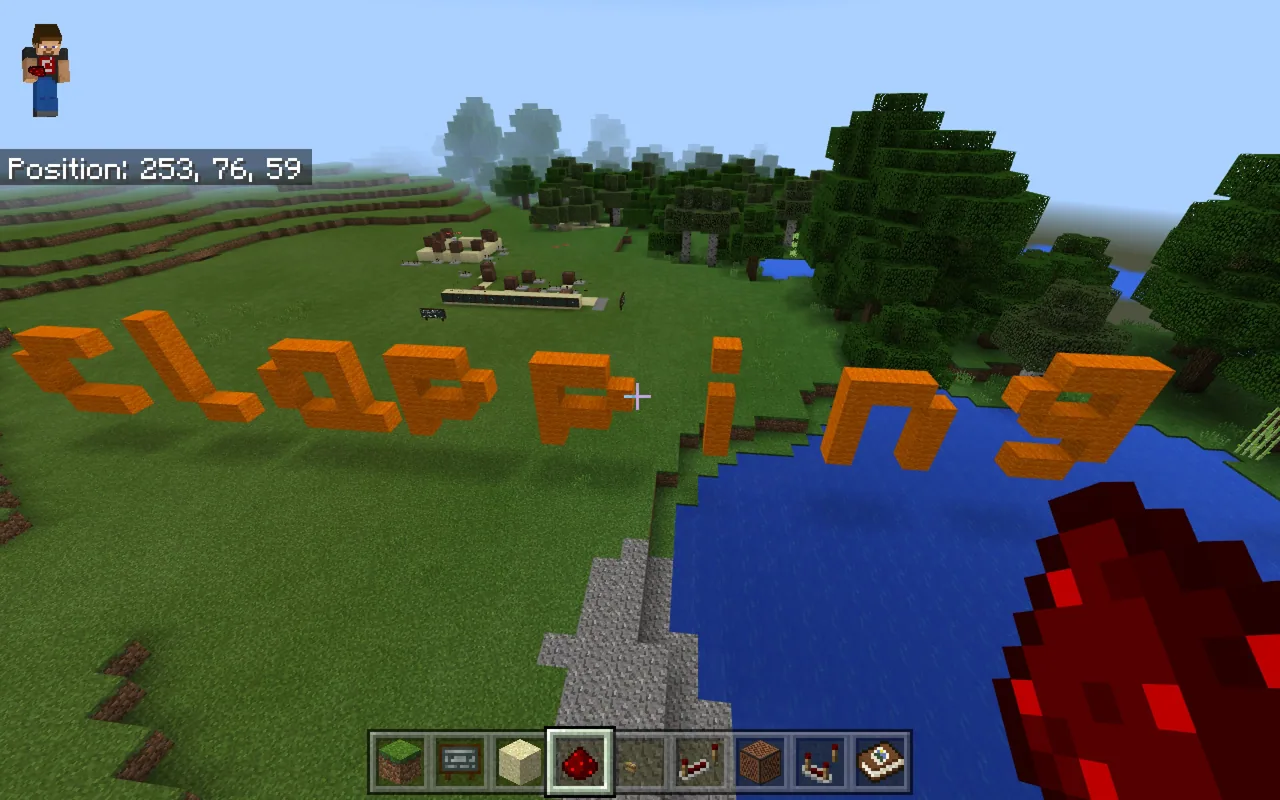
Using the Code Connector with Minecraft, students program square structures to build looping circuits. By wiring redstone to note blocks set atop sand to create snare drum sounds, students construct autonomous rhythm machines and explore musical phasing.
Learning objectives
By the end of this lesson students will be able to:
- Represent musical rhythms using binary notation where ones signify beats and zeros signify rests.
- Use Code Connector commands to construct square loops in Minecraft.
- Wire redstone circuits to trigger note blocks placed on sand for snare drum percussion.
- Model repetitive musical structures based on Steve Reich's Clapping Music.
Blocks and items used in this lesson


Key vocabulary
- Binary Rhythm
- A method of writing rhythms using ones for beats and zeros for rests.
- Note Block
- A block that plays a musical tone when triggered by a redstone signal.
- Redstone
- A Minecraft element used to create circuits that power and activate mechanisms.
- Phasing
- A musical technique where two identical patterns shift out of alignment over time.
Before class
Lesson sequence
Suggested timing: about 60 minutes in total.
- Warm-up: Listening and Binary Notation10 min
Introduce students to Steve Reich's 'Clapping Music' using audio or video examples. Discuss how the continuous clapping pattern functions and explain how beats and rests can be represented digitally using binary code (1 for a beat, 0 for a rest).
- Explore: Analyzing the In-World Circuits15 min
Have students open the Music Phasing World to investigate how the Code Connector links to Minecraft. Students inspect the coded square structures and trace how redstone carries power to activate repeating rhythmic patterns.
- Build: Assembling Rhythm Loops20 min
Students write code commands to generate their own square loop layouts. They place note blocks over sand blocks to produce snare drum percussion and wire redstone along the loop to play their rhythm steadily.
- Extend and Reflect15 min
Learners test and refine their rhythm loops. Students discuss how changing block spacing or wiring alters the rhythm, while advanced learners construct the second phase of 'Clapping Music' alongside their first loop.
Assessment: success criteria
- Student accurately translates a rhythm into binary notation with ones as beats and zeros as rests.
- Student writes code to generate a functional square structure for a circuit loop.
- Student places note blocks on sand blocks and wires them with redstone to produce an audible, repeating snare pattern.
- Student explains or builds a variation or second phase based on the Clapping Music pattern.
Differentiation
Allow students to work in pairs to analyze the provided example loop before attempting to code their own square circuit.
Have students code and wire the second phase pattern of Steve Reich's 'Clapping Music' alongside their initial loop to observe how the rhythms interact.
Knowledge check
5 questions to check understanding after the lesson. Tap an answer to see if it is right; the score appears at the end.
1How are rhythm beats and rests represented in binary notation for this lesson?
Answer: B. The lesson uses binary notation where ones indicate active beats and zeros indicate rests.
2Which musical composition serves as the primary inspiration for this project?
Answer: C. The rhythm loops in this lesson are explicitly modeled after Steve Reich's 'Clapping Music.'
3What block material should note blocks be placed on to create a snare drum sound?
Answer: D. Placing a note block on top of a sand block produces a snare drum sound in Minecraft.
4What geometric shape is built using code commands to create the repeating rhythm circuit?
Answer: A. Students write code to build a square layout that facilitates a closed, repeating loop.
5Which external tool is linked with Minecraft to execute the building commands for the loops?
Answer: C. The source specifies using the Code Connector to send coding commands into the world.
Resources
Frequently Asked Questions
Why do students place note blocks specifically on sand blocks?
In Minecraft mechanics, placing a note block on sand changes its instrument to a snare drum, providing the percussion sound needed for the clapping rhythm.
What is the primary extension task for fast finishers?
Fast finishers can construct the second rhythmic phase from Steve Reich's 'Clapping Music' alongside their initial square loop to hear the two patterns interact.
Adapted from Music Phasing by Samuel Wright on Minecraft Education, last updated Jan 23, 2018. This classroom version, the timings and the quiz were written by 9Minecraft Education.