- Type
- Lesson plan
- Subject
- Science
- Topics
- Science
- Ages
- Ages 11-18
- Duration
- about 1.5 hours (suggested)
- Skills
- Collaboration
- Includes
- Quiz: 5 questions
How do the heart chambers, valves, and connected blood vessels direct the flow of oxygenated and deoxygenated blood?
Overview
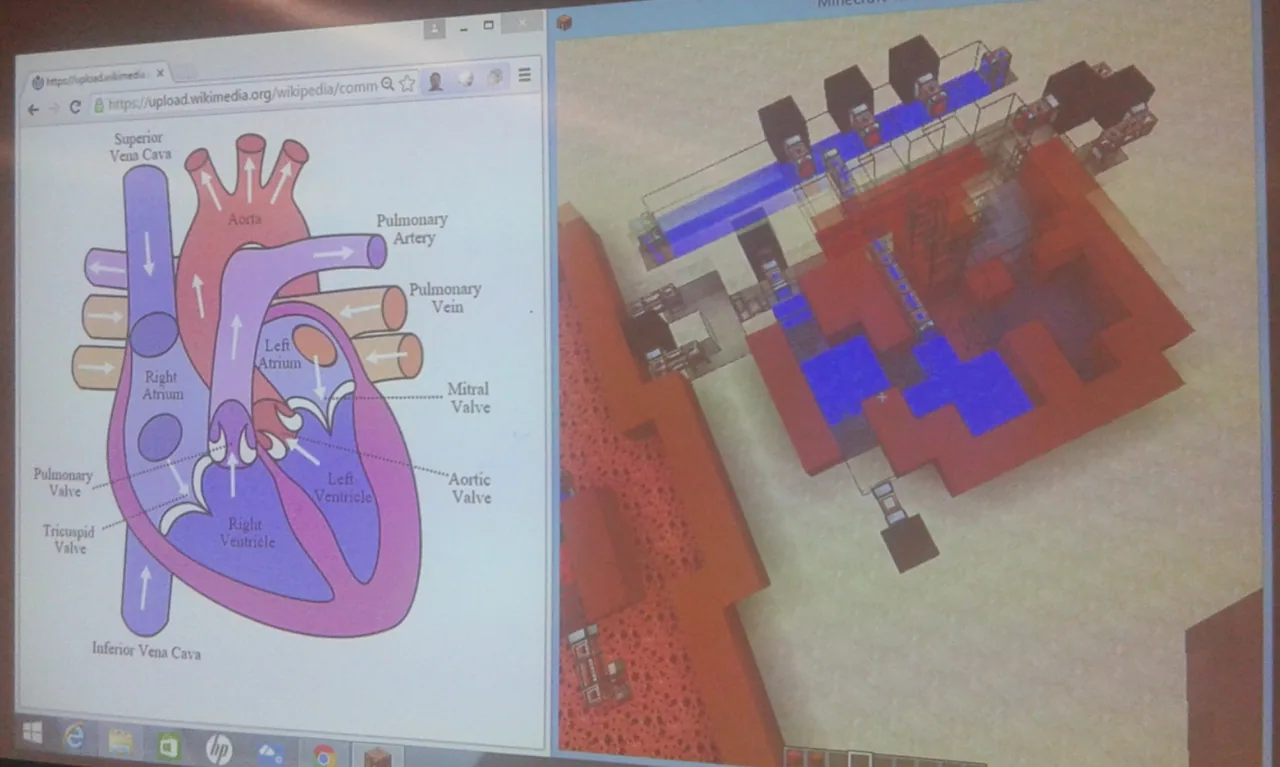
Understanding the circulatory system requires visualizing how blood moves through heart chambers, heart valves, and the lungs. In this biology activity, learners investigate heart anatomy by planning and constructing an anatomical model that shows how oxygen-poor and oxygen-rich blood move along distinct pathways.
Using Minecraft, student teams select different block textures to represent various tissues in the heart and lungs. They use color-coded liquids—red for oxygenated blood, blue for deoxygenated blood, and grey for air in the lungs—while designing structures that demonstrate directional flow through the chambers and valves.
Learning objectives
By the end of this lesson students will be able to:
- Identify and construct the four chambers of the human heart.
- Distinguish between oxygenated and deoxygenated blood pathways using red and blue liquids.
- Explain the purpose of heart valves in maintaining one-way blood flow.
- Model the structural connection and gas exchange interface between the heart and lungs.
Blocks and items used in this lesson


Key vocabulary
- Oxygenated Blood
- Blood rich in oxygen traveling from the lungs through the heart to the body, represented in this project with red liquid.
- Deoxygenated Blood
- Blood depleted of oxygen returning from the body to the heart and lungs, represented with blue liquid.
- Heart Chambers
- The four internal compartments of the heart that collect and pump blood.
- Heart Valves
- Internal structures that open and close to stop blood from flowing backward.
Before class
Lesson sequence
Suggested timing: about 90 minutes in total.
- Inquiry and Structural Planning15 min
Introduce the driving questions about heart function, including why the left side is larger than the right side and how valves maintain directional flow. Student groups sketch a design layout that includes all four chambers, associated blood vessels, and lung connections.
- Tissue and Chamber Construction35 min
Working in teams, students select distinct block types to represent the varied textures of heart and lung tissues. They build the four main chambers, ensuring the left side reflects its larger muscular proportion relative to the right side.
- Fluid Pathways and Valve Placement25 min
Learners place red liquid to demonstrate oxygenated blood pathways, blue liquid for deoxygenated blood, and grey liquid to represent air within the lungs. Teams build valve mechanisms to illustrate how backflow is prevented.
- Demonstration and Evaluation15 min
Groups guide their peers through their builds, explaining the flow of blood between the heart and lungs and describing how their models demonstrate valve mechanics and vessel functions.
Assessment: success criteria
- Correct identification and layout of all four internal heart chambers.
- Accurate color differentiation using red liquid for oxygenated blood and blue liquid for deoxygenated blood.
- Clear representation of heart valves preventing the backflow of blood.
- Demonstrated connection between the heart and lungs with grey liquid representing lung air.
Differentiation
Provide a labeled 2D anatomical diagram showing chamber positions and fluid colors for learners to reference while building.
Have students research and model the physiological impact of a hole in the central heart wall or use advanced pumping mechanics to simulate active blood circulation.
Knowledge check
5 questions to check understanding after the lesson. Tap an answer to see if it is right; the score appears at the end.
1Which color liquid represents oxygenated blood in the Minecraft model?
Answer: B. The lesson uses red liquid to designate oxygenated blood moving through the heart.
2What is the primary function of heart valves shown in this build?
Answer: C. Heart valves function specifically to prevent blood from flowing backward.
3What does the grey liquid represent in the lungs?
Answer: A. The project uses grey liquid inside the lung build to represent air.
4How many main chambers should students model inside the heart?
Answer: C. The lesson design specifically requires modeling the four chambers of the heart.
5Why is the left side of the heart modeled differently from the right side?
Answer: D. The guiding inquiry asks students to account for why the left side of the heart is noticeably larger than the right.
Frequently Asked Questions
Do students need to install third-party mods to complete the core objectives?
No. While advanced students may choose to use mods to pump fluids or label vessels, standard building blocks and liquids in the base game are fully sufficient to build the chambers, valves, and fluid pathways.
Is there a ready-made world file included for this lesson?
No world download is supplied with this lesson. Students can construct their anatomical models in a standard flat or open sandbox world.
Adapted from Modelling the heart by Rachel Chisnall on Minecraft Education, last updated Dec 21, 2016. This classroom version, the timings and the quiz were written by 9Minecraft Education.