- Type
- Lesson plan
- Subject
- Science
- Topics
- ScienceBiology and Life
- Ages
- Ages 11-13
- Duration
- about 7.8 hours (suggested)
How can the unique cellular features, adaptations, and species diversity of Earth's five kingdoms of life be accurately modeled in a collaborative zoo?
Overview
In this biology project, students explore biological taxonomy by investigating the five traditional kingdoms of life: Monera, Protista, Fungi, Plantae, and Animalia. Through guided research and essential inquiry questions, learners analyze what defines a species, compare variations within groups, and study how distinct organisms adapt to their natural habitats.
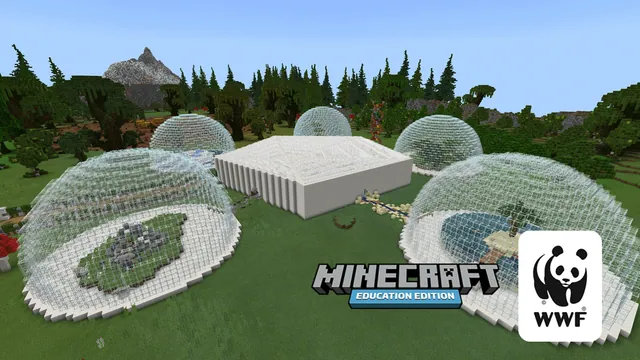
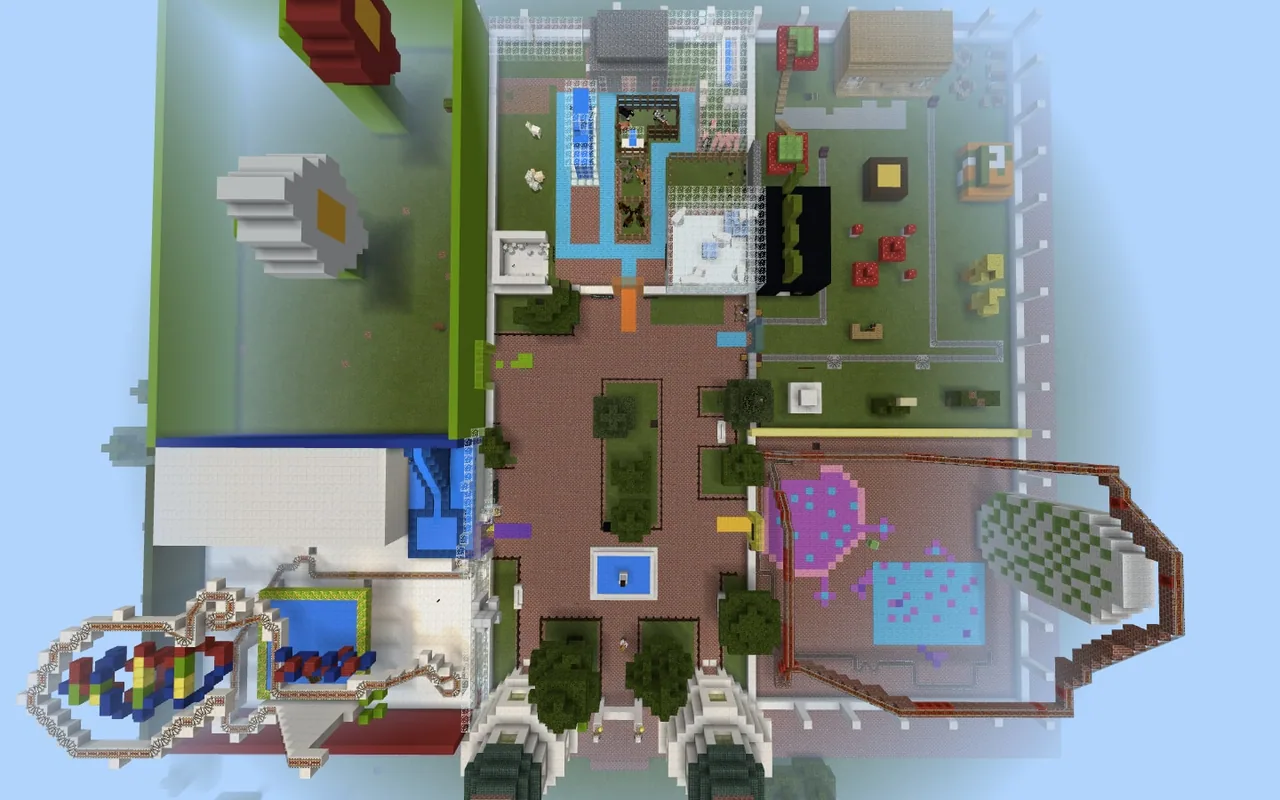
Working collaboratively inside a prebuilt Minecraft zoo world with demarcated kingdom zones, student groups take responsibility for an assigned kingdom. Teams use creative building techniques—ranging from mob habitats and natural vegetation to pixel-art cell models and simulated microscope views—to construct informative exhibits demonstrating their kingdom's defining traits.
Learning objectives
By the end of this lesson students will be able to:
- Classify living organisms into the five kingdoms of life and describe their main characteristics.
- Explain the scientific concepts of species, habitat, and variation within an organism group.
- Construct accurate Minecraft models representing specific species, cellular structures, or natural habitats for an assigned kingdom.
- Describe how organisms adapt to their habitats and interact with other species in their environment.
Blocks and items used in this lesson
 Glass
 Chalkboard
 Moss Block
 Water Bucket
Key vocabulary
- Monera
- The kingdom of microscopic single-celled organisms, such as bacteria, that lack an organized nucleus.
- Protista
- A kingdom of mostly single-celled or simple multicellular organisms that are distinct from plants, animals, and fungi.
- Taxonomy
- The scientific branch concerned with grouping, naming, and classifying living things.
- Species
- A specific group of organisms sharing common characteristics and biological traits.
- Habitat
- The natural environment where a particular organism or species lives, feeds, and survives.
Before class
Lesson sequence
Suggested timing: about 465 minutes in total.
- Inquiry and Guided Research90 min
Introduce the five kingdoms of life and provide students with the objectives checklist. Present guiding questions exploring whether any kingdom is more critical than others, whether all Monera are harmful, and how to classify ambiguous organisms like mosses and algae.
Students complete research worksheets in their groups to collect key biological facts, species examples, and cellular traits for their assigned kingdom before entering Minecraft.
- World Orientation and Layout Planning45 min
Have students log into the shared Kingdoms Zoo world and locate their designated kingdom sector. Groups sketch out enclosure boundaries, pathways, and information stations based on their research notes.
- Zoo Exhibit Construction240 min
Across multiple sessions, groups build their exhibits. Students assigned to Fungi, Plantae, or Animalia curate native flora and spawn mobs while designing suitable habitats.
Teams modeling Monera and Protista build enlarged models, such as pixel-art cells, glass microscope simulations, flagella, pili, and DNA pools representing unorganized nuclei.
- Zoo Walkthrough and Reflection90 min
Teams tour each other's kingdom exhibits to complete their objective checklists. Address emergent ecological phenomena, such as animal competition and food chain dynamics observed among penned mobs.
Conclude with a class discussion reflecting on captive habitat conditions, human impacts on wildlife, and species conservation.
Assessment: success criteria
- Completion of the objectives checklist and session worksheets covering all five kingdoms.
- Accurate representation of kingdom characteristics, including microscopic cell features or habitat adaptations in Minecraft.
- Effective collaborative participation within the shared world boundaries without interfering with other groups' enclosures.
Differentiation
Guide students toward kingdoms with native Minecraft items like Plants, Fungi, or Animals using spawn eggs before attempting abstract block builds.
Have learners evaluate zoo enclosure sizes for animal welfare, explore food webs and competition, or participate in a virtual interview with a real zoo expert.
Knowledge check
5 questions to check understanding after the lesson. Tap an answer to see if it is right; the score appears at the end.
1Which kingdom includes single-celled organisms that lack an organized cell nucleus?
Answer: A. Monera consists of bacteria and related organisms without a membrane-bound nucleus.
2How did students creatively model the microscopic kingdom Protista in Minecraft?
Answer: C. Students used pixel art and glass enclosures designed to resemble microscope viewports to display Protista.
3What biological structure did students build to represent the genetic material of Monera?
Answer: B. Students represented the unorganized nucleus of Monera by constructing pools containing DNA chains.
4What ecological interaction occurred when students placed multiple animals like wolves into the Animal Kingdom?
Answer: B. Students observed competition between wolves and other animals, demonstrating survival of the fittest.
5What resource do students use throughout the project sessions to track their learning goals?
Answer: C. Students follow an objectives checklist provided at the start of the project to monitor their progress across sessions.
Resources
- Lesson package (.zip)Everything the author attached to this lesson in one download.
- Objectives checklistThe objectives the students need to accomplish throughout their research and completion of the project.
- Kingdoms Zoo WorldThe final world built by the students in which we have the 5 Kingdoms of Life. Feel free to use/edit.
Frequently Asked Questions
How can students build microscopic kingdoms like Monera or Protista?
Students can construct scaled-up models using blocks to make pixel art, design glass viewing areas that resemble looking through a microscope, or build physical cell parts such as flagella, pili, and unorganized DNA pools.
How is the shared Minecraft world set up for multiple student groups?
The teacher prepares the world beforehand by mapping out the zoo perimeter and defining clear section limits for each of the five kingdoms so groups can build simultaneously without encroaching on others.
How much instructional time is required for this project?
The project was designed across seven 90-minute classes, allowing time for research worksheets, world planning, extensive building, and peer evaluations.
Adapted from Kingdoms of Life Zoo by Andreia Salgueiro on Minecraft Education, last updated May 23, 2025. This classroom version, the timings and the quiz were written by 9Minecraft Education.