- Type
- Lesson plan
- Subject
- Science
- Ages
- Ages 11-18
- Duration
- about 60 min (suggested)
- Skills
- Critical thinking
- Includes
- Quiz: 5 questionsLesson files
How do elemental charges guide the formation and naming of chemical compounds?
Overview
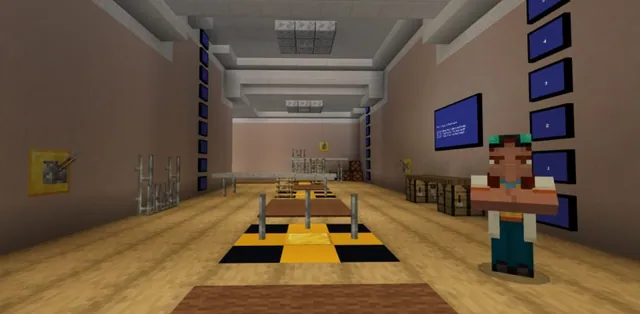
Ionic World is a chemistry review game designed to reinforce student understanding of fundamental elements, ionic charges, and chemical formulas. Learners begin with foundational element properties before advancing to multi-element ionic equations and specialized chemical compounds such as polyatomic ions.
Using an interactive game environment, students navigate through distinct stages that test their recall and problem-solving skills. The final stage introduces high-stakes gameplay where students race along correct compound paths against a timer to deactivate an in-game pillager device.
Learning objectives
By the end of this lesson students will be able to:
- Identify the charges and symbols of common metallic and nonmetallic elements.
- Determine balanced chemical formulas for basic ionic compounds.
- Recognize specific polyatomic ions and common chemical substances including hydrochloric acid and diamond.
- Apply chemistry knowledge under time constraints to complete a multi-step challenge.
Blocks and items used in this lesson
 Pillager
 Sodium (Element 11)
 Chlorine (Element 17)
 Calcium (Element 20)
 Oxygen (Element 8)
 Diamond
Key vocabulary
- Ionic Compound
- A chemical compound composed of ions held together by electrostatic forces.
- Ion Charge
- The positive or negative electrical charge acquired by an atom when it loses or gains electrons.
- Polyatomic Ion
- A charged group of covalently bonded atoms that behaves as a single unit, such as ammonium or chlorate.
Before class
Lesson sequence
Suggested timing: about 60 minutes in total.
- Stage 1: Core Element and Compound Review25 min
Students review foundational elements such as sodium, chlorine, calcium, and oxygen. They answer questions regarding elemental properties and charges, then determine balanced equations for compounds like calcium oxide, sodium bromide, and magnesium chloride.
Because this stage forms the bulk of the content review, students should take extra time to secure their understanding before proceeding.
- Stage 2: Advanced Charges and Formulas15 min
Students recall charges for elements such as barium, iron, lead, and nitrogen. They then assemble formulas for more complex pairings, including iron(II) nitride, barium nitride, and lead oxide.
- Stage 3: Polyatomics and Named Substances10 min
Learners identify the composition and properties of specialized substances, including hydrochloric acid, diamonds, hydroxide, chlorate, acetate, bicarbonate, and ammonium.
- Stage 4: Pillager Machine Speed Round10 min
Students press the I'm ready! button to release the barrier block, gaining 45 bonus seconds on top of their earned points. They must follow the correct compound trail and answer three final chemistry questions to disable the pillager machine before time expires.
Assessment: success criteria
- Accurately state the chemical symbols and charges for elements listed in Stages 1 and 2.
- Produce correct formulas for paired binary compounds such as sodium phosphide and strontium fluoride.
- Identify the single element that constitutes diamond and recognize polyatomic ions from Stage 3.
- Answer all three terminal review questions before the Stage 4 timer expires.
Differentiation
Allow students to refer to a standard periodic table or reference sheet while completing Stages 1 and 2.
Have students predict formulas for additional multivalent metal compounds beyond those provided in Stage 2.
Knowledge check
5 questions to check understanding after the lesson. Tap an answer to see if it is right; the score appears at the end.
1Which element forms a compound with bromine to produce sodium bromide in Stage 1?
Answer: C. Sodium combines with bromine to form the binary compound sodium bromide.
2According to the lesson structure, which stage serves as the primary review and takes the longest time?
Answer: A. Stage 1 contains the bulk of the element and compound review and takes significantly longer than subsequent stages.
3Which compound featured in Stage 2 contains a transition metal with a specified Roman numeral charge?
Answer: D. Iron II nitride specifically requires students to recognize the charge of the iron(II) cation.
4What happens immediately when students press the 'I’m ready!' button in Stage 4?
Answer: B. Pressing the button adds 45 seconds, removes the barrier block, and initiates the timed race.
5Which of the following is studied in Stage 3 as a polyatomic ion or specific chemical substance?
Answer: A. Ammonium is one of the specific polyatomic groups reviewed in Stage 3.
Resources
Frequently Asked Questions
How is student progress assessed across the different stages?
Stage 1 functions as the comprehensive instructional review, whereas Stages 2 and 3 serve as informal formative checks before the timed evaluation in Stage 4.
What happens if students take a wrong path in Stage 4?
Students must find the trail displaying the correct compound sequence; choosing an incorrect path loses precious time needed to answer the final three questions before the timer runs out.
Adapted from Ionic World: Chemistry Review by Ben Spieldenner on Minecraft Education, last updated Jul 21, 2025. This classroom version, the timings and the quiz were written by 9Minecraft Education.