What tools, environmental conditions, and processes are required to run a productive modern farm?
Overview
Modern agriculture depends on advanced machinery, careful soil stewardship, and a clear understanding of environmental conditions. In this unit, students explore where food comes from and examine the complex sequence of actions required to cultivate sustainable, healthy crops from seed to harvest.
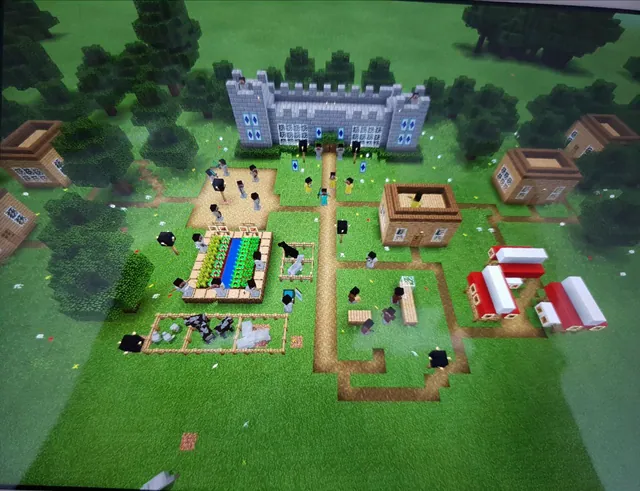
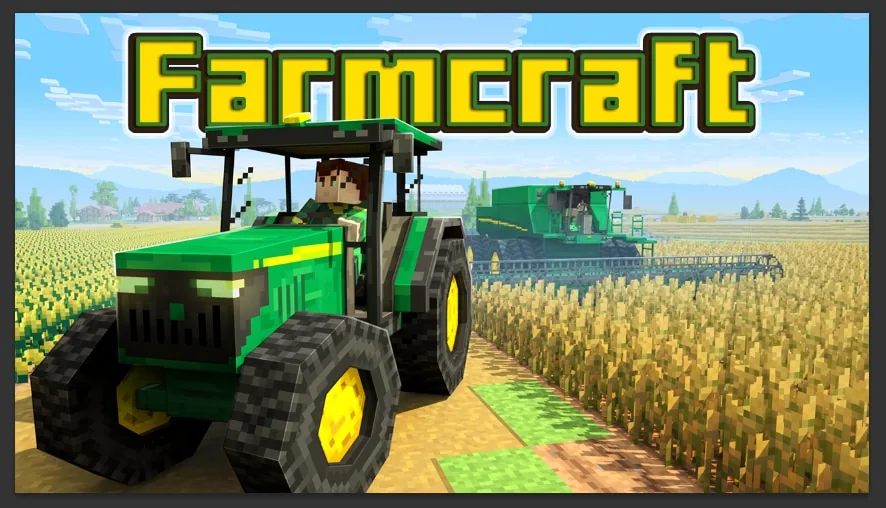
Using the FarmCraft environment, students interact with specialized vehicles stored at The Factory to work the fields surrounding The Ranch. Learners prepare soil, fertilize, sow seeds, harvest yields, and trade their produce for different crop varieties while observing how weather, water, and soil conditions impact farm productivity.
Learning objectives
By the end of this lesson students will be able to:
- Identify the roles of modern agricultural vehicles in tilling, planting, and harvesting crops.
- Describe the key stages of crop production, including soil preparation, fertilization, planting, and harvesting.
- Explain how weather patterns, climate, soil quality, and water availability affect plant growth.
- Manage simulated agricultural plots by operating machinery and trading harvested yields for new crop types.
Blocks and items used in this lesson


Key vocabulary
- Tilling
- The process of preparing soil by digging, overturning, or stirring it before planting.
- Fertilization
- Adding nutrients to soil to support healthier and more vigorous plant development.
- Harvesting
- The process of gathering mature crops from the fields.
- Climate
- The long-term weather patterns and conditions typical of a particular region.
Before class
Lesson sequence
- Part 1: Introduction to Farming and Equipment
Begin by asking students where their everyday food originates and what tools are required to produce it at scale. Introduce students to modern agricultural machinery, focusing on the vehicles stored at The Factory used for tilling, seeding, and collecting yields.
- Part 2: Weather, Soil, and Water
Guide students through an investigation of environmental requirements for healthy crops. Discuss how climate, ambient weather, soil nutrient levels, and dependable water sources combine to sustain crop growth or cause crop failure.
- Part 3: Running the Farm
Direct students to The Ranch to apply their knowledge. Students use agricultural vehicles from The Factory to till soil, apply fertilizer, sow seeds, and harvest mature fields, followed by trading harvested crops for new crop types to expand production.
- Review and Reflection
Bring the class together to discuss the challenges of maintaining multiple fields. Have students reflect on how modern technology changes the efficiency of food production compared to manual labor.
Assessment: success criteria
- Student accurately explains the functions of modern farming equipment used for tilling, planting, and harvesting.
- Student demonstrates the full sequence of crop production from ground preparation to harvest.
- Student articulates how weather, climate, soil, and water directly influence crop health.
- Student successfully operates field equipment around The Ranch and trades harvested goods for new crops.
Differentiation
Pair students together to divide equipment operation and plot maintenance duties around The Ranch.
Challenge learners to optimize crop rotations by trading for diverse crop varieties and managing multiple fields simultaneously.
Knowledge check
5 questions to check understanding after the lesson. Tap an answer to see if it is right; the score appears at the end.
1Which location provides the vehicles used to work the fields around The Ranch?
Answer: B. Vehicles used to till, fertilize, plant, and harvest are obtained from The Factory.
2What is the primary purpose of tilling in crop production?
Answer: A. Tilling is the initial stage of soil preparation prior to planting.
3What can players do with their harvested crops around The Ranch?
Answer: A. The activity allows players to trade their harvested yields to obtain new varieties of crops.
4Which set of environmental factors is explored for its direct impact on crop health?
Answer: B. Lesson 2 focuses on how weather, climate, soil, and water determine crop success.
5Which action correctly represents the sequence of agricultural field work?
Answer: C. Field management begins with soil preparation and fertilization, followed by planting and harvesting.
Frequently Asked Questions
Can this lesson be split across several class periods?
Yes. The curriculum is designed with three distinct parts that can be delivered as separate standalone sessions or condensed into a single longer lesson.
Do students need prior Minecraft farming experience?
No prior farming experience is required, as the activities introduce fundamental principles, equipment operations, and environmental concepts step by step.
Adapted from FarmCraft by BlockWorks on Minecraft Education, last updated Jun 23, 2021. This classroom version, the timings and the quiz were written by 9Minecraft Education.