- Type
- Lesson plan
- Subject
- Science
- Topics
- ScienceBiology and Life
- Ages
- Ages 11-13
- Duration
- about 1.5 hours (suggested)
- Skills
- CommunicationCreativity
How do the structures inside plant and animal cells help us distinguish between them?
Overview
Eukaryotic cells contain specialized internal structures called organelles that carry out vital life functions. In this biology lesson, students investigate the microscopic architecture of life by comparing the structural similarities and differences between plant and animal cells.
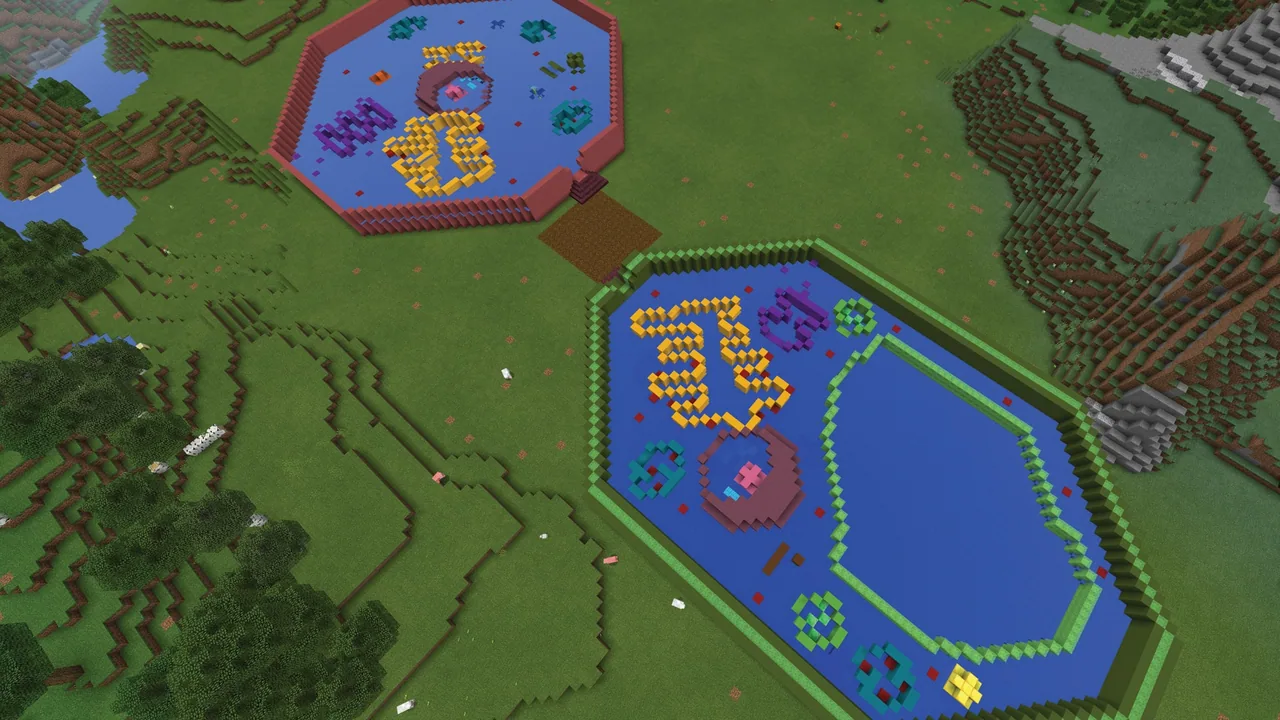
Using a dedicated Minecraft Education world available in English and Spanish, students navigate through oversized cell models in a boat. They photograph and research individual organelles for a portfolio, then collaborate in groups to construct their own accurate cell models for a peer guessing challenge.
Learning objectives
By the end of this lesson students will be able to:
- Identify major cell organelles inside eukaryotic cells.
- Differentiate between plant and animal cells based on their structures.
- Document organelle characteristics using the in-game camera and portfolio.
- Construct a representative cell model in a team to demonstrate understanding.
Blocks and items used in this lesson


Key vocabulary
- Eukaryotic Cell
- A complex cell type that contains a membrane-bound nucleus and specialized organelles.
- Organelle
- A specialized subunit within a cell that performs a specific function.
- Plant Cell
- A eukaryotic cell characterized by structures such as a rigid cell wall and chloroplasts.
- Animal Cell
- A eukaryotic cell that lacks a cell wall and chloroplasts.
Before class
Lesson sequence
Suggested timing: about 90 minutes in total.
- Introduction and Orientation10 min
Introduce the driving question and review the concept of eukaryotic cells. Explain that students will enter a giant cellular environment where they will travel by boat to observe cellular structures up close.
- Cell Exploration and Documentation25 min
Students launch a boat and navigate through the cell models. As they locate each organelle, they must take a photo with the camera and write brief descriptive notes in their portfolio identifying its name and key characteristics.
- Portfolio Review and Group Formation10 min
Review student portfolios to confirm accurate organelle identification and note differences between plant and animal structures. Divide the class into small collaborative building teams.
- Collaborative Cell Construction30 min
Each team selects or is assigned a cell type (plant or animal) to construct from scratch in Minecraft. Teams must build accurate representations of the relevant organelles using blocks that represent their functions and shapes.
- Presentation and Guessing Challenge15 min
Groups present their finished cell models to the class or run a guessing game where visiting classmates observe the organelles to determine whether the build represents a plant or animal cell.
Assessment: success criteria
- Student portfolio includes clear photos of organelles with accurate identifying labels and descriptions.
- Student distinguishes key differences between plant and animal cell structures.
- Group cell build includes proportional and recognizable organelle structures.
- Student communicates organelle functions clearly during the presentation or guessing game.
Differentiation
Provide a printed checklist of target organelles so students know exactly which structures to seek out and photograph.
Challenge advanced students to include specialized or less common organelles and explain their metabolic processes in their portfolios.
Knowledge check
5 questions to check understanding after the lesson. Tap an answer to see if it is right; the score appears at the end.
1What method of transportation do students use to explore the cell world in this lesson?
Answer: C. The lesson specifically directs students to take a boat and explore the giant cells.
2How do students record their observations of each organelle during exploration?
Answer: A. Students take pictures of each organelle and write a few lines about their characteristics in the portfolio.
3What is one primary learning objective of this cell lesson?
Answer: B. The stated learning objectives are identifying cell organelles and differentiating between animal and plant cells.
4What group task do students complete after the teacher reviews their portfolios?
Answer: B. After the teacher checks portfolios, students form groups to build their own cell models.
5How do student groups share their completed cell models at the end of the lesson?
Answer: B. Teams either present their build or host a game where classmates guess which cell type was created.
Resources
- Lesson package (.zip)Everything the author attached to this lesson in one download.
- Minecraft worldIn the .zip you have access to two world: one in English and the other in Spanish.
- Lesson worldOpens the world page in Minecraft Education (sign-in with a school account may be needed).
Frequently Asked Questions
Which languages are supported by this Minecraft world?
The downloadable world is provided in both English and Spanish versions, making it suitable for bilingual or Spanish-language classrooms.
What age group is this cell activity designed for?
This lesson plan is aimed at middle school students between the ages of 11 and 13 studying life science and biology.
Adapted from Eukaryotic cells by Leticia Ahumada on Minecraft Education, last updated May 23, 2025. This classroom version, the timings and the quiz were written by 9Minecraft Education.