- Type
- Lesson plan
- Ages
- Ages 14-18
How do leadership, economic choices, and social rules interact to create a functioning community?
Overview
In this project, students collaborate in small groups to design and establish their own functioning community on an assigned plot of land. Learners must grapple with real-world civic challenges, defining their community name, national symbols, governing structure, social hierarchy, economic exchange, and a legal code of at least ten laws alongside everyday social customs.
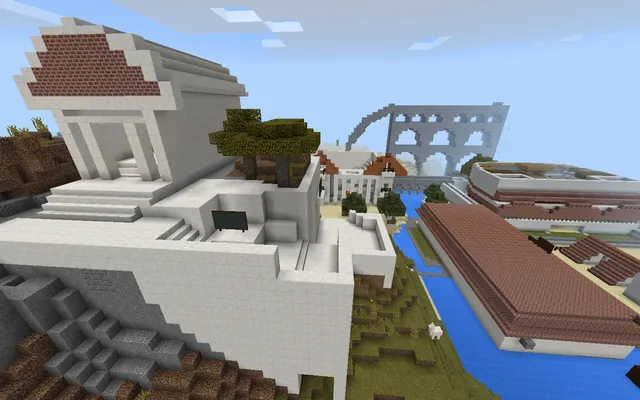
Using Minecraft Education, teams translate their political and social blueprints into physical settlements. Students construct essential public and residential buildings, document their reasoning on signs, record civil history in books, and compile a portfolio of photographs. The project concludes with community visits, presentations, and a peer vote to determine which settlement students would choose to inhabit.
Learning objectives
By the end of this lesson students will be able to:
- Formulate a community identity, governing structure, and legal system balancing laws with social rules.
- Construct essential public and residential infrastructure in Minecraft with explanatory signs detailing purpose and authorship.
- Document civic history and personal reflection using an in-game book, an exported photo portfolio, and individual journals.
- Present community systems to peers and evaluate other societies through guided site visits and voting.
Blocks and items used in this lesson


Key vocabulary
- Welfare
- Public systems designed to provide care, education, and healthcare for community members such as children, the elderly, and the sick.
- Social Rule
- An unwritten or informal behavioral expectation within a community, such as queuing or removing shoes indoors.
- Taxes
- Required payments contributed by community members to fund shared services like defense, schooling, and medical aid.
- Compulsory
- Required by official rule or law, such as mandatory schooling or military service.
Before class
Lesson sequence
- Introduction and Foundation
Introduce the project using the supporting PowerPoint and instructions. Have students watch the four recommended videos exploring nation building, wealth distribution, and democracy individually or in groups.
- Civic and Social Planning
Groups establish group collaboration norms and outline their community fundamentals: settlement name, flag, national anthem, and type of society. Teams draft their legal framework, including at least ten laws, informal social rules, consequences for crimes, ruler authority, taxation, schooling, and healthcare systems.
- Minecraft Construction and Documentation
Teams claim their land in Minecraft and build their community. For every finished building, students must place a sign stating the building type, who constructed it, and why. Students take photos for their exportable portfolio and record their community history in an in-game book.
- Lesson Journaling
At the end of each work session, individual students record new vocabulary and write reflections in their ongoing project journal document.
- Presentations, Tours, and Voting
Groups deliver a brief presentation explaining their community choices across government, law, welfare, and life. Students visit all other worlds to explore peer settlements, submit their exported portfolios, and vote on which community they would choose to live in.
Assessment: success criteria
- Production of a cohesive community plan addressing leadership, welfare, trade or currency, and at least ten laws and social rules.
- Completion of labeled Minecraft structures featuring signs that state the building purpose and builder names.
- Submission of an exported photo portfolio, an in-game history book, and individual student journal entries reflecting consistent effort.
- Delivery of a group presentation explaining community systems followed by participation in peer world tours and voting.
Differentiation
Permit students who do not wish to build in-game to focus on external planning tasks such as drafting the legal code, designing the flag, or writing the community history.
Challenge advanced students to incorporate optional programming and code automation into their infrastructure or design elaborate defensive and public welfare systems.
Knowledge check
5 questions to check understanding after the lesson. Tap an answer to see if it is right; the score appears at the end.
1How many laws does the lesson outline suggest as sufficient for each community?
Answer: C. The source explicitly states that 10 laws are enough for the community.
2What information must students include on signs placed on their Minecraft buildings?
Answer: B. The guidelines instruct students to put up a sign that states what kind of building it is, who built it, and why it was built.
3Which of the following is highlighted in the source as an example of a social rule rather than a formal law?
Answer: D. The lesson lists standing in line, removing shoes inside, and bringing gifts when visiting as examples of social rules.
4What documentation item must students assemble and export to the teacher at the conclusion of the project?
Answer: A. Students are directed to take photos, place them in a portfolio, and export it for the teacher at the end of the project.
5How is the winning community decided at the end of the unit?
Answer: B. After presentations and community visits, students vote on where they would want to live, and the group with the most votes wins.
Resources
- Lesson package (.zip)Everything the author attached to this lesson in one download.
- Powerpoint - introductionThe first powerpoint
- The journalThis is how the journal should look
- InstructionsHere are the instructions
Frequently Asked Questions
Does every student in a group need to play and build inside Minecraft?
No. The lesson notes that many foundational decisions occur outside the game, allowing students to divide tasks so non-builders can focus on governance, writing laws, drafting history, or designing the national anthem and flag.
Is coding required for students to build their settlement?
No. While the source notes that programming and coding are cool additions, they are explicitly not necessary to complete the project.
What should groups do if members cannot agree on rules or community design?
Teams are expected to establish their decision-making process before building starts, determining whether they will resolve conflicts through group voting, assigned topic leaders, or general consensus.
Adapted from A Piece of Land by Rebekka Markström on Minecraft Education, last updated Feb 9, 2018. This classroom version, the timings and the quiz were written by 9Minecraft Education.