- Type
- Lesson plan
- Grade
- Early years (Pre-K to Grade 2)Primary (Grades 3-5)Middle school (Grades 6-8)High school (Grades 9-12)
- Ages
- All ages
- Duration
- 1 hour
- Level
- Beginner
How can we use computer programming and empathy to build an inclusive community that values diversity?
Overview
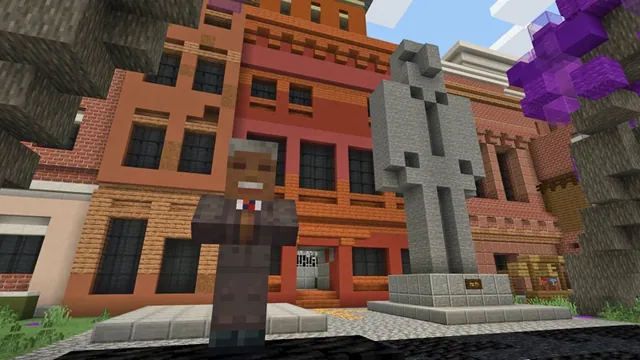
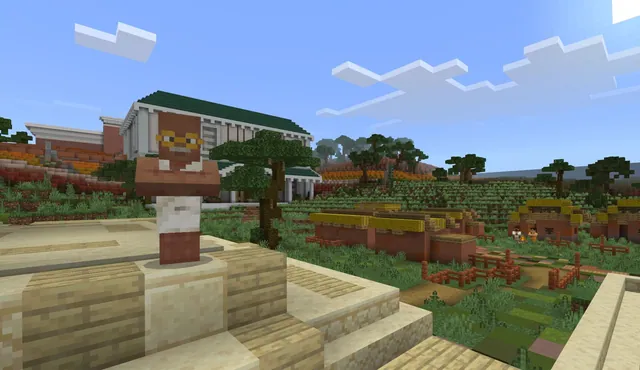
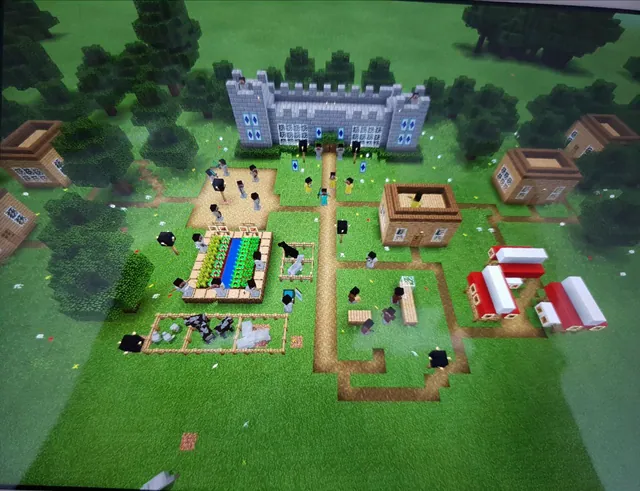
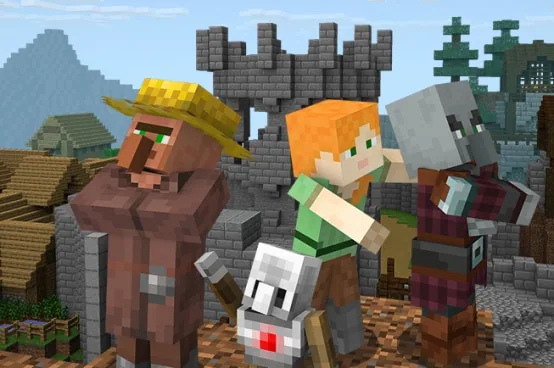
Villagers and Illagers have lived side by side for generations without interacting, separated by suspicion and misunderstanding. In this lesson, students explore themes of empathy, diversity, and social inclusion by acting as a bridge between the two communities. Working through story-driven scenarios, learners recognize how bias can cause harm and discover the mutual benefits of cooperative community life.
Using Minecraft Education, students program their in-game Agent using either MakeCode visual blocks or text-based Python. Across six core challenges, players code the Agent to build infrastructure, tend crops, dispel community fears about misunderstood creatures, and solve neighborly disputes through automation, loops, and sequenced instructions.
Learning objectives
By the end of this lesson students will be able to:
- Decompose complex community problems into precise sequential instructions.
- Create and iterate on coding solutions using loops and sequences in Blocks or Python.
- Explain the harmful effects of bias and the value of inclusion in a community.
- Identify collaborative strategies to bring divided groups together.
Blocks and items used in this lesson


Key vocabulary
- Sequence
- An ordered set of precise instructions executed step by step.
- Iteration
- Repeating or refining a process to improve and complete a solution.
- Loop
- A programming structure that repeats a block of code multiple times.
- Decomposition
- Breaking down a large, complex task into smaller, manageable parts.
- Inclusion
- The practice of ensuring all individuals feel welcomed, respected, and supported.
- Bias
- An unfair assumption or preference that can lead to misunderstanding and harm.
Before class
Lesson sequence
Suggested timing: about 60 minutes in total.
- Introduction & Onboarding15 min
Introduce the story of the separated Villagers and Illagers. Explain that students will use code to build cooperation and empathy between the towns.
Students start inside the castle and choose between MakeCode Blocks or Python. They complete two onboarding tasks: programming the Agent to walk onto a gold block, and receiving a gift to plant a sapling in the center of the castle courtyard.
- Villager Coding Challenges20 min
Students program their Agent to assist the Villagers while building relationships with their Illager neighbors:
- Build a Dock: Code the Agent to build a shoreline dock 4 blocks wide and 6 blocks long so Illagers can teach Villagers how to fish.
- Introduce the Ravager: Lead a gentle ravager to three hesitant Villagers to help them overcome their fear of this misunderstood creature.
- Protect the Beet Farm: Construct a protective fence around the beet field to safeguard the crops without making wrongful accusations.
- Illager Coding Challenges20 min
Students guide their Agent through coding challenges that support the Illager community:
- Prepare the Field: Program the Agent to till a block of farmland so the Villagers can teach the Illagers agricultural skills.
- Help the Kids Get Their Ball: Move the Agent up an exterior wall and press elevator buttons to return a lost toy from a neighbor's roof.
- Build a Motorized Railway: Lay powered rails up the hillside so Villagers can easily transport trade goods to the Illager fair.
- Reflection & Discussion5 min
Gather the class to discuss how assumptions and bias affected the two villages. Prompt students to reflect on how diversity benefits a neighborhood and discuss how the CALM framework (Challenge, Adjust, Learn, Mix it up) can guide everyday inclusive behavior.
Assessment: success criteria
- The Agent successfully executes movement, building, and interaction tasks across the challenges.
- Code demonstrates appropriate use of sequences, decomposition, and loops.
- Students can explain how cooperation resolved misunderstandings between the two communities.
- Students actively participate in closing reflection questions about inclusion and diversity.
Differentiation
Encourage beginners to use MakeCode Blocks and trace the Agent's path physically on paper before coding movements.
Have advanced students complete all challenges using Python syntax and refine their code using minimal loop structures.
Knowledge check
5 questions to check understanding after the lesson. Tap an answer to see if it is right; the score appears at the end.
1Which two coding language options are available to students in this lesson?
Answer: B. The source specifies that the lesson is offered in both MakeCode Blocks and Python.
2What specific dimensions must students build for the shoreline fishing dock?
Answer: C. Villager Challenge 1 states that the dock should be 4 blocks wide and 6 blocks long.
3Why had the Villagers stopped attending the Illagers' fair?
Answer: B. Villagers stopped attending because carrying their trade goods up the hill was too difficult.
4What task must students complete in the second onboarding challenge at the castle?
Answer: A. Onboarding Challenge 2 requires players to receive a gift from the Agent and plant a sapling in the center of the castle.
5What does the CALM reflection framework stand for?
Answer: D. The lesson conclusion defines CALM as Challenge, Adjust, Learn, Mix it up.
Resources
Part of the Hour of Code curriculum
This is lesson 6 of 8 in Hour of Code.
- Hour of AI: Field Agent
- Hour of AI: The First Night
- Hour of Code: AI for Good
- Hour of Code: Escape Estate
- Hour of Code: Generation AI
- Hour of Code: Inclusion
- Hour of Code: The Show Must Go On
- Hour of Code: TimeCraft
Frequently Asked Questions
Which coding option is best suited for beginner students?
Students who are new to programming should select MakeCode Blocks at the castle onboarding point, while students ready for text-based syntax can select Python.
How can teachers support students who get stuck on a coding puzzle?
Teachers can consult the downloadable answer key and prompt students to break down the problem into smaller, sequential Agent steps such as turning, moving, and placing blocks.
Can this entire lesson be completed within a single class period?
Yes, the lesson is designed to fit a standard one-hour block, allocating 30 to 40 minutes for the coding tasks and five minutes for closing discussion.
Adapted from Hour of Code: Inclusion by Minecraft Education on Minecraft Education, last updated Jun 19, 2024. This classroom version, the timings and the quiz were written by 9Minecraft Education.