- Type
- Lesson plan
- Ages
- Ages 8-18
- Duration
- about 2.4 hours (suggested)
- Includes
- Quiz: 5 questionsLesson files
How can non-violent resistance and collective personal beliefs bring about independence and systemic change?
Overview
This lesson guides students through the history and philosophies behind India's non-violent independence movement. Learners investigate the conditions created by colonial rule, explore the meaning of sovereignty, and analyze how Mahatma Gandhi's philosophy of satyagraha mobilized millions to demand national change through peaceful resistance.
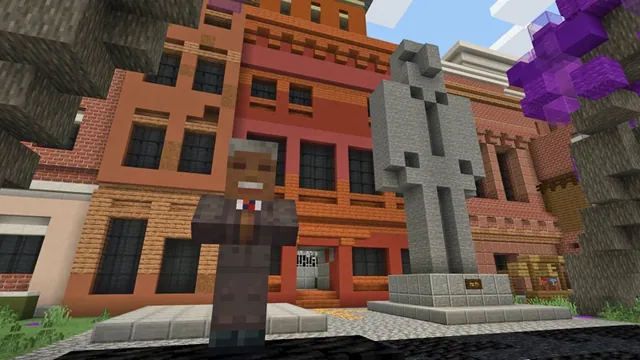
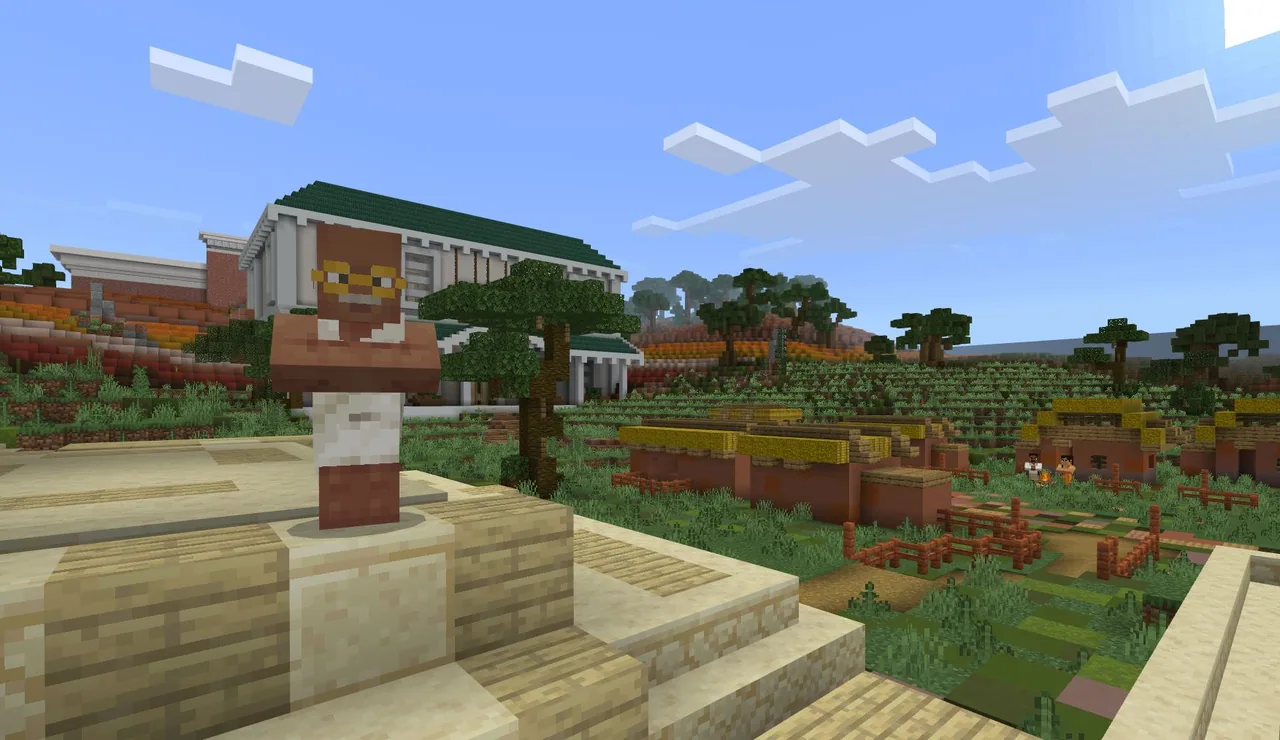
Using the Good Trouble world in Minecraft Education, students travel to the India setting to meet non-player characters representing Indian National Congress Leader Mohandas Gandhi and Civil Rights leader Congressman John Lewis. After observing local terrains and architectural styles, students complete an in-game build prompt based on Gandhi's teachings before composing reflective responses.
Learning objectives
By the end of this lesson students will be able to:
- Explain how colonialism influenced India's push for sovereignty and self-sufficiency.
- Define and apply core movement concepts including satyagraha, pacifism, and nationalism.
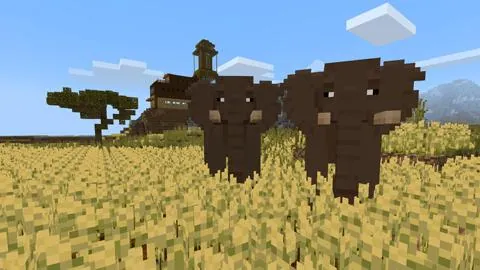
- Investigate architectural styles and terrains in the India region of the Good Trouble world.
- Construct an in-game response to an activity prompt delivered by the Mohandas Gandhi NPC.
- Evaluate the philosophy of non-violence in a written or recorded reflection.
Blocks and items used in this lesson


Key vocabulary
- Sovereignty
- The supreme power and authority of an independent nation to govern itself.
- Satyagraha
- A Sanskrit term meaning non-violent resistance or devotion to truth.
- Colonialism
- The policy or practice of acquiring full or partial political control over another country to exploit it economically.
- Nationalism
- Identification with and strong support for the interests, culture, and independence of one's own nation.
- Pacifism
- The principled opposition to war, militarism, and violence as a means of settling disputes.
- Self-sufficiency
- The ability to supply one's own needs without relying on external assistance or foreign goods.
Before class
Lesson sequence
Suggested timing: about 145 minutes in total.
- Introductory Discussion5 min
Facilitate a short discussion contrasting colonialism with independence. Have students set up diagrams outlining the characteristics of each, asking how colonialism affects nations, its historical impact on India, and how social justice intersects with the fight for independence.
- Vocabulary and Fishbone Analysis45 min
Introduce historical and modern definitions for key concepts like sovereignty, satyagraha, and colonialism. Ask students to record these on fishbone diagrams and discuss how colonialism links to exploration and capitalism, examining who benefits and who does not.
- Independent Research and Artifact Creation45 min
Students work individually or in small teams through the hyperdoc lesson. They create a product demonstrating their understanding, such as a slide presentation, a visual narrative, an advocate's non-violent journal, or a period-accurate public artifact tied to a specific location.
- Minecraft Good Trouble Exploration30 min
Students enter the Good Trouble world and travel to India, where they encounter NPCs of Congressman John Lewis and Mohandas Gandhi. After noting the terrain and regional architectural features, students head to the designated activity spot to complete a build prompt based on Gandhi's teachings.
- Writing Prompt and Reflection20 min
Students write or record a brief response analyzing Gandhi's famous statement, "An eye for an eye ends up making the whole world blind." Conclude with a short written or Flipgrid reflection assessing the effectiveness of non-violent methods in pursuing social justice.
Assessment: success criteria
- Student accurately defines and connects key terms like colonialism, sovereignty, and satyagraha on their diagram.
- Student produces a finished learning artifact such as a slide deck, journal entry, or historical artifact.
- Student successfully completes the build challenge assigned by the Gandhi NPC in the Good Trouble world.
- Student articulates an insightful analysis of non-violent social justice in their quote reflection.
Differentiation
Provide partially completed fishbone diagrams and structured sentence frames for the quote analysis.
Have students design an artifact representing their interpretation of satyagraha or film a 60-second video on what independence means to them.
Knowledge check
5 questions to check understanding after the lesson. Tap an answer to see if it is right; the score appears at the end.
1Which Sanskrit term describes the non-violent resistance philosophy championed by Mahatma Gandhi?
Answer: A. Satyagraha is the Sanskrit term explicitly highlighted in the lesson as the philosophy of non-violent resistance.
2Which Minecraft world do students enter to access the India setting and lesson NPCs?
Answer: B. The lesson directs students to load the Good Trouble world to find the India area.
3Which graphic organizer format does the teacher provide to help connect key terms to Indian independence?
Answer: D. The preparation and whole-class activity sections specify using a fishbone diagram anchor chart.
4Which two non-player characters (NPCs) greet students in the India area of the world?
Answer: B. The source identifies Congressman John Lewis and Indian National Congress Leader Mohandas Gandhi as the NPCs present in the India area.
5What quote from Gandhi is used for the student writing prompt?
Answer: C. The writing prompt activity specifically assigns students to analyze Gandhi's statement: 'An eye for an eye ends up making the whole world blind.'
Resources
- Revolutionary Movement for India IndependenceThis is the full lesson plan with additional resources.
Frequently Asked Questions
Where can teachers find the Minecraft world used in this lesson?
This activity takes place within the Good Trouble world, which is available directly within the Minecraft Education lesson library.
Can students complete the final reflection without using video tools?
Yes. Students can submit a short written response to the quote and non-violence prompts if Flipgrid or video recording is unavailable.
Adapted from India's Independence Movement by Felisa Ford, Ken Shelton, Natasha Rachell on Minecraft Education, last updated Jul 14, 2025. This classroom version, the timings and the quiz were written by 9Minecraft Education.