- Type
- Lesson plan
- Subject
- History & Social Studies
- Ages
- Ages 14-18
- Duration
- about 60 min (suggested)
Was Morse code an effective means of communication during the World War I era?
Overview
During World War I, rapid and reliable communication across vast distances was a decisive factor on the battlefield. Morse code allowed military units to transmit critical intelligence, orders, and distress signals using simple electrical pulses, acoustic tones, or visual light flashes.
In this lesson, students visit historical figures in Minecraft Education to learn the origin of Morse code, decipher an emergency message embedded in the environment, and engineer their own working telegraph transmitters to broadcast authentic historical dispatches.
Learning objectives
By the end of this lesson students will be able to:
- Explain how Morse code translates letters into auditory or visual patterns.
- Decipher an unknown Morse code message displayed in the Minecraft world.
- Design and build a working telegraph mechanism in Minecraft using redstone, lights, or sounds.
- Research and transmit an authentic wartime message for classmates to decode.
Blocks and items used in this lesson


Key vocabulary
- Morse Code
- A system of communication invented in the 1830s that represents letters and numbers with patterns of short and long signals.
- Telegraph
- An electrical apparatus used to transmit messages along wires over long distances.
- SOS
- An internationally recognized distress signal transmitted via Morse code as three dots, three dashes, and three dots.
Before class
Lesson sequence
Suggested timing: about 60 minutes in total.
- Rhythm Warm-Up and Hook10 min
Begin by tapping an intentional rhythmic pattern on your desk and asking students to mimic it. Increase the complexity and repeat the exercise. Explain that entire languages can be translated into sequences of taps, flashes, or pulses, and introduce Morse code as a primary communication method of the World War I era.
- In-Game Navigation and Message Decoding15 min
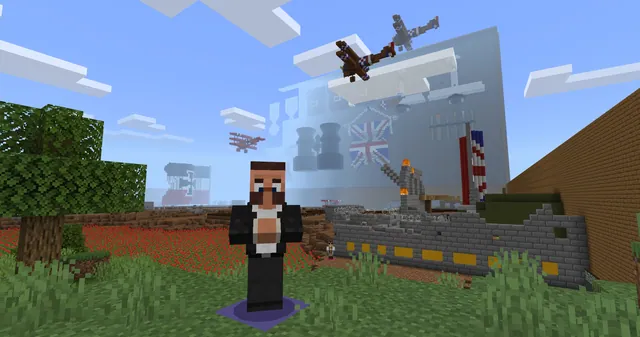
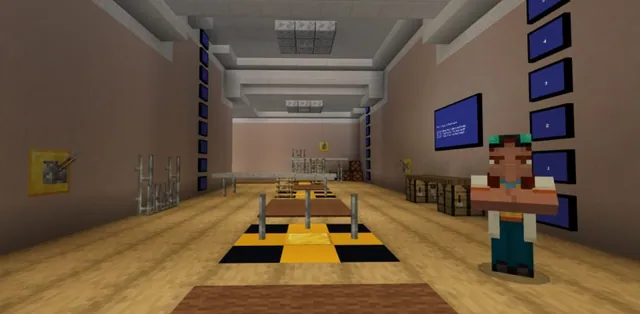
Have students load the World War I world, fly to NPC President Woodrow Wilson, and select the Morse code dialogue button. Upon meeting NPC Samuel Morse, students use the decoding chart to translate the message displayed in yellow blocks on the nearby wall. Reconvene to verify the message reads SOS and discuss why decoding under pressure presents challenges.
- Telegraph Construction Challenge25 min
Read the project sign located at the end of the wall. Instruct students, working individually or in pairs, to build a working telegraph device in the provided space or in a Blocks of Grass template. The machine must communicate a message using sound, lights, or redstone mechanisms. Encourage students to research authentic wartime dispatches to encode into their builds.
- Testing, Deciphering, and Wrap-Up10 min
Invite students who finish their telegraphs to visit a peer's machine, observe the output signals, and attempt to transcribe the transmitted dispatch. Instruct learners to speak with NPC Samuel Morse and click the Lesson Selection button to return to NPC Woodrow Wilson before logging off.
Assessment: success criteria
- Student successfully decodes the in-game wall message as SOS using the provided reference chart.
- Student constructs a functional telegraph apparatus in Minecraft using light, sound, or redstone signals.
- Student programs or demonstrates an authentic wartime dispatch on their machine for a classmate to decipher.
Differentiation
Allow students to work in pairs, matching learners who are new to Minecraft with peers fluent in redstone circuitry.
Have students research peacetime versus wartime uses of Morse code, or build a physical telegraph device using a Hacking STEM hands-on activity.
Knowledge check
5 questions to check understanding after the lesson. Tap an answer to see if it is right; the score appears at the end.
1In which decade was Morse code originally developed?
Answer: B. According to NPC Samuel Morse in the lesson, Morse code was invented in the 1830s.
2Which NPC in the Minecraft world transports students directly to the Morse code activity?
Answer: C. Students fly to NPC President Woodrow Wilson and click the morse code button to reach the activity.
3What hidden message is spelled out in yellow blocks on the wall?
Answer: A. The source identifies the yellow block message on the wall as the distress signal SOS.
4What machine is traditionally used to send written Morse code over long distances?
Answer: C. The lesson notes that Morse code is written out using a machine called a telegraph.
5What are students instructed to encode into their custom telegraph builds?
Answer: D. The activity encourages students to research and program actual wartime messages for classmates to decipher.
Resources
- Lesson package (.zip)Everything the author attached to this lesson in one download.
- World War I Toybox AssessmentResource
- WWI Flight impact Notes PDFResource
- WWI Flight impact Notes .DOCResource
- Lesson worldOpens the world page in Minecraft Education (sign-in with a school account may be needed).
Part of the World War I curriculum
This is lesson 2 of 5 in World War I.
- World War I Lesson 1 of 5
- World War I Lesson 2 of 5
- World War I Lesson 3 of 5
- World War I Lesson 4 of 5
- World War I Lesson 5 of 5
Frequently Asked Questions
Where should students construct their telegraph machines if space runs out?
Students can construct their machines directly in the designated space in front of the challenge sign, or they may open a fresh Blocks of Grass template world to complete their build.
How can students return to the main hub once the lesson is finished?
Students can interact with NPC Samuel Morse and select the Lesson Selection button to teleport back to NPC President Woodrow Wilson.
Adapted from World War I Lesson 2 of 5 by Phygital Labs on Minecraft Education, last updated Jul 16, 2025. This classroom version, the timings and the quiz were written by 9Minecraft Education.