- Type
- Lesson plan
- Subject
- MathArt, Music & Design
- Ages
- Ages 11-13
How can decomposing a rectangular garden into trapezoids help us determine and verify total area?
Overview
This lesson connects geometric area calculations with spatial design. Based on an extension of a math textbook problem, students explore how composite shapes can be broken down into simpler polygons. By translating a two-dimensional textbook illustration into a garden layout, learners investigate the relationship between individual trapezoid plots and the total area of a rectangular plot.
Using Minecraft: Education Edition, students build within a coordinate environment that relies on whole blocks. Because fractional or decimal units cannot be placed directly, students scale measurements to whole numbers to construct their garden plots. Students document their work with the in-game camera and portfolio, exporting their documentation to OneNote to compute and compare area measurements across different calculation methods.
Learning objectives
By the end of this lesson students will be able to:
- Build a rectangular garden frame subdivided into three distinct trapezoidal sections.
- Convert decimal measurements from a textbook diagram into whole-block Minecraft dimensions.
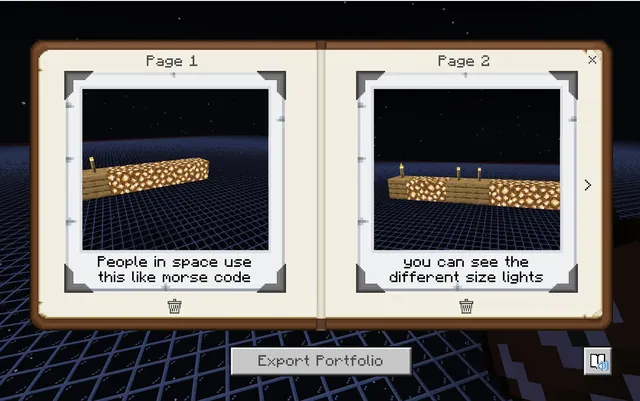
- Document and label dimensions in-game using the camera and portfolio.
- Calculate the total garden area using two separate mathematical methods in OneNote.
Blocks and items used in this lesson


Key vocabulary
- Trapezoid
- A four-sided polygon that has at least one pair of parallel sides.
- Composite polygon
- A geometric figure formed by joining two or more simpler shapes together.
- Area
- The total two-dimensional space contained within the borders of a flat figure.
- Decomposition
- Breaking a complex shape down into smaller, familiar shapes to make calculations easier.
Before class
Lesson sequence
- World Setup and Dimension Conversion
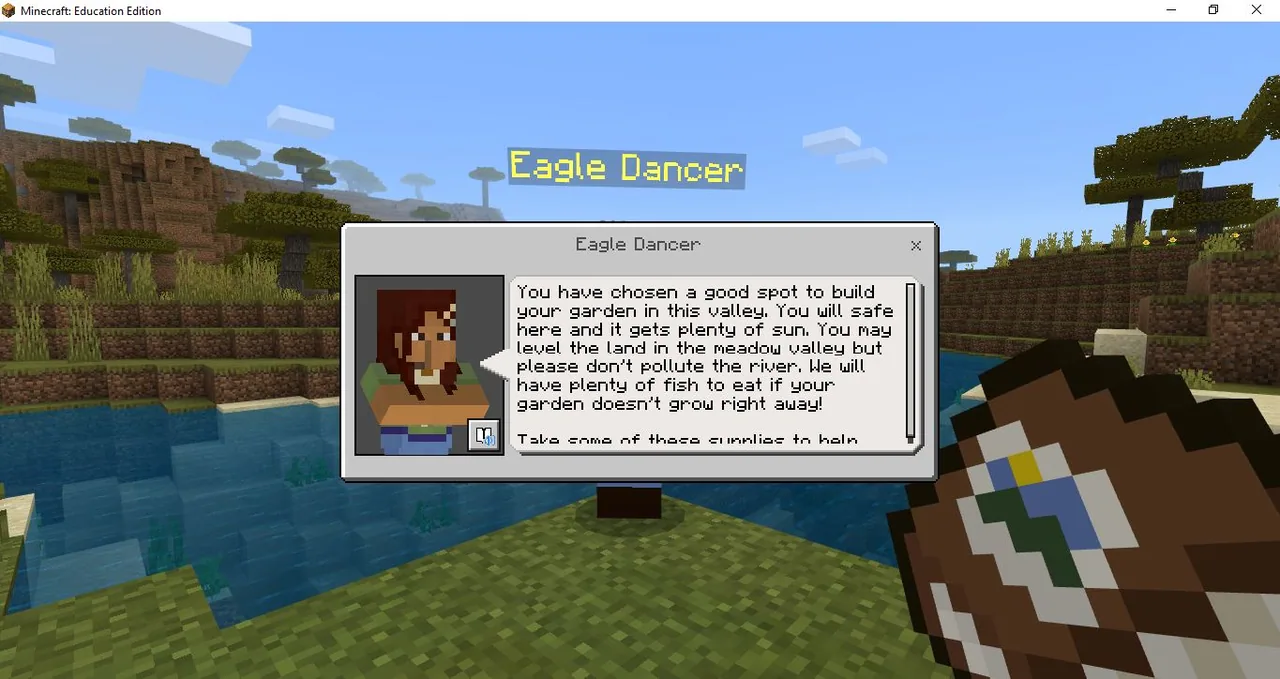
Introduce the textbook garden illustration to the class. Explain that Minecraft requires whole blocks, so students will convert decimal numbers into double-digit integers (such as converting 1.4 m to 14 blocks). Have students open the Garden Challenge world file, or guide them to start a new world and locate a large meadow near water if the file is unavailable.
- Garden Construction and Subdivision
Students construct the outer rectangular boundary of their garden. Inside the rectangle, they divide the space into three trapezoids of varying sizes, ensuring each section has a distinct border separating the interior plots.
- Planting and Measurement Documentation
Learners plant at least three different crops across their trapezoid sections to visually separate each area. Once planting is finished, students measure and label the dimensions of each trapezoid in the world and use the camera and portfolio tools to take captioned photographs.
- Export and Mathematical Analysis
Students export their portfolio into a OneNote page. In OneNote, they calculate the area of each trapezoid, find the sum for the total garden, and then calculate the total area of the entire garden using an alternative method. To conclude, students write a brief explanation comparing both final calculations.
Assessment: success criteria
- The garden forms a rectangle composed of three clearly divided trapezoids with visible borders.
- At least three varieties of crops are planted across the garden sections.
- Trapezoid dimensions are correctly measured, labeled, and photographed in-game.
- Calculations in OneNote demonstrate total area using two methods alongside an explanation comparing the outcomes.
Differentiation
Provide an explicit conversion chart translating the textbook's decimal dimensions directly into whole block counts before building begins.
Ask learners to design an additional garden section using other composite polygons mentioned in the curriculum expectation, such as rhombuses or kites.
Knowledge check
5 questions to check understanding after the lesson. Tap an answer to see if it is right; the score appears at the end.
1How do students convert textbook decimal numbers like 1.4 m into Minecraft measurements?
Answer: B. The lesson instructions specify ignoring decimals and turning values like 1.4 m into double-digit numbers such as 14 m.
2What larger shape should the three trapezoid garden plots form together?
Answer: C. The student instructions state that the three trapezoids must together form a rectangle.
3What planting requirement must students follow inside their garden plots?
Answer: B. The activity steps require students to plant at least three different kinds of crops inside each trapezoid section.
4Where do students export their captioned garden photos for calculations and reflection?
Answer: A. Students are directed to export their camera portfolio directly into a page in OneNote.
5What mathematical comparison must students complete after calculating the garden's area?
Answer: C. The instructions ask students to calculate the area of the whole garden in another way and explain whether the two areas are the same or different.
Resources
- Lesson package (.zip)Everything the author attached to this lesson in one download.
- Textbook garden questionThis is the textbook question that is the basis of this activity.
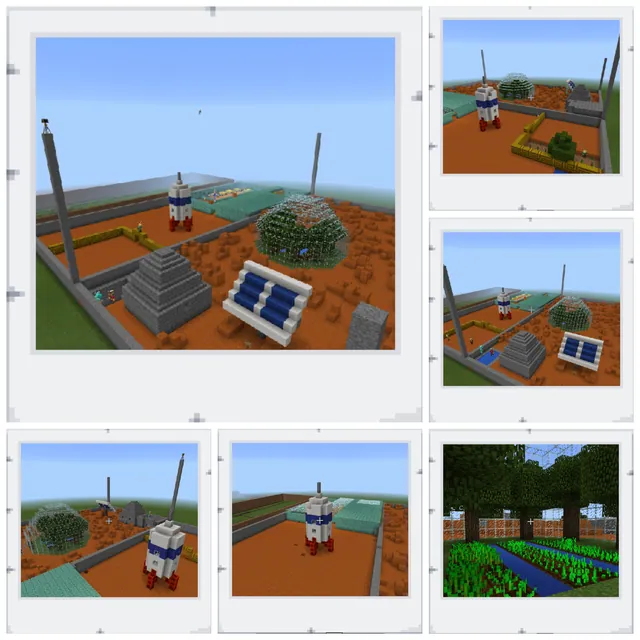
- Student ExampleA portfolio photo taken from one student's submitted work.
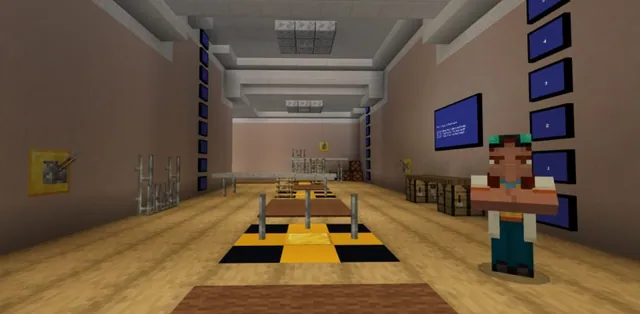
- Trapezoid Garden Challenge World FileA basic world with an introductory NPC and a suggested space for building their garden.
Frequently Asked Questions
What should students do if the downloadable world file will not launch?
Students can open a standard new world and locate a flat, open meadow near water to construct their garden plots according to the textbook dimensions.
Why is the area calculated in two different ways?
Calculating the area of individual trapezoids and adding them together, then calculating the outer rectangle directly, helps students verify their calculations and explore decomposition principles.
What tools are used to document the garden build in Minecraft?
Learners use the in-game camera and portfolio to take pictures, write descriptive captions of their dimensions, and export the file into OneNote.
Adapted from Trapezoid Garden Challenge by Jan Lewis on Minecraft Education, last updated Oct 27, 2026. This classroom version, the timings and the quiz were written by 9Minecraft Education.