- Type
- Lesson plan
- Subject
- MathHistory & Social Studies
- Ages
- Ages 14-18
- Includes
- Quiz: 5 questions
How did environmental geography, available technology, and religious beliefs shape the scale and construction of the Great Pyramid of Giza?
Overview
When examining ancient monuments like the Great Pyramid of Giza, students often struggle to grasp the sheer physical footprint and human labor involved. This lesson challenges high school learners to examine the historical, geographical, and mathematical realities faced by ancient Egyptian planners by simulating the construction process through collaborative engineering.
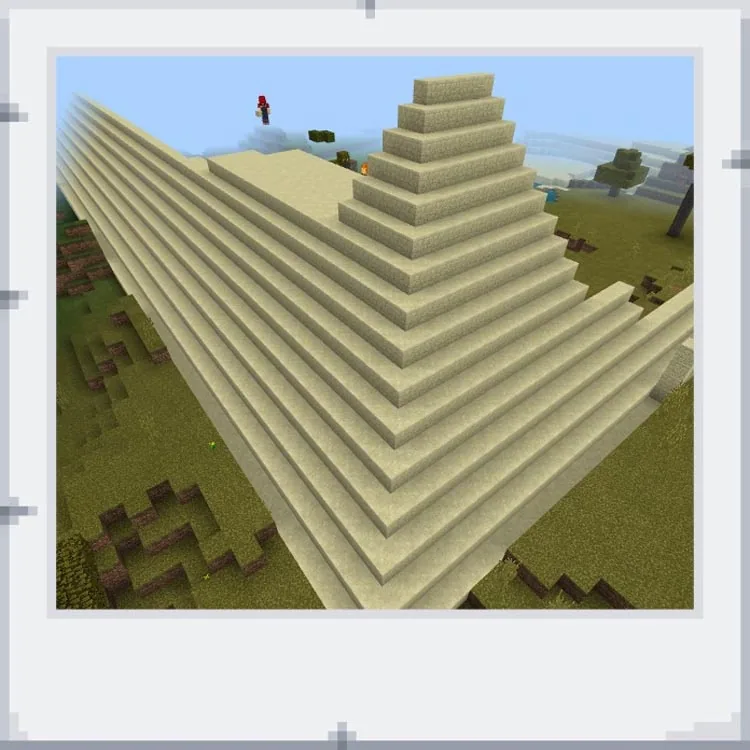
Working together in a shared desert world, the entire class plans a massive structure with a 240-meter square base. Students carefully evaluate the terrain to avoid disrupting natural waterways, construct a solid pyramid, mine out authentic internal burial chambers, and calculate surface areas and volumes while documenting their workflow in a project journal.
Learning objectives
By the end of this lesson students will be able to:
- Evaluate geographic terrain to select an appropriate construction site without disrupting natural river systems.
- Calculate the base area, surface area, and total volume of the pyramid using real-world and in-game dimensions.
- Construct a large-scale solid pyramid collaboratively and excavate historically researched internal chambers.
- Document the logistics of ancient Egyptian labor, material transport, and construction methods in a written report.
Blocks and items used in this lesson


Key vocabulary
- Terraforming
- Altering the natural landscape or terrain to prepare an area for construction.
- Surface Area
- The total area that the exterior faces of a three-dimensional shape occupy.
- Volume
- The amount of three-dimensional space enclosed by a closed structure.
- Internal Chambers
- Rooms and passageways constructed inside the pyramid, such as burial vaults and escape shafts.
Before class
Lesson sequence
- Site Survey and Geographic Planning
Introduce the project scope and have the class survey the desert environment. Students assess the surrounding landscape, identifying natural obstacles such as rivers and elevated terrain. Emphasize that in ancient Egypt, builders worked with the landscape rather than diverting vital waterways like the Nile.
- Mathematical Layout
Students mark out the perimeter of the 240-meter square foundation. Before placing blocks, learners calculate the base area and estimate the total volume and block count needed. Have students open Google Earth to measure the 240-meter footprint over their own school grounds to comprehend the monument's true scale.
- Collaborative Pyramid Construction
The class works together over multiple sessions to construct the solid pyramid layer by layer. Students choose appropriate building materials, document their material justification in their journals, and capture photographs at key stages of the build.
- Excavation and Interior Detailing
Once the solid form is established, research teams consult historical diagrams of the Great Pyramid's known internal chambers. Students tunnel into the structure to carve out authentic passageways, galleries, and burial chambers, decorating them with period-appropriate artifacts.
- Documentation and Reflection
Each student compiles an illustrated report using a Book and Quill. Students detail the roles they performed, describe ancient logistical hurdles (such as quarrying, feeding workers, and transporting stone), and compare the height of the Minecraft build against the real monument.
Assessment: success criteria
- The pyramid base accurately reflects the assigned 240-meter square footprint.
- The chosen site respects environmental features, avoiding unrealistic alterations to rivers.
- Mathematical calculations for volume, surface area, and block counts are mathematically sound and clearly explained.
- The final portfolio and written book report detail historical construction logistics, student roles, and excavated interior chambers.
Differentiation
Provide a pre-marked or partially assembled foundation grid so students can focus on vertical construction and chamber excavation.
Have advanced learners calculate the human workforce and caloric requirements needed to transport blocks from distant quarries to the site.
Knowledge check
5 questions to check understanding after the lesson. Tap an answer to see if it is right; the score appears at the end.
1What is the approximate base measurement of the Great Pyramid model planned in this lesson?
Answer: B. The lesson specifies that the base of the Great Pyramid is approximately 240 meters square.
2Why does the lesson recommend building the initial pyramid as a solid structure?
Answer: A. A solid pyramid is built first so students can excavate realistic inner chambers and corridors inside it.
3What geographical guideline must students follow when choosing where to place the monument?
Answer: C. The teacher notes emphasize that in real Egypt, builders moved the site rather than trying to divert the Nile.
4Which real-world digital tool does the lesson suggest to help students grasp the pyramid's physical size?
Answer: B. The lesson directs students to use Google Earth's ruler or geolocator to overlay the pyramid footprint on their school.
5How do students submit their final research, progress photos, and reflections to the teacher?
Answer: C. The performance expectations state that students should email their completed portfolio and book to the teacher.
Frequently Asked Questions
How long should I plan for this build project?
Because constructing a 240-meter solid pyramid requires thousands of placed blocks, plan for an entire class working collaboratively across several class periods or up to a full week of sessions.
Can I shorten the building phase if class time is limited?
Yes. The teacher notes recommend pre-building a portion of the foundation base beforehand, as establishing the massive footprint takes up the largest amount of build time.
What seed is recommended for this project?
The lesson suggests using desert seed -439747027 to provide an authentic arid environment with minimal immediate terrain conflicts.
Adapted from The Great Pyramid of Giza by Warren Parkes on Minecraft Education, last updated Jul 10, 2018. This classroom version, the timings and the quiz were written by 9Minecraft Education.