- Type
- Lesson plan
- Ages
- Ages 11-18
- Duration
- about 2.2 hours (suggested)
How can we combine inputs, processing, and outputs using Redstone to automate a functional machine?
Overview
Machines rely on inputs, processing, and outputs to automate tasks in both physical and digital environments. In this lesson, students analyze these fundamental technological concepts and observe how interconnected components activate mechanisms and move objects to accomplish work.
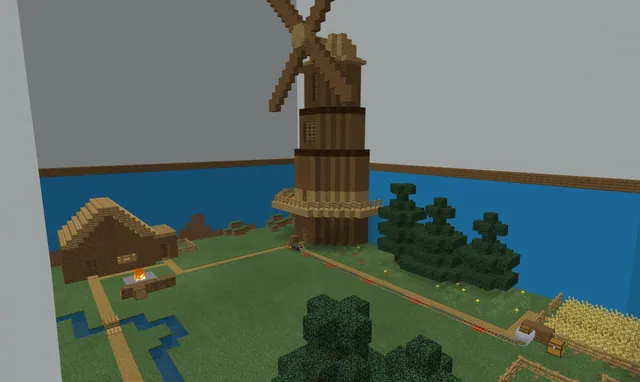
Learners travel through the Redstone Road world to investigate various demonstration stations showing Redstone mechanics in action. Afterward, they apply their observations by engineering a custom, functional Redstone machine that fulfills an automated purpose and explaining how their system operates.
Learning objectives
By the end of this lesson students will be able to:
- Identify real-world analogue and digital examples of inputs, processing, and outputs.
- Investigate how Redstone activates, transmits energy, and moves components within the Redstone Road world.
- Design and assemble a functioning automated machine in Minecraft to fulfill a clear purpose.
- Explain in writing or speech how the constructed Redstone machine processes inputs to generate outputs.
Blocks and items used in this lesson


Key vocabulary
- Input
- A signal, action, or data fed into a system to trigger a response, such as a switch or pressure plate.
- Processing
- The actions or logic pathways a system uses to handle incoming signals before generating a result.
- Output
- The final action, movement, or result produced by a system, such as a moving piston or powered light.
- Redstone
- A Minecraft material that conducts power and connects components to form automated circuits and machines.
- Automation
- The technique of setting up a system to operate automatically without constant manual control.
Before class
Lesson sequence
Suggested timing: about 130 minutes in total.
- Introduction to Systems25 min
Lead an introductory classroom discussion centered on how machines work. Guide students to define inputs, processing, and outputs, and prompt them to identify examples from both analogue and digital real-world systems.
- Investigating Redstone Road45 min
Have students load the Redstone Road World and travel along the path to examine the demonstration stations. Direct learners to test each setup, observing how Redstone conducts power, activates mechanisms, and moves blocks.
- Machine Engineering Challenge40 min
Challenge learners to apply what they discovered along the road to invent their own working Redstone machine. Students must construct a functional automated build that accomplishes an objective of their choosing.
- Explanation and Reflection20 min
Ask students to present or document their creations by explaining the purpose of their machine. Learners outline how their build receives inputs, processes signals through Redstone, and produces a functional output.
Assessment: success criteria
- Student accurately defines and identifies real-world examples of inputs, processing, and outputs.
- Student actively explores and identifies key Redstone mechanisms along the Redstone Road.
- Student constructs an original, functioning machine powered by Redstone.
- Student clearly explains the specific purpose and operational stages of their machine.
Differentiation
Pair students who need help with a partner and encourage them to recreate a basic circuit demonstrated along the road before attempting a new build.
Prompt fast finishers to integrate multiple sequential inputs or automate a multi-step task within a complex structure.
Knowledge check
5 questions to check understanding after the lesson. Tap an answer to see if it is right; the score appears at the end.
1What are the three core stages of a machine system discussed in this lesson?
Answer: A. The lesson introduces machines through the framework of inputs, processing, and outputs.
2What is the primary purpose of exploring the Redstone Road world?
Answer: B. Students travel along the road to investigate how Redstone operates and powers mechanisms.
3In a mechanical system, which item represents an input?
Answer: C. Flipping a lever is an input action that triggers a signal in a system.
4What are students challenged to build in the final stage of the lesson?
Answer: D. The challenge requires learners to build their own functioning Redstone machine with a defined purpose.
5How does Redstone enhance structures in Minecraft according to the lesson?
Answer: A. The guiding ideas explain that Redstone gives builds the power to move, activate, and become complex structures.
Resources
- Lesson package (.zip)Everything the author attached to this lesson in one download.
- Challenge Redstone RoadChallenge PDF document that provides the granularity for the steps of the Challenge
- Redstone Road WorldA Minecraft world to use as a catalyst for the Challenge
Frequently Asked Questions
Do students need prior Redstone experience before starting this lesson?
No prior experience is necessary. The demonstration stations along the Redstone Road introduce learners to fundamental mechanics before they begin building their own machine.
What materials do I need to prepare before class?
You will need Minecraft: Education Edition installed on student devices, the Redstone Road World file, and the Challenge Redstone Road supporting document for assessment criteria.
How long should I plan for this lesson to take?
The source indicates the three-step challenge takes approximately two or more hours, making it ideal for a double period or a multi-day module.
Adapted from Redstone Road by Hwb MLCs on Minecraft Education, last updated Jul 14, 2022. This classroom version, the timings and the quiz were written by 9Minecraft Education.