- Type
- Lesson plan
- Topics
- Art and DesignTechnology
- Grade
- Primary (Grades 3-5)
- Ages
- Ages 8-10
- Skills
- Project Based Learning
- Includes
- Quiz: 5 questions
How can we design and construct a future school environment that improves learning for students and staff?
Overview
School environments play a vital role in how students learn, socialize, and interact every day. In this lesson, learners reflect on their current campus, examine indoor and outdoor spaces, and gather input from teachers and peers to identify what works well and what could be reimagined to support future learning.
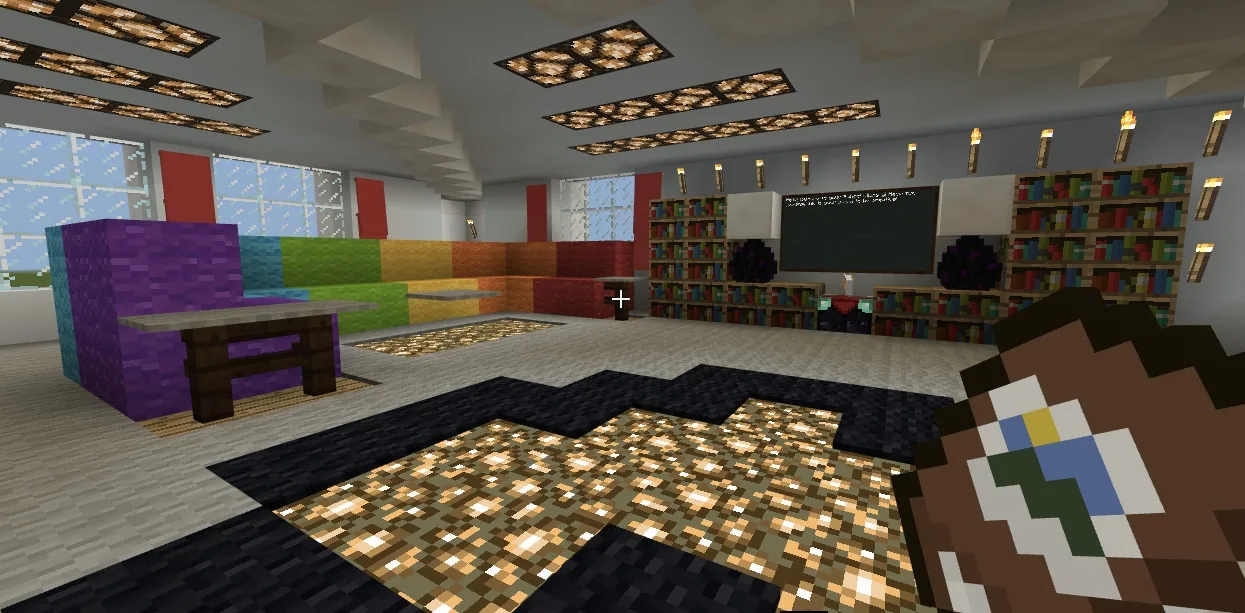
Using Minecraft, students collaborate to design and build these updated spaces based on their research. Working through an iterative Think-Make-Improve cycle, learners document their building decisions with screenshots and journal entries, justifying how their design choices enhance the learning community.
Learning objectives
By the end of this lesson students will be able to:
- Investigate the existing school environment to identify strengths and areas for improvement.
- Gather community input using a digital survey to determine student and staff needs.
- Collaborate with peers to construct a future learning space within Minecraft.
- Document and justify architectural design choices through screenshots and reflective journal entries.
Blocks and items used in this lesson


Key vocabulary
- Learning space
- A physical area designed to support teaching, study, and student interaction.
- Aerial perspective
- A bird's-eye view looking down on a location from above, such as on a satellite map.
- Think-Make-Improve
- A design cycle where creators plan an idea, build it, and refine it based on feedback.
- Self-regulation
- The ability to manage one's own time, focus, and actions during independent and group work.
Before class
Lesson sequence
- Campus Audit and Aerial Review
Students inspect the current school layout, noting hard and soft surfaces, buildings, and outdoor play areas. They use Google Maps to analyze boundary dimensions from an aerial perspective and record observations with photos and reflective notes.
- Research and Community Survey
Working independently, in pairs, or in groups, students research modern learning spaces online. They build a Google Form survey to gather perspectives from school staff and peers, then select a specific room or zone to redesign.
- Minecraft Construction
Students enter Minecraft to construct their chosen learning space based on their research and survey data. They follow a Think-Make-Improve cycle, negotiating tasks respectfully and agreeing not to modify teammates' work without permission.
- Reflection and Documentation
Learners take screenshots of their build progress and write reflective journal entries explaining how their design supports learning. The class concludes each session with teacher-moderated peer feedback.
Assessment: success criteria
- Student documents the current school layout using aerial observations and reflective notes.
- Student collects and analyzes survey responses from staff and peers to inform their build.
- Student works respectfully within the shared Minecraft space following agreed-upon team rules.
- Student justifies design decisions in a project journal supported by progress screenshots.
Differentiation
Assign students a single specific room to design and provide a pre-made template for their survey and journal entries.
Have students calculate real-world room dimensions and create a basic budget for interior materials like carpet and paint.
Knowledge check
5 questions to check understanding after the lesson. Tap an answer to see if it is right; the score appears at the end.
1Which tool does the lesson recommend using to view the school's boundaries from above?
Answer: A. The lesson specifically directs students to use Google Maps for an aerial perspective of surfaces and boundaries.
2What is the primary purpose of creating a Google Form in this project?
Answer: B. Students generate a survey to collect data on teacher and peer perspectives regarding a future school.
3Which reflective design process do students follow while building?
Answer: C. The student activities outline a Think-Make-Improve flexible design cycle during construction.
4How do students document their ongoing work during the build?
Answer: D. The lesson instructs students to document progress in a journal and take screenshots of their build.
5What collaboration rule is explicitly highlighted for working in Minecraft?
Answer: A. Performance expectations emphasize negotiated processes, including not touching or altering others' work without consent.
Frequently Asked Questions
Does this lesson require a custom downloadable Minecraft world file?
No, the lesson does not require a custom download. Students can complete their builds in any standard flat or open world configured by the teacher.
How can teachers integrate mathematics into this design unit?
Teachers can incorporate math by having students calculate spatial dimensions, map perimeters, and estimate budgeting costs for materials such as carpet and paint.
Adapted from My Future School by Neil Bramsen on Minecraft Education, last updated Jul 13, 2018. This classroom version, the timings and the quiz were written by 9Minecraft Education.