- Type
- Lesson plan
- Ages
- Ages 6-18
- Duration
- 3 hours
- Level
- Beginner
How can we design a safe, self-sufficient, and inclusive community that overcomes the environmental challenges of Mars?
Overview
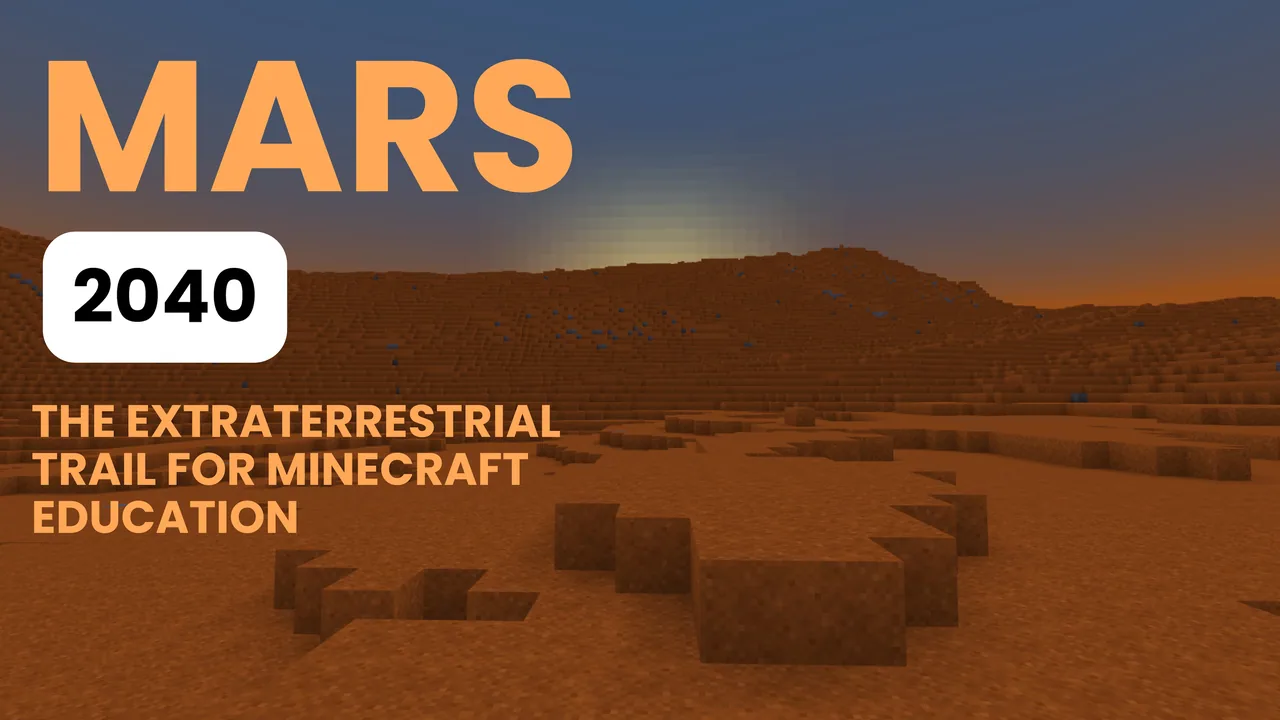
Drawing inspiration from historical pioneers on the Oregon Trail, this lesson challenges students to step into the role of space pioneers establishing humanity's first settlement on Mars. Learners examine the scientific and survival challenges of living on the Red Planet, such as extreme temperatures, a thin atmosphere, and the need for self-sufficient food, water, and shelter systems.
Using authentic Martian terrain world files imported into Minecraft Education, students survey the landscape, plan their settlement layout on paper, and collaboratively construct a safe, welcoming, and expandable habitat. The project culminates in presentations where learners justify their design choices and explain how their colony supports human well-being.
Learning objectives
By the end of this lesson students will be able to:
- Identify key environmental risks of Mars and the basic needs required for human survival.
- Survey authentic Martian landscape files in Minecraft Education and sketch a settlement plan on paper.
- Construct a collaborative Martian habitat that provides life-support essentials, inclusivity, and space to expand.
- Present the community design, explaining why specific locations and structures were included or omitted.
Blocks and items used in this lesson


Key vocabulary
- Self-sufficient
- Able to satisfy all basic survival needs, such as food, water, and shelter, without outside help.
- Multi-planetary
- Referring to a species that inhabits more than one planet to ensure long-term survival.
- Atmosphere
- The layer of gases surrounding a planet, which on Mars is extremely thin compared to Earth.
- Life support
- Technological systems that provide breathable air, thermal regulation, and water in hostile environments.
Before class
Lesson sequence
Suggested timing: about 180 minutes in total.
- Mission Briefing & Environmental Inquiry30 min
Introduce the mission by framing students as pioneers on the Extra-Terrestrial Trail, comparing their journey to historic expeditions like the Oregon Trail. Discuss the driving questions around Martian colonization: basic life needs, thin atmosphere, extreme cold, isolation, and the importance of teamwork.
- Terrain Survey & Paper Planning40 min
Students load their chosen Martian terrain world file in Minecraft Education and conduct an aerial or ground survey of the landscape. After observing the terrain features, students step away from the screens to draft their community blueprint on paper, listing critical facilities and resource needs using the provided handouts.
- Colony Construction70 min
Working in teams or independently, students construct their Martian community inside Minecraft. Remind builders to address harsh environmental factors, ensure accessibility and safety for all residents, and preserve designated open areas for future colony expansion.
- Community Presentations & Debrief40 min
Learners host a walking tour or formal presentation of their Martian settlements. Each group must justify the placement of key structures, explain how survival needs are met, and discuss why certain features were left out. Optionally, teachers can capture screenshots or recordings to share with the wider educational community.
Assessment: success criteria
- A completed paper blueprint illustrating thoughtful placement of community facilities based on surveyed terrain.
- A finished Minecraft build featuring basic survival necessities, including shelter, water, and food solutions.
- Structural evidence of accommodations for Martian environmental challenges, safety, and community expansion.
- A clear presentation explaining the reasoning behind included and excluded colony features.
Differentiation
Use the Essential Build Considerations handout to provide a structured checklist of basic survival buildings before students begin drafting.
Have students incorporate advanced engineering solutions for radiation shielding and atmospheric management, or prepare a guided video walkthrough of their base.
Knowledge check
5 questions to check understanding after the lesson. Tap an answer to see if it is right; the score appears at the end.
1What historical expedition is the Mars 2040 challenge modeled after?
Answer: B. The lesson introduces the Martian journey as an extraterrestrial equivalent to the historic Oregon Trail.
2Which environmental challenges on Mars are highlighted for students to overcome?
Answer: C. The guiding questions focus specifically on overcoming harsh conditions such as extreme temperatures and a thin atmosphere.
3What must students do immediately after surveying the Martian terrain in Minecraft?
Answer: A. According to the student activity sequence, learners draft their community plan on paper after examining the in-game terrain.
4What requirement must students keep in mind regarding the size and layout of their build?
Answer: C. The activity instructions specifically direct students to build a community that includes room to expand.
5What must students be able to explain during their final community presentation?
Answer: B. Students are expected to present their community while discussing why certain locations and aspects were included and why some were not.
Resources
- Lesson package (.zip)Everything the author attached to this lesson in one download.
- Essential Build Considerations (Teacher Aid)A list of locations for students to consider building
- Lesson file
- ISTE Standard ConnectionsConnections to the ISTE Student Standards for Mars 2040 - The Extraterrestrial Trail
- Next Generation Science Standard ConnectionsConnecting Mars 2040 to the NGSS.
- Mars 2040 Title ImageTitle Image for Teacher Use.
Frequently Asked Questions
Can students complete this project individually or must they work in groups?
The lesson is flexible and permits students to work either independently or in collaborative teams, depending on classroom needs and available devices.
Where do students obtain the Martian terrain maps?
Students select a Martian location and download the corresponding authentic terrain world file from the external resource site specified in the lesson materials.
Adapted from Mars 2040 - The Extraterrestrial Trail by Logics Academy on Minecraft Education, last updated Sep 13, 2024. This classroom version, the timings and the quiz were written by 9Minecraft Education.