How can clear communication, strategic planning, and peer assessment help a team succeed in a timed 3D design challenge?
Overview
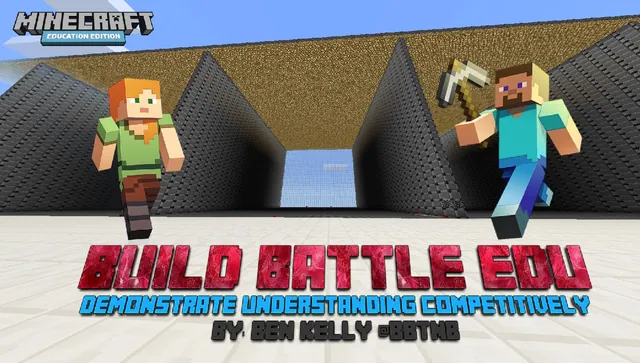
Esports build battles offer an engaging way to develop spatial visualization, 3D thinking, and teamwork. By placing learners in timed competitive situations, this maker-space challenge encourages students to translate abstract ideas or two-dimensional concepts into tangible three-dimensional builds while learning to communicate and adapt under pressure.
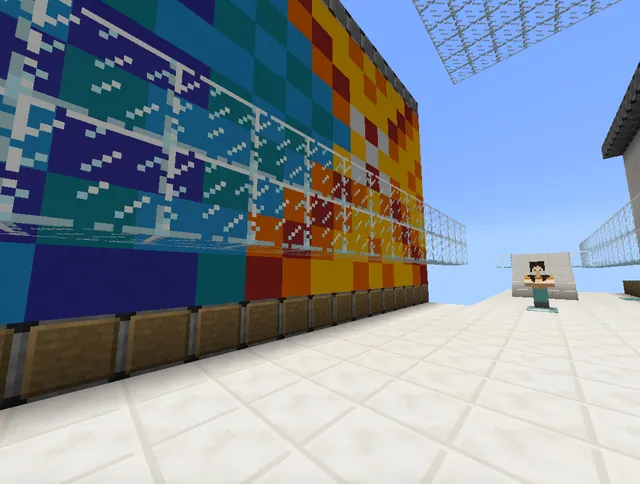
Set inside a giant 3D printer arena, two teams of four to six students battle against the clock to construct a designated item. Non-competing students take on active roles as spectators, shoutcasters, or analysts who evaluate the work against clear criteria and vote from special platforms, with the option to export final models using structure blocks for physical 3D printing.
Learning objectives
By the end of this lesson students will be able to:
- Translate two-dimensional concepts or design prompts into three-dimensional structures inside Minecraft.
- Collaborate within a team by assigning specific roles, planning strategy, and communicating during timed challenges.
- Assess peer creations fairly by applying predetermined evaluation criteria on voting platforms.
- Reflect on individual and group performance in a play journal to identify actionable improvements for future builds.
Blocks and items used in this lesson


Key vocabulary
- Build Battle
- A timed competitive format where teams construct models based on a specific theme or prompt.
- Structure Block
- An in-game block used to capture and export 3D Minecraft constructions for physical 3D printing or digital modeling.
- Shoutcaster
- A commentator who provides live narration and gameplay analysis during an esports competition.
- Spatial Visualization
- The cognitive skill of understanding, manipulating, and interpreting three-dimensional forms from two-dimensional perspectives.
Before class
Lesson sequence
Suggested timing: about 60 minutes in total.
- Introduction and Strategy Setup10 min
Introduce the build challenge prompt and discuss the core elements of successful teamwork. Work with the class to establish the criteria spectators will use to evaluate each build, such as accuracy, creativity, and structural completeness.
- Team Roles and Planning10 min
Divide participating builders into two teams of 4 to 6 members. Assign spectator roles to remaining students, such as shoutcasters, press media, team coaches, or gameplay analysts. Competing teams spend a few minutes planning their strategy and assigning building tasks to each member.
- Arena Build Battle20 min
Start the timer as both teams enter the giant 3D printer arena to create their models. Spectators encourage builders and shoutcasters provide commentary while teams communicate actively to monitor progress and adapt their designs before time expires.
- Judging and Exporting10 min
When time is called, spectators examine both creations and stand on their chosen voting platforms to select a winner according to the agreed-upon criteria. Teachers or students can use the integrated structure blocks to export completed models for 3D printing.
- Journal Reflection and Goal Setting10 min
Students write in their Professional Play journals to evaluate how well their team functioned, how effectively they communicated, and what strategic adjustments they want to make in their next match.
Assessment: success criteria
- Students actively translate 2D concepts or design themes into 3D Minecraft builds.
- Team members demonstrate clear division of tasks and consistent communication during the build battle.
- Spectators evaluate builds objectively using pre-established criteria from the voting platforms.
- Learners complete thoughtful journal entries outlining personal contributions and future goals.
Differentiation
Provide teams with a 2D reference drawing of a simple geometric object to guide their 3D construction step-by-step.
Have advanced builders design a complex 3D shape and challenge spectators to produce an accurate 2D technical drawing of it.
Knowledge check
5 questions to check understanding after the lesson. Tap an answer to see if it is right; the score appears at the end.
1Where is the build battle arena located in this Minecraft world?
Answer: B. The world features a maker space theme set directly inside a giant 3D printer.
2What is the recommended size for each competing team in this lesson?
Answer: B. The lesson specifically recommends two teams of 4 to 6 students per game.
3How do student spectators register their final votes for the winning creation?
Answer: A. Spectators cast their votes after the match by standing on allocated voting platforms in the arena.
4Which tool within the world allows students to easily export their designs for physical 3D printing?
Answer: C. The source highlights that an in-built structure block allows easy export of designs for 3D printing.
5What is the primary purpose of the Professional Play journal?
Answer: C. The journal serves as a tool for students to reflect on teamwork, self-evaluate performance, and set goals for future play.
Frequently Asked Questions
What roles can students take if they are not on one of the building teams?
Spectating students can serve as shoutcasters giving live play-by-play commentary, press and media reporters documenting the event, team coaches advising builders, or gameplay analysts tracking team strategies.
How does this lesson connect Minecraft gameplay to real-world fabrication?
The lesson includes built-in structure blocks that allow students to capture and export their 3D creations, making it easy to convert digital Minecraft models into physical objects using a 3D printer.
Adapted from Make & Model 3D Print by Immersive Minds on Minecraft Education, last updated Jun 22, 2020. This classroom version, the timings and the quiz were written by 9Minecraft Education.