- Type
- Lesson plan
- Ages
- Ages 14-18
- Includes
- Quiz: 5 questions
How do hydroelectric power plants transform natural water flows into electrical energy, and what impacts do they have on the surrounding landscape?
Overview
Energy generation shapes modern society, yet students often overlook the physical science and environmental trade-offs behind the electricity powering their homes. In this lesson, learners examine how energy matrices work, analyze household electricity consumption data, and trace how mechanical systems convert natural water resources into usable power.
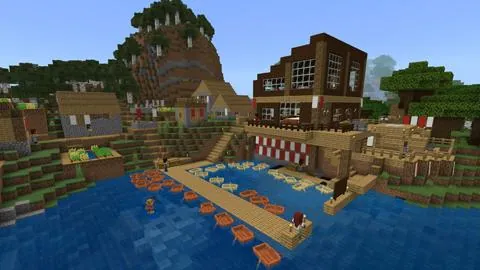
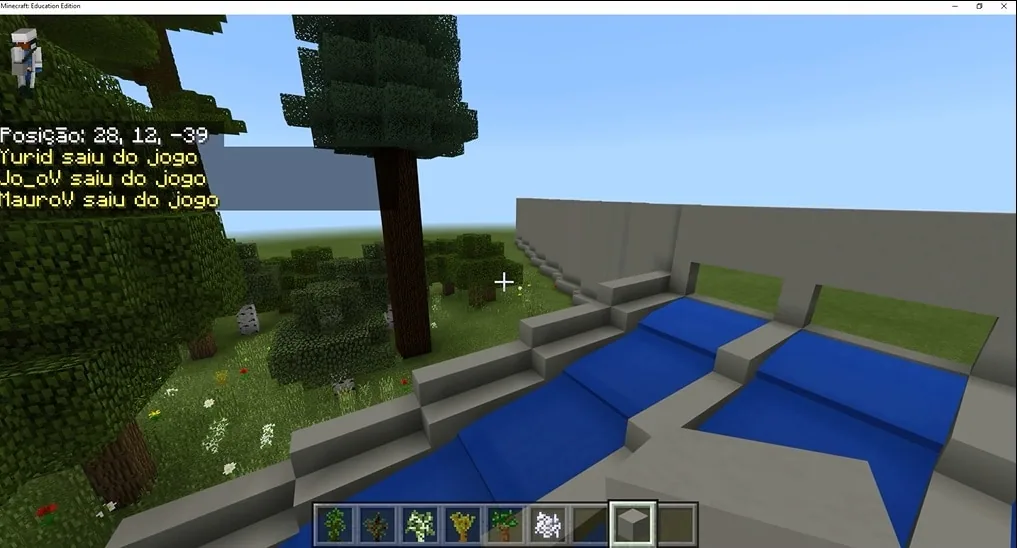
Inside a shared creative mode world in Minecraft, students work together to model a complete hydroelectric station. By excavating river beds, planting surrounding ciliary forests, and engineering dams with redstone circuits and pistons, learners visualize how gravitational potential energy transforms into kinetic and electrical energy.
Learning objectives
By the end of this lesson students will be able to:
- Identify multiple methods for generating electrical energy and compare energy matrix data.
- Calculate household electricity usage and associate physical quantities with proper units of measurement.
- Construct a collaborative hydroelectric dam in Minecraft featuring a river bed, ciliary forest, and redstone-driven mechanisms.
- Explain the energy transformations from stored potential energy to kinetic and electrical energy.
- Evaluate the environmental impacts of creating large reservoirs and altered water flows.
Blocks and items used in this lesson


Key vocabulary
- Energy Matrix
- The total breakdown of all primary energy sources utilized by a region or country to produce power.
- Hydroelectric Plant
- A facility that generates electricity by routing dammed water through turbines connected to an electrical generator.
- Potential Energy
- Stored energy possessed by water held at a height behind a reservoir dam.
- Kinetic Energy
- The energy of motion observed as falling water flows rapidly through pipes to turn turbines.
- Ciliary Forest
- The riparian vegetation and wildlife habitat growing alongside river banks and water bodies.
Before class
Lesson sequence
- Discussion and Energy Habits
Lead an opening conversation circle where students hypothesize how electric power reaches their residences. Provide data tables and graphs depicting energy-saving actions, guiding students to record observations and calculate how utility providers bill for electricity usage.
- Analyzing Energy Matrices
Have students examine a world map alongside Brazilian energy data from 2016, noting that hydroelectric sources accounted for 66%, fossil fuels 19%, biomass 9%, wind 5%, and nuclear 1%. Discuss the relationship between technological development and natural resource availability.
- River and Landscape Excavation
Students log into the shared creative world and coordinate tasks using the in-game text chat. One group carves out the river bed and raises the banks into plateaus using dirt blocks before filling the trench with water blocks, while another group establishes the surrounding ciliary forest with plants and animals.
- Dam Engineering and Redstone
Reunite all students to engineer the reservoir dam structure. Guide them to integrate pistons and redstone circuitry to simulate water movement through pipes, modeling the mechanical path to turbines and generators.
- Energy Transformations and Review
Gather students to trace energy changes from gravitational potential energy in the reservoir to kinetic motion in turbines and electrical power in generators. Conclude by discussing why large dams are required and how flooding impacts local ecosystems.
Assessment: success criteria
- Student accurately calculates electricity billing exercises using appropriate physical units.
- Student identifies the primary components of an energy matrix, including the dominant role of hydropower in Brazil's 2016 data.
- Minecraft build contains a functional water barrier, river bed, ciliary forest ecosystem, and redstone piston system.
- Student correctly explains the sequence of potential, kinetic, and electrical energy transformations in a hydropower plant.
Differentiation
Provide step-by-step redstone wiring diagrams and pre-calculated electricity formula templates.
Challenge students to model waste assimilation or research ecological mitigation strategies for the flooded terrain.
Knowledge check
5 questions to check understanding after the lesson. Tap an answer to see if it is right; the score appears at the end.
1According to the 2016 Brazilian energy matrix analyzed in class, which source generated the largest share of electricity?
Answer: B. The 2016 data shows hydric energy represented 66% of the Brazilian energy matrix.
2What type of energy is stored in the water held high behind a hydroelectric dam?
Answer: A. Water stored at height in the reservoir holds gravitational potential energy before it is released.
3In the Minecraft building project, what mechanism did students use to simulate the controlled movement of water?
Answer: C. Students used pistons and redstone circuits to simulate water release and movement.
4Which ecosystem element did students build along the riverbanks alongside flora and fauna?
Answer: B. Students built the ciliary forest along the raised banks of the river bed.
5Which sequence correctly tracks energy transformations in a working hydroelectric plant?
Answer: D. Stored potential energy becomes kinetic energy as water falls through pipes to spin turbines, which generators convert to electrical energy.
Frequently Asked Questions
Can this activity be completed in single-player or does it require multiplayer?
The lesson is designed around collaborative building and in-game chat communication, so hosting a shared multiplayer world is recommended, though individual students could complete a simplified version independently if needed.
What math skills are required before starting the Minecraft build?
Students should be able to interpret energy consumption graphs and tables, apply units of measure to physical quantities, and perform arithmetic to solve how electricity bills are calculated.
Adapted from Hydropower by Juliano Gonçales on Minecraft Education, last updated Jun 14, 2018. This classroom version, the timings and the quiz were written by 9Minecraft Education.