- Type
- Lesson plan
- Ages
- Ages 6-7
How can we translate a two-dimensional grid plan into an accurate three-dimensional space?
Overview
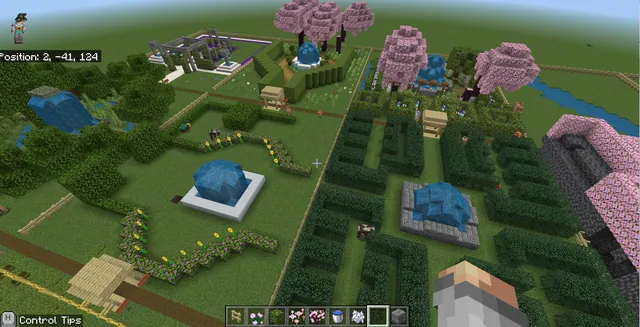
Students explore how gardens satisfy human needs by designing their own vegetable, flower, or bonsai garden. The activity connects mathematics, art, and science as learners plan distinct garden beds, identify geometric shapes, calculate dimensions, and account for materials.
After completing their paper blueprint on a grid, students move into Minecraft to translate their work into a 17 by 17 block area. This building phase reinforces concepts of perimeter, area, symmetry, and mapping through hands-on three-dimensional construction.
Learning objectives
By the end of this lesson students will be able to:
- Design a 17 by 17 garden plan on a grid using varied shapes, beds, and plant types.
- Calculate the perimeter and area of four distinct garden beds.
- Construct an accurate three-dimensional replica of the paper design within Minecraft.
- Justify design choices by explaining why the garden meets user needs.
Blocks and items used in this lesson


Key vocabulary
- Area
- The total amount of flat space contained within the borders of a shape.
- Perimeter
- The total measurement around the outside edge of a shape.
- Symmetry
- A property where one half of a shape or layout is a mirror reflection of the other half.
- Grid Map
- A network of crossing lines forming squares that helps locate features and plan spaces.
Before class
Lesson sequence
- Introduction and Garden Discussion
Discuss what defines a garden and explore why people construct them. Prompt students to consider how different garden types—such as vegetable plots, flower beds, or bonsai displays—serve different purposes.
- 2D Blueprint Design
Students draft their garden layout on a 17 by 17 grid sheet. They map out pathways, water, rocks, ten distinct plants, at least five 2D shapes, and one symmetrical garden bed.
- Calculations and Planning Checklist
Learners measure and record the area and perimeter of four garden beds. They also tally total construction expenses using the reference sheet and prepare a written justification for their design.
- 3D Minecraft Construction
Students load into Minecraft and build their garden inside a 17 by 17 block perimeter. They select matching blocks to ensure their digital structure mirrors their paper drawing.
- Review and Presentation
Students verify that their virtual garden matches their paper plan square by square. They present their work and explain the reasoning behind their chosen layout.
Assessment: success criteria
- The digital garden mirrors the paper plan within a 17 by 17 block boundary.
- Calculations for the perimeter and area of four garden beds are complete and accurate.
- The layout incorporates at least one symmetrical bed and five identifiable 2D shapes.
- Ten different plants or seedlings are labelled in the plan key and represented in the build.
Differentiation
Assist students with calculating area and perimeter on simple rectangular plots before they draft complex shapes.
Have students evaluate peer designs to combine standout elements into a single collaborative school garden plan.
Knowledge check
5 questions to check understanding after the lesson. Tap an answer to see if it is right; the score appears at the end.
1What are the total grid dimensions students must use for their garden?
Answer: B. The project guidelines require students to design and build their layout across a 17 by 17 grid.
2How many different plants or seedlings must be labelled in the plan key?
Answer: D. The project checklist specifies that ten different plants or seedlings must appear in the design key.
3What property must at least one of the garden beds have?
Answer: A. The plan checklist requires at least one symmetrical garden bed.
4Which measurements must students calculate for four of their garden beds?
Answer: C. Students are tasked with finding both the area and the perimeter for four different garden beds.
5What should students finish before building their garden in Minecraft?
Answer: B. Students create and calculate their 2D paper plan first, then use Minecraft to bring that design to life.
Resources
- Lesson package (.zip)Everything the author attached to this lesson in one download.
- Garden Plan Checklist and RulesStudent design rules
- Garden ShopCostings and expenses for garden inventory
- Teach Starter Garden Design ProjectTeacher resources for project
Frequently Asked Questions
Do I need a custom downloadable world for this project?
No custom world is required. Students can build their 17 by 17 structure in any flat or open area in a standard Minecraft world.
Can this activity connect to real-life gardening at school?
Yes. If resources allow, classes can host a design contest and construct portions of the winning plans in the actual school grounds.
Adapted from Garden Design Project by Victorian Minecraft Innovators on Minecraft Education, last updated Apr 27, 2021. This classroom version, the timings and the quiz were written by 9Minecraft Education.