- Type
- Lesson plan
- Subject
- MathArt, Music & Design
- Ages
- Ages 8-13
- Duration
- about 80 min (suggested)
- Skills
- CommunicationCreativity
How can we visually represent and compare quantities using fractions, percentages, and ratios?
Overview
Understanding the relationships between fractions, percentages, and ratios is essential for developing proportional reasoning. While fractions and percentages typically describe parts of a whole, ratios compare two distinct quantities, and connecting these concepts through visual models helps students solidify their mathematical understanding.
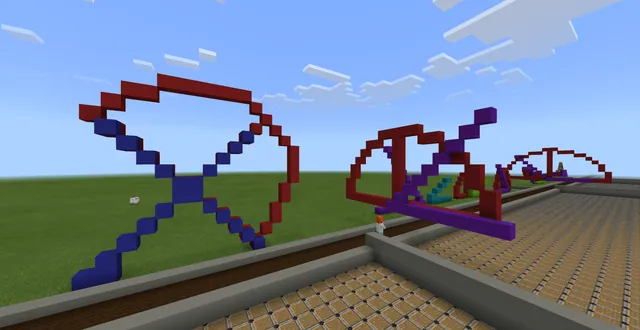
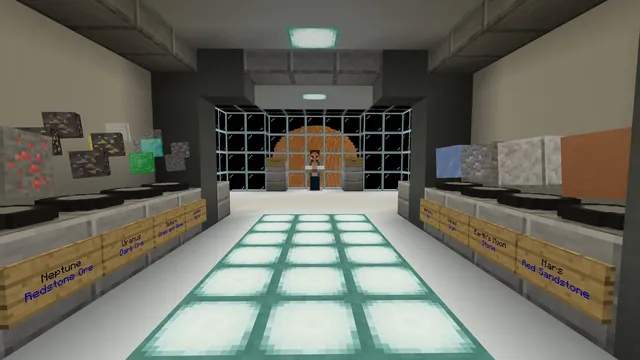
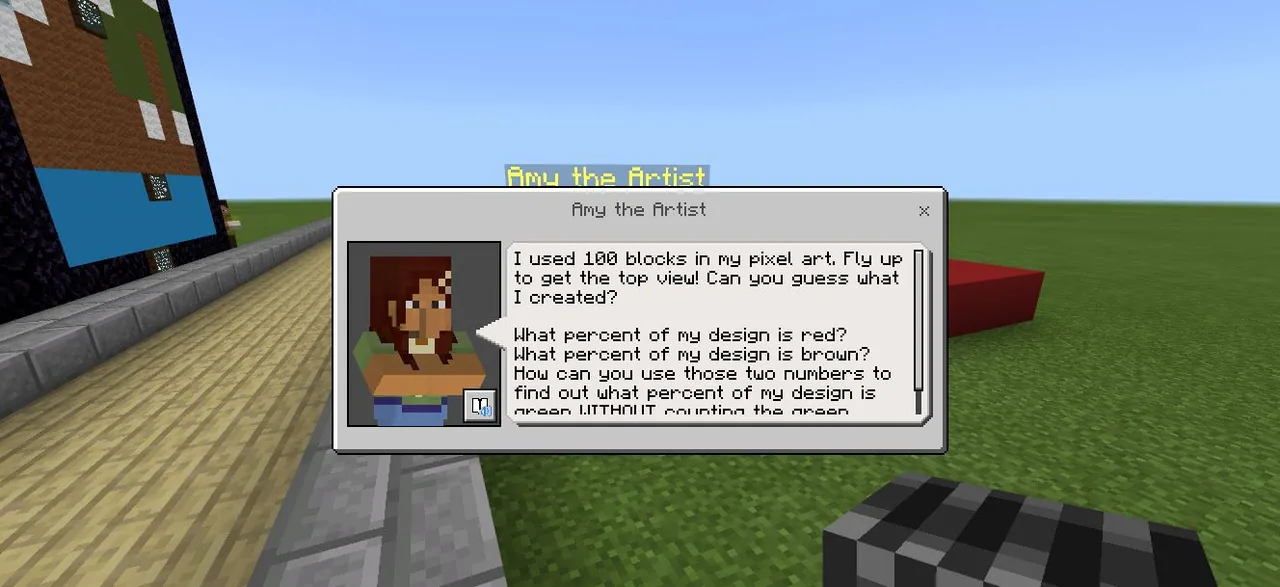
In the Percent and Ratio Modeling world, learners travel down three distinct pathways to solve math challenges presented by non-player characters and signs. They then build their own artistic and ratio displays with blocks, labeling each part with signs and capturing their learning using the camera, portfolio, and book and quill.
Learning objectives
By the end of this lesson students will be able to:
- Represent fractional and percentage values through visual block builds and art.
- Construct a ratio model that clearly compares two distinct quantities.
- Explain mathematical reasoning using in-game signs and exported portfolio documentation.
- Calculate and describe parts of a whole using equivalent fractions and percentages.
Blocks and items used in this lesson


Key vocabulary
- Fraction
- A numerical representation that describes a part of a whole.
- Percent
- A mathematical value that represents a quantity out of one hundred.
- Ratio
- A comparison between two different quantities rather than parts of a single whole.
- Hundreds Grid
- A visual ten-by-ten tool used for counting, division, and modeling parts of one hundred.
Before class
Lesson sequence
Suggested timing: about 80 minutes in total.
- Introduction and Equipment10 min
Students enter the world individually or in groups and speak with the Get Started NPC to collect their camera, portfolio, and book and quill.
- Exploring Representation Roads20 min
Learners travel along the three roads of representation, read the prompts on signs and from NPCs, and record their solutions using their preferred documentation tool.
- Class Sharing and Review10 min
Students share their pathway findings and mathematical answers with the teacher or whole class before beginning their building tasks.
- Artistic and Ratio Building25 min
Students design a visual or artistic model labeled with signs explaining fractions and percentages, then create a separate ratio model with signs detailing each compared quantity.
- Documentation and Export15 min
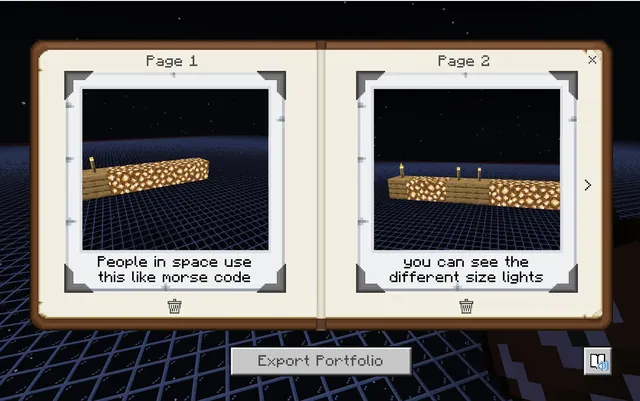
Learners take photographs of their structures with the camera, assemble their reflections in the portfolio, and export their final file for assessment.
Assessment: success criteria
- Answers recorded from the three representation roads accurately address the prompts.
- Artistic models clearly demonstrate correct fractional and percentage relationships.
- Ratio models correctly compare two different quantities and are properly labeled with signs.
- Exported portfolios demonstrate clear mathematical reasoning and documentation.
Differentiation
Allow students to collaborate in small groups and receive peer or teacher assistance while working through the pathway questions.
Challenge students to model and calculate percent of a number problems focusing on 1%, 5%, 10%, 15%, 25%, and 50%.
Knowledge check
5 questions to check understanding after the lesson. Tap an answer to see if it is right; the score appears at the end.
1What does the term percent mean in mathematical calculations?
Answer: C. Percent translates to out of one hundred, allowing values to be expressed with a denominator of 100.
2How do ratios differ from fractions representing parts of a whole?
Answer: A. Ratios are fractions used to compare two separate quantities rather than parts of a single whole.
3Which items are given to students by the Get Started NPC?
Answer: D. The Get Started NPC equips learners with a camera, a portfolio, and a book and quill for documentation.
4Which strategy is mentioned for finding the percent of a number or a fractional value?
Answer: B. The guiding concepts state that fractional and percent values can be found via modeling, counting on a hundreds grid, and division.
5What must students place next to their builds to describe their mathematical thinking?
Answer: C. Learners are directed to use signs to explain their creations in terms of fractions, percent, and ratio parts.
Resources
- Lesson package (.zip)Everything the author attached to this lesson in one download.
- Ratio Problem Sample
- Percent Modeling Sample
- Percent and Ratio Modeling worldthe world file for this lesson
Frequently Asked Questions
Can students work together during this lesson?
Yes, students may enter the world and complete the exploration and building activities individually or in collaborative groups.
What supporting files accompany the world download?
The lesson includes a Ratio Problem Sample, a Percent Modeling Sample, and the Percent and Ratio Modeling world file.
How do students submit their final mathematical work?
Students photograph their builds, compile their evidence into the in-game portfolio, and export the file to share with the teacher.
Adapted from Fractions, Percent & Ratios by Jan Lewis on Minecraft Education, last updated Jun 6, 2022. This classroom version, the timings and the quiz were written by 9Minecraft Education.