- Type
- Lesson plan
- Ages
- Ages 8-18
- Includes
- Quiz: 5 questions
How did the technological changes of the Industrial and Agricultural Revolutions transform everyday survival and quality of life?
Overview
This lesson explores how technological developments during the Agricultural and Industrial Revolutions transformed daily life, labor, and human survival. Students examine how communities met basic needs prior to mechanization and evaluate the technological, economic, and social shifts brought about by new inventions.
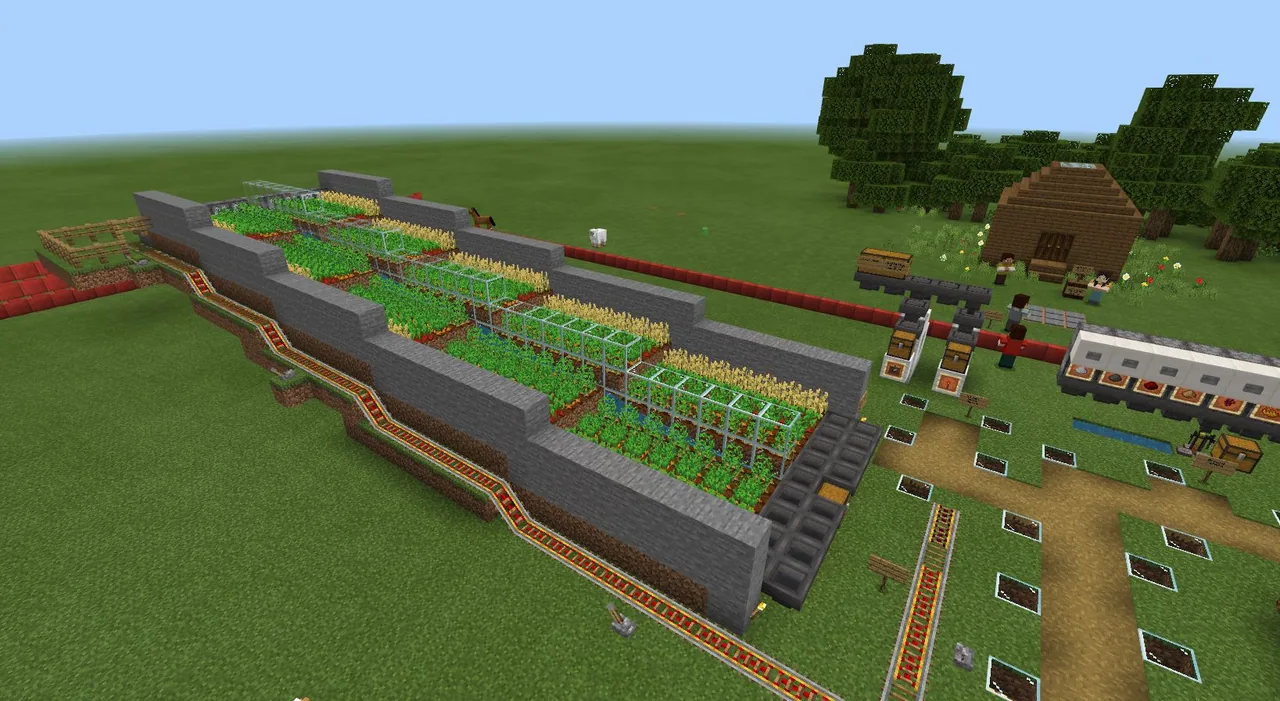
Working collaboratively in small family groups, students enter a Survival mode environment with limited starting supplies to establish an early farm. As they encounter hardships, document challenges with a camera and portfolio, and consult historical figures, they eventually transition across border blocks to examine automated, post-industrial agricultural setups utilizing redstone, dispensers, water, and lava.
Learning objectives
By the end of this lesson students will be able to:
- Identify key historical figures and inventions that drove the Industrial and Agricultural Revolutions.
- Collaborate within a group to establish a working farm under pre-industrial survival conditions.
- Document survival challenges, causes of death, and building progress using the camera and portfolio.
- Compare the efficiency and quality of life between manual pre-industrial farming and automated post-industrial farming.
Blocks and items used in this lesson


Key vocabulary
- Industrial Revolution
- A historical period of rapid technological, economic, and social change driven by mechanized manufacturing and new inventions.
- Agricultural Revolution
- A major shift in farming practices and tools that increased food production and fundamentally changed rural labor.
- Automation
- The use of mechanical systems to perform tasks with minimal human intervention, represented in Minecraft by redstone and dispensers.
Before class
Lesson sequence
- Introduction and Pre-Industrial Discussion
Ask students to name technologies that simplify their daily routines and discuss where their food and goods come from. Show images of life prior to the Industrial Revolution to introduce manual farming conditions.
- Pre-Industrial Family Survival
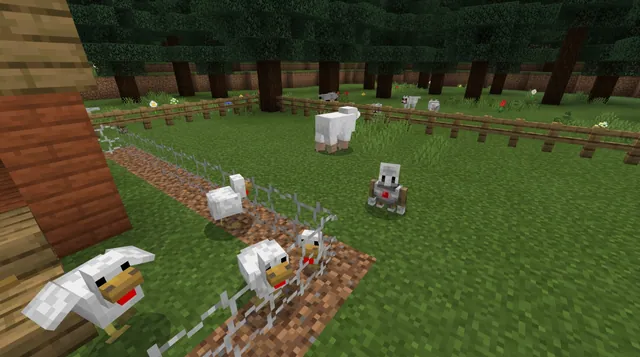
Organize students into small groups representing historical families and assign specific roles to each member. In Survival mode, groups must work together to construct a functional farm using materials found in a wooden farmhouse while managing basic survival needs.
- Historical Inventions and Documentation
Have students locate non-player characters to study historical figures and the agricultural inventions they introduced. Students use their camera and portfolio to record their building efforts and document any causes of character death for later analysis.
- Transition to Post-Industrial Farming
Grant Worldbuilder access to one member per group so they can break the border blocks separating their plots from the post-industrial area. Students explore advanced farm models powered by redstone, dispensers, water, and lava.
- Class Debrief and Portfolio Review
Lead a concluding discussion where students export their portfolios and present their captioned screenshots. Discuss the causes of survival deaths, compare manual labor to mechanized farming, and examine how technological advances improved living standards.
Assessment: success criteria
- Active collaboration within family groups to successfully build a working pre-industrial farm.
- Accurate portfolio documentation of construction milestones, survival obstacles, and causes of death.
- Identification of key inventors and technological developments that spurred agricultural change.
- Meaningful participation in discussions contrasting pre-industrial and post-industrial standards of living.
Differentiation
Set the game difficulty to Easy and provide step-by-step guidance as students establish their initial crops.
Set the survival difficulty to Hard and challenge students to research and build additional historical figure NPCs in their area.
Knowledge check
5 questions to check understanding after the lesson. Tap an answer to see if it is right; the score appears at the end.
1Which three items are fixed in students' inventory slots when entering the world?
Answer: B. The lesson specifies that all students enter the world with three fixed inventory slots containing a camera, portfolio, and map.
2What is the primary role of the non-player characters (NPCs) in this lesson?
Answer: A. Students interact with NPCs to learn about the inventors and inventions that spurred the Agricultural and Industrial Revolutions.
3What features are used in the sample world to demonstrate post-industrial farming?
Answer: C. The post-industrial farming examples in the world highlight automation using redstone, dispensers, water, and lava.
4What should students do if their character dies during the survival activity?
Answer: C. Students are instructed to document what caused their deaths so they can evaluate survival challenges during the debrief.
5How do students gain access to the post-industrial section of the world?
Answer: B. The teacher grants Worldbuilder access to one designated student per group to destroy the border blocks separating the areas.
Frequently Asked Questions
Do the historical NPCs include built-in web links for student research?
No. The non-player characters do not contain web links, so teachers need to provide appropriate external research links for the historical figures beforehand.
Why must Worldbuilder permissions be revoked at the start of the lesson?
Revoking Worldbuilder status prevents students from breaking the border blocks early or altering the informational NPCs before completing the pre-industrial survival phase.
Which game difficulty setting should be selected for the survival phase?
The teacher can select Easy, Normal, or Hard survival difficulty depending on the students' age, familiarity with Minecraft, and the desired level of survival challenge.
Adapted from Farming Industrial Revolution by Mark Grundel on Minecraft Education, last updated Oct 11, 2019. This classroom version, the timings and the quiz were written by 9Minecraft Education.