- Type
- Lesson plan
- Ages
- Ages 3-10
- Duration
- about 12.5 hours (suggested)
How can we use Minecraft to adapt a traditional fairy tale and retell our own twisted version?
Overview
Fairy tales have evolved across cultures and authors for generations. In this unit, students explore traditional stories and key writers to understand how familiar narratives can be modified, then plan and draft their own original twisted fairy tales that alter classic plot points or character perspectives.
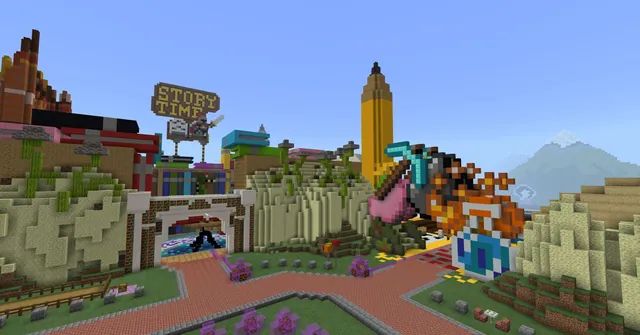
Learners then translate their writing into Minecraft: Education Edition by designing and constructing a key architectural setting or scene. Using interactive storytelling tools such as Non-Player Characters, boards, and books, students present their narrative to classmates for exploration and peer feedback.
Learning objectives
By the end of this lesson students will be able to:
- Investigate traditional fairy tales and identify how stories adapt over time.
- Draft and write an original twisted fairy tale with modified narrative elements.
- Plan and construct a detailed story setting or piece of architecture in Minecraft.
- Retell a story by configuring interactive tools such as NPCs, boards, and books.
- Provide constructive feedback to peers after exploring their digital story worlds.
Blocks and items used in this lesson


Key vocabulary
- Traditional Fairy Tale
- A classic story featuring folklore, magical elements, or moral lessons passed down through authors over time.
- Twisted Fairy Tale
- An adapted version of a traditional tale that changes key elements like character roles, setting, or plot.
- Non-Player Character (NPC)
- An in-game character that teachers and students can set up to deliver dialogue and guide visitors through a story.
- Board
- A surface block in Minecraft used to present written text, descriptions, or instructions to players.
Before class
Lesson sequence
Suggested timing: about 750 minutes in total.
- Investigating Traditional Fairy Tales150 min
Introduce students to traditional fairy tales, key authors, and the origins of these stories. Have students investigate how classic tales have changed over time and record their research findings.
- Planning and Writing Twisted Tales180 min
Examine examples of twisted or modified tales with the class. Guide students as they independently plan, draft, and write their own original twisted fairy tale narratives.
- Setting Design and World Building180 min
Ask students to select a critical setting or piece of architecture from their story. Students create a design plan on paper before building their twisted fairy tale environment inside Minecraft.
- Integrating Interactive Storytelling Tools120 min
Students add narrative details to their builds using in-game communication features. They set up Non-Player Characters (NPCs), boards, chests, portfolios, or book and quill items to retell their tale to visitors.
- Peer Tours and Story Review120 min
Learners host classmates in their Minecraft worlds, guiding them through the setting to interact with their story features. Peers provide constructive feedback, and creators make adjustments to their builds.
Assessment: success criteria
- Student notes document research on traditional tales and how stories change over time.
- The written twisted fairy tale includes clear modifications to a traditional story.
- The Minecraft build accurately reflects the planned setting or architecture from the student's text.
- In-game elements like NPCs, boards, and books effectively convey the story narrative to visitors.
- The student offers constructive feedback to peers and applies received suggestions to their own world.
Differentiation
Provide graphic organizers and sentence starters to help students plan their story changes and NPC dialogue.
Encourage learners to build multiple connected scenes and program multi-stage NPC dialogues across their world.
Knowledge check
5 questions to check understanding after the lesson. Tap an answer to see if it is right; the score appears at the end.
1What is a 'twisted' fairy tale?
Answer: B. The source defines twisted fairy tales as modified adaptations of traditional tales.
2What should students complete before building their scene in Minecraft?
Answer: A. The activities indicate that learners must draft a plan and design for their setting before constructing it.
3Which in-game Minecraft feature is specifically used to speak directly to visiting players with dialogue?
Answer: C. NPCs are highlighted in the source as tools to relay information and retell stories to visitors.
4What is the primary purpose of the peer review activity at the end of the project?
Answer: D. The source specifies that peers tour each other's worlds, give constructive feedback, and adjust settings accordingly.
5Besides NPCs, which Minecraft tool is listed in the source to deliver written text to visitors?
Answer: B. The source explicitly names boards alongside NPCs and book and quill as features for relaying story details.
Resources
- Lesson package (.zip)Everything the author attached to this lesson in one download.
- Fairy Tales SoW and Lesson SupportThe Scheme of Work (SoW) provides the overarching structure of the project and each Lesson Support document provides the granularity for each stage
- Fairy Tales WorldA Minecraft world to use as a catalyst for the project
Frequently Asked Questions
What supporting materials come with this lesson project?
The source includes a Fairy Tales Scheme of Work (SoW) and Lesson Support plan, as well as a pre-made downloadable Fairy Tales World.
How can younger learners participate if writing is still developing?
Teachers can adapt the lesson across the indicated age ranges (ages 3-10) by pairing younger students with partners or using simple boards and verbal retelling instead of extensive written manuscripts.
Adapted from Fairy Tales by Hwb MLCs on Minecraft Education, last updated Jun 6, 2022. This classroom version, the timings and the quiz were written by 9Minecraft Education.