- Type
- Lesson plan
- Ages
- Ages 8-13
- Includes
- Quiz: 5 questions
How can partners best collaborate to gather resources, design buildings on grid paper, and establish a functional village?
Overview
This lesson introduces students to civic participation, resource management, and geometric design through a cooperative building challenge. Working in pairs, students coordinate their efforts to gather raw materials, manage a designated plot of land, and understand how individual structures contribute to an interconnected local economy.
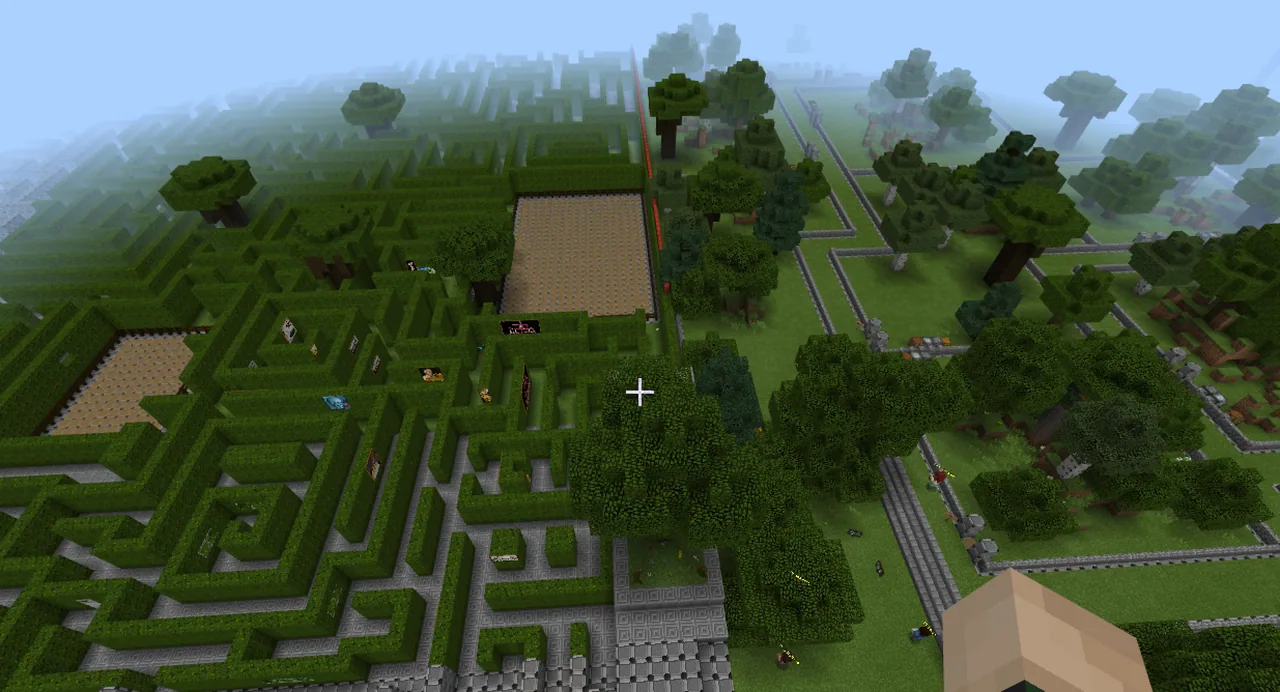
In Minecraft, pairs first navigate through an obstacle-filled maze to gather building resources and traverse an underground tunnel to enter a village site. Once there, they claim land parcels secured with iron doors, draft scaled architectural plans on grid paper, construct their assigned buildings, and negotiate trades with neighbouring plots such as farms and markets.
Learning objectives
By the end of this lesson students will be able to:
- Navigate a maze cooperatively in pairs while gathering necessary building resources.
- Draft bird's-eye and side-view plans on grid paper using metric measurements, titles, labels, and keys.
- Construct designated village buildings based on drafted plans while tracking perimeter, area, and volume.
- Engage in community trade to exchange goods between complementary structures such as farms and marketplaces.
Blocks and items used in this lesson


Key vocabulary
- Perimeter
- The total distance around the outside edge of a flat shape or building site.
- Area
- The total amount of flat surface enclosed within the boundaries of a shape or plot.
- Volume
- The amount of three-dimensional space enclosed inside a solid structure.
- Bird's-Eye View
- An overhead design perspective that looks straight down at a plan from above.
Before class
Lesson sequence
- Maze Exploration and Resource Gathering
Students enter the maze in pairs and work together to collect building materials. Pairs may utilize available free-build zones within the maze to test routes or plan strategies before heading through the underground tunnel into the village.
- Plot Selection and Site Security
Students listen to village tips from teacher figures and evaluate available plots based on size and natural features such as trees or animals. Once a parcel is chosen, partners open the plot chest and install an iron door and pressure plate to secure their land, ensuring at least one partner stays on the plot to prevent being locked out.
- Architectural Design on Grid Paper
Pairs research real-world examples online and draw complete building blueprints on grid paper. Plans must display a bird's-eye view, side elevations, labels, titles, keys, and dimensions measured in meters.
- Village Construction
Partners construct their designated structures according to their grid paper designs. While one student builds, the other may return through the maze to gather additional resources if needed, maintaining site security on their claimed land.
- Community Economy and Trade
Once buildings are complete, pairs interact as active citizens by trading supplies across the village. For example, students managing a marketplace trade with peers operating a farm to stock goods for sale.
Assessment: success criteria
- Partners remain together in the maze and demonstrate cooperative decision-making.
- Blueprints on grid paper accurately include bird's-eye views, side views, metric measurements, labels, and keys.
- Constructed buildings reflect the planned measurements of perimeter, area, and volume.
- Students actively engage in civic trade between complementary village sites.
Differentiation
Allow learners to experiment with layout concepts in the maze free-build zones and supply extra chest resources to teams that demonstrate strong cooperation.
Challenge advanced students to produce intricate, fully detailed multi-view plans and calculate exact building volume before receiving additional construction materials.
Knowledge check
5 questions to check understanding after the lesson. Tap an answer to see if it is right; the score appears at the end.
1What should students install immediately after claiming a plot of land?
Answer: A. The source states that after choosing their land, students must put up the iron door and pressure plate found in the plot chest to secure it.
2How do students reach the village area after navigating the maze?
Answer: B. The source notes that at the end of the maze, an underground tunnel takes students to the beginning of the village.
3What happens if both partners leave their secured plot at the same time?
Answer: C. Because of the iron door and pressure plate, both partners leaving results in a lockout, and the teacher enforces a rule of removing resources from their chest.
4What elements must be included on the grid-paper blueprints?
Answer: B. The performance expectations specify that designs must include measurements in meters, a title, a key if needed, labels, and both bird's-eye and side views.
5How do students running the marketplace obtain goods to sell once building is complete?
Answer: D. The source gives the specific example that students who built the marketplace trade with students who built the farm so they have goods to sell.
Frequently Asked Questions
Can the teacher change what gets built on each plot?
Yes. The teacher can edit the signs posted outside each block of land before lessons begin to assign different building types to each team.
How can the teacher reward high-quality planning and teamwork during the lesson?
While operating in creative mode, the teacher can place extra construction resources directly into the chests of pairs who produce detailed plans or demonstrate strong cooperation.
Why do land plots differ across the village area?
Plots vary in size and natural resource availability, meaning some parcels contain more trees while others have more animals, which students can factor into their plot selection.
Adapted from Class Village by Rebecca Elliott on Minecraft Education, last updated Jun 3, 2022. This classroom version, the timings and the quiz were written by 9Minecraft Education.