- Type
- Lesson plan
- Ages
- Ages 3-10
- Duration
- about 1.5 hours (suggested)
- Includes
- Quiz: 5 questionsMinecraft world
How can designing a physical environment in Minecraft help authors describe and develop a story setting in writing?
Overview
Writers use descriptive language to establish a vivid sense of time and place that grounds their storytelling. In this lesson, learners investigate how published authors build scenes in the reader's imagination by examining picture books and read-aloud texts for specific setting details and sensory phrases.
Students then bring their literary analysis into Minecraft by designing an environment either independently or in small groups. After building, learners use their constructed digital world as the foundation for a descriptive passage or narrative, reflecting on how tangible environment design enhances creative writing.
Learning objectives
By the end of this lesson students will be able to:
- Identify words, phrases, and visual elements that convey setting in published books.
- Build a Minecraft environment that includes specific details necessary for a story setting.
- Write a narrative or detailed descriptive passage set inside the constructed Minecraft space.
- Evaluate which elements of setting are easy or challenging to build in Minecraft compared to writing them in text.
Blocks and items used in this lesson


Key vocabulary
- Setting
- The time, place, and environment in which the events of a story take place.
- Descriptive Language
- Words and phrases that appeal to the senses to help a reader visualize a scene.
- Narrative
- A spoken or written account of connected events; a story.
- T-Chart
- A two-column graphic organizer used to compare two aspects of a topic.
Before class
Lesson sequence
Suggested timing: about 90 minutes in total.
- Mini-Lesson: Exploring Setting in Text15 min
Share a picture book with an easily recognizable setting with the class. Guide students to identify details that define the location and time period, and begin a shared anchor chart of setting elements found across different stories.
Read a selected passage aloud, prompting learners to listen for descriptive words and phrases the author uses to construct the scene in the reader's imagination.
- Planning and World Building30 min
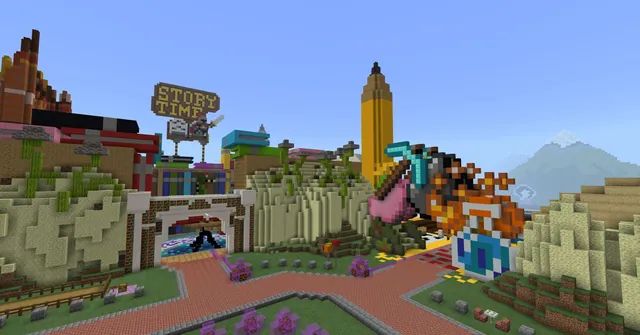
Have students work independently or in cooperative pairs to design a setting in Minecraft where an upcoming story can occur. Learners place key environmental details, structures, and land features that support their intended narrative.
Remind learners that classmates collaborating on the same built world can still write completely different stories based in that shared space.
- Writing the Setting and Story25 min
Using their completed Minecraft builds as inspiration, students compose a written piece. Learners may draft a detailed descriptive passage of their world or a narrative that uses the digital environment as its active backdrop.
- Documenting and Reflection20 min
Students capture screenshots or record a short screencast of their completed Minecraft world to accompany their text. In small groups or as a class, learners fill out T-charts comparing what was easy versus difficult to depict in Minecraft versus in writing.
Wrap up by allowing students to share favorite excerpts from their stories and reflect on how setting details enhance creative writing.
Assessment: success criteria
- Student accurately identifies descriptive setting phrases in mentor texts.
- Minecraft build contains recognizable environmental features suited for a story setting.
- Written text clearly reflects and utilizes the details constructed in the Minecraft world.
- T-chart reflection thoughtfully examines the differences between building a setting visually and describing it in writing.
Differentiation
Allow students to work with a partner to build a shared setting and provide sentence stems focused on sensory details for the written description.
Challenge students to introduce a sudden change in environment or atmosphere into both their Minecraft build and narrative.
Knowledge check
5 questions to check understanding after the lesson. Tap an answer to see if it is right; the score appears at the end.
1What is the primary role of a story's setting?
Answer: B. A setting represents the environment, time, and location where the events of a story unfold.
2What should students listen for during the read-aloud portion of the mini-lesson?
Answer: A. The mini-lesson focuses on identifying specific phrases and words authors use to craft scenes in readers' imaginations.
3If two students collaborate on building the same setting in Minecraft, what is true about their writing?
Answer: B. The lesson notes that students can build the same setting together and still write distinct stories based on it.
4How do students capture their Minecraft creations for documentation?
Answer: A. Performance expectations specify screenshots or a screencast as acceptable evidence of the student world.
5What tool does the lesson use to reflect on what was easy and difficult to create in Minecraft versus in writing?
Answer: B. The assessment instructions suggest using a T-Chart to compare what was easy and difficult to incorporate in both mediums.
Resources
Frequently Asked Questions
Do students need to create entirely new worlds from scratch?
No. Students can construct a new world or simply build a designated area inside an existing world, including the provided downloadable template.
Can students work in groups during the building stage?
Yes. The building activity can be completed independently or cooperatively in small groups, after which students can write individual stories using the shared space.
What writing formats are acceptable for the written assessment?
Students can write either a detailed descriptive passage focusing entirely on the environment or a complete narrative story that incorporates the setting.
Adapted from Building a Story Setting by Minecraft Education on Minecraft Education, last updated Mar 19, 2026. This classroom version, the timings and the quiz were written by 9Minecraft Education.