How can historical clues and environmental evidence help us solve complex problems and escape the past?
Overview
Students enter an escape-room simulation set in the past where they must apply critical thinking, collaboration, and historical knowledge of Native American culture to solve four breakout puzzles. Each stage of the journey challenges learners to interpret historical cues and environmental indicators to unlock directional, numerical, and word-based locks.Learning objectives
By the end of this lesson students will be able to:
- Interpret directional cave drawings to determine the correct sequence for a directional lock.
- Translate linguistic clues found in the environment into numerical values to solve math problems for a three-digit lock.
- Identify sixteenth-century Native American tools and rotate arrow markers to deduce a four-digit code.
- Collect and sequence letter clues from five settlement dwellings to solve a five-letter word lock.
Blocks and items used in this lesson
 Chest
 Redstone Lamp
 Stone Axe
 Bow
 Bone
 Leather
Key vocabulary
- Breakout EDU
- A game-based learning format where players solve puzzles to open physical or digital locks.
- Directional Lock
- A lock mechanism opened by entering a specific sequence of directions such as up, down, left, or right.
- Guidestone
- An environmental reference point that shows how symbols or positions translate into numbers.
Before class
Lesson sequence
- World Setup and Introduction
Introduce the breakout challenge and explain that students will travel back in time to solve four themed puzzles using Native American history. Direct learners to import and open the world file from their game menu.
- Puzzle 1: The Cave Directional Lock
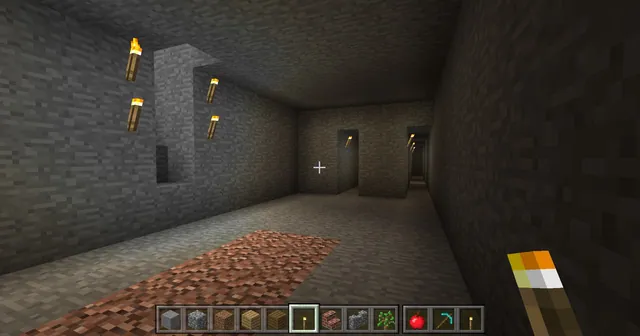
Students enter the cave at coordinates 198, 65, -188. They must observe five cave drawings on the walls, note the direction each painting points, and record the directions in sequential order to open the directional lock.
- Puzzle 2: Language and Math Three-Digit Lock
After exiting time travel, students speak with a tour guide near coordinates -72, 63, -119. By investigating a chest, an NPC link, or a rear hut, learners discover that words on tree signs stand for numbers. They use these values to solve math equations and obtain the three-digit code.
- Puzzle 3: Sixteenth-Century Tools Four-Digit Lock
Near coordinates -6, 63, 799, students learn about tools used by Native Americans in the 1500s: a stone axe, leather pelt, bow, and bone. Using a guidestone, players rotate arrows under each tool into positions 1 through 8 until each lamp lights and stays lit, revealing the four-digit lock code.
- Puzzle 4: Village Neighborhood Wordlock
Students explore five homes near coordinates -50, 64, 1372. Each home contains a chest with an item whose starting letter or stack quantity provides a letter. Players check the dot sign above each doorway to find the letter position, combining all five letters to unlock the word lock.
Assessment: success criteria
- Correctly input the five directional entries observed from the cave paintings at coordinates 198, 65, -188.
- Accurately calculate the three-digit numerical code from the tree sign math equations at coordinates -72, 63, -119.
- Properly rotate all four tool arrows to illuminate the lamps and produce the four-digit code at coordinates -6, 63, 799.
- Assemble the correct five-letter word based on door markers and chest items at coordinates -50, 64, 1372.
Differentiation
Provide struggling learners with direct coordinate teleportation commands and an alphabet-to-number reference chart for the final lock.
Ask fast finishers to write clear hint cards or design an additional historical puzzle concept based on Native American daily life.
Knowledge check
5 questions to check understanding after the lesson. Tap an answer to see if it is right; the score appears at the end.
1What visual clues provide the solution to the directional lock in Puzzle 1?
Answer: B. The source specifies that five cave drawings on the cave walls point in directions that unlock the directional lock.
2Where can students find information explaining what the words on tree signs mean in Puzzle 2?
Answer: A. The source lists the chest in front of players, an NPC link, or the hut in the back as the clue locations.
3Which four items must players focus on to solve Puzzle 3?
Answer: C. The source explicitly names the stone axe, leather pelt, bow, and bone as the sixteenth-century tools used for this puzzle.
4How do players know that an arrow rotation is set to the right position in Puzzle 3?
Answer: C. The source states that when players rotate each arrow to the correct position, the lamp will light and stay lit.
5What feature on each house indicates where its letter belongs in the five-letter word lock?
Answer: D. The source explains that the dot sign on top of the door corresponds to the position of each letter in the final word.
Frequently Asked Questions
Can this lesson be run using digital forms instead of physical lock boxes?
Yes. Teachers can configure a digital breakout form using online survey or quiz tools with response validation matching the directional, three-digit, four-digit, and word locks.
What should I do if students get separated or lost in the world?
Use the coordinates listed in the lesson plan for each puzzle station to teleport players directly back to their group's current challenge.
Adapted from Breakout EDU | Lost In Time by Minecraft Education on Minecraft Education, last updated Aug 27, 2025. This classroom version, the timings and the quiz were written by 9Minecraft Education.