- Type
- Lesson plan
- Subject
- MathArt, Music & Design
- Grade
- Primary (Grades 3-5)
- Ages
- Ages 8-10
- Duration
- about 60 min (suggested)
What kind of math problem is a rectangle, and how can you prove it?
Overview
This lesson guides learners to understand multiplication through spatial representations. By linking prior knowledge of repeated addition and grouped numbers to rectangular grids, students discover that every rectangle can be represented as a multiplication problem involving factors.
Inside Minecraft, students work in pairs to gather blocks, construct visual arrays, and verify given multiplication equations. They then participate in a creative Build Battle made entirely of rectangular figures, challenging their peers to label and solve the mathematical equations represented by their builds.
Learning objectives
By the end of this lesson students will be able to:
- Build rectangular arrays using equal groups of blocks to represent multiplication.
- Identify and record factors and multiplication equations using in-game slates.
- Prove given multiplication equations by constructing corresponding rectangular models.
- Analyze a peer's rectangular structures to extract and solve multiplication sentences.
Blocks and items used in this lesson


Key vocabulary
- Array
- An arrangement of objects or blocks in equal rows and columns.
- Factor
- A number multiplied by another number to find a product.
- Variable
- A symbol or placeholder representing a number in a mathematical expression.
Before class
Lesson sequence
Suggested timing: about 60 minutes in total.
- Opening Brainstorm10 min
Present the Opening Slideshow on the whiteboard. Prompt students to notice shapes, patterns, and groupings, guiding them to recall that repeated addition and grouped numbers are multiplication. Introduce the Big Idea: All Rectangles are Multiplication Problems. Have students record this statement and corresponding equations in their notebooks.
- Array Building Challenges15 min
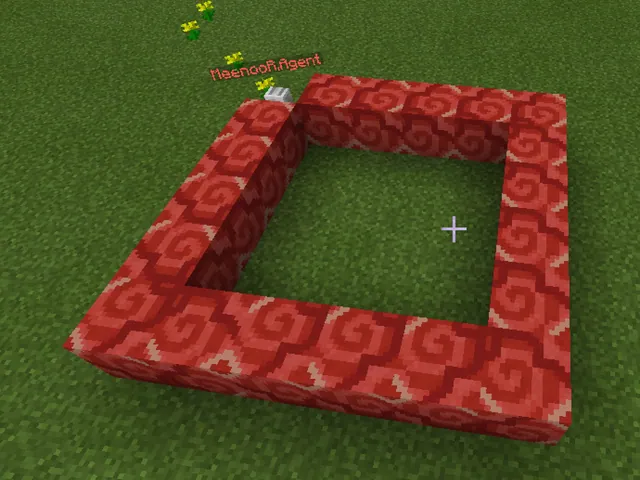
Students enter the world in pairs. Working through the initial challenges, learners gather scattered blocks into equal groups of colors to form arrays, label the factors at the end using slates, take in-game photographs, and construct models that prove assigned multiplication equations.
- Build Battle10 min
Students teleport into the Build Battle rooms and have ten minutes to build any design they choose, provided it consists of at least five distinct rectangular shapes. If learners get stuck, encourage them to think back to rectangular objects discussed during the opening brainstorm.
- Partner Play Test15 min
Partners swap to inspect each other's creations. Each student locates their partner's rectangles, records five multiplication equations on slates, and calculates the solutions for at least three of them.
- Debrief and Reflection10 min
Learners spend five minutes in their math journals responding to the prompt: What kind of math problem is a rectangle and how can you prove it? Conclude with a five-minute teacher-led group discussion sharing student observations.
Assessment: success criteria
- Student successfully gathers scattered blocks and arranges them into an accurate rectangular array.
- Student correctly labels factors along the rows of an array using slates.
- Student builds a correct rectangular model to prove a given multiplication equation.
- Student identifies and correctly solves at least three multiplication equations from a partner's Build Battle creation.
Differentiation
Refer students to previous brainstorm notes on what can be built from rectangles, and have them use graph paper to plan their rows and columns before placing blocks.
Challenge students to explain skip-counting strategies, describe variable models, and identify and solve five or more equations from their partner's structure.
Knowledge check
5 questions to check understanding after the lesson. Tap an answer to see if it is right; the score appears at the end.
1What is the central Big Idea introduced in this lesson?
Answer: B. The lesson explicitly introduces the Big Idea that all rectangles are multiplication problems.
2What do students place at the end of their array rows to mark the factors?
Answer: A. Challenge 1 directs students to fill in factors with slates at the end of the array.
3How many rectangles must students include during the ten-minute Build Battle?
Answer: C. The Build Battle instructions require students to create at least five rectangles.
4What task must a student complete when inspecting their partner's Build Battle creation?
Answer: C. Partners inspect the build, write down five multiplication problems, and solve at least three of them.
5What question prompt do students answer in their journals during the debrief?
Answer: D. The debrief prompt specifically asks students what kind of math problem a rectangle is and how to prove it.
Resources
- Lesson package (.zip)Everything the author attached to this lesson in one download.
- Opening Slideshow
- Rubric
Frequently Asked Questions
What supplies are needed for the non-digital parts of the lesson?
You will need math notebooks, pencils, the Opening Slideshow file, and a whiteboard with markers. Colored pencils and graph paper are also recommended for sketching arrays.
How are students paired and organized for the in-game tasks?
Students work in pairs. Each learner completes two of the challenges before teleporting into the Build Battle rooms to construct and inspect rectangular builds together.
How does the lesson evaluate student understanding?
Assessment uses Depth of Knowledge tiers based on whether students can build models from equations, label factors on slates, explain skip-counting strategies, and correctly solve equations from their partner's structures.
Adapted from Arrays and Multiplication by Minecraft Education on Minecraft Education, last updated Dec 15, 2022. This classroom version, the timings and the quiz were written by 9Minecraft Education.