- Type
- Lesson plan
- Subject
- Math
- Topics
- Math & Economics
- Grade
- Middle school (Grades 6-8)High school (Grades 9-12)Adults & educators (Higher education and teacher learning)
- Ages
- Ages 11+
- Skills
- Critical thinking
How can identifying the hidden rules within a sequence help us predict its future terms and total sums?
Overview
Mathematical sequences are systematic patterns governed by underlying rules. In this lesson, students explore how systems function by identifying numerical patterns, predicting missing terms, and understanding how simpler information can explain more complex mathematical structures.
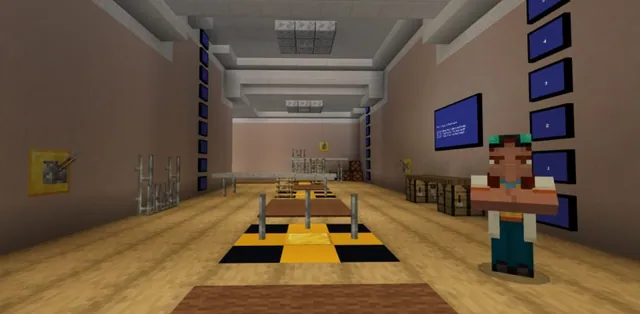
Using an interactive puzzle map, learners work individually or in small teams across three progressive challenges. Correctly solving sequence puzzles provides password letters that open Sway checkpoints, while switching perspectives in Creative mode allows students to inspect spatial sequence layouts from every angle.
Learning objectives
By the end of this lesson students will be able to:
- Identify underlying rules that govern basic numerical systems and sequences.
- Analyze three-dimensional spatial block formations to determine visual sequence patterns.
- Calculate the sums of numerical sequence elements across progressive puzzle stages.
- Infer complex mathematical patterns using clues derived from simpler structural information.
Blocks and items used in this lesson


Key vocabulary
- Sequence
- An ordered list of numbers or objects that follows a specific pattern or mathematical rule.
- System
- A collection of interconnected elements that operate together according to fixed rules.
- Summation
- The process of adding together elements or terms within a numerical sequence.
- Term
- An individual number, object, or component within an ordered sequence.
Before class
Lesson sequence
- Introductory Discussion
Introduce the concept of systems and operational rules. Ask students how patterns work in nature and everyday life, then connect the conversation to numeric systems and regular numerical sequences.
- Phase 1: Basic Numerical Sequences
Organize students into small collaborative teams or independent problem solvers. Learners tackle the first chamber of puzzles focused on fundamental number sequences, recording the letters they earn with each correct solution.
- Phase 2: Spatial and Flat Sequences
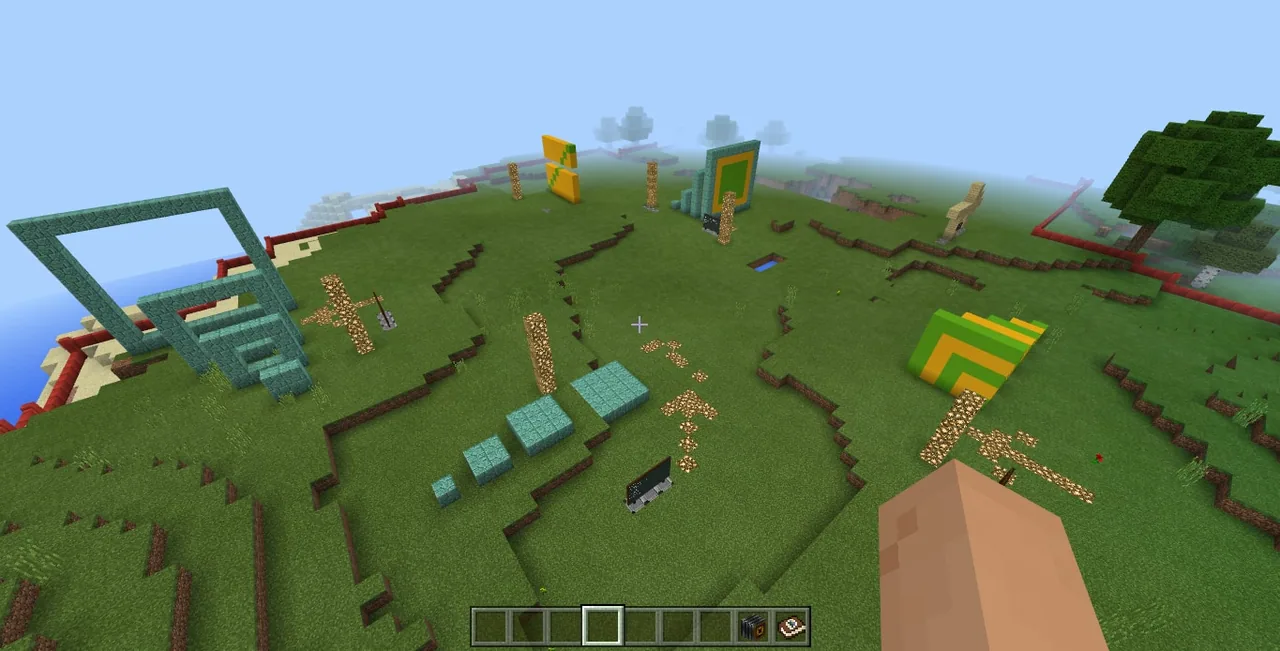
After unlocking the first Sway checkpoint with their six-letter password, students move to phase two. In this stage, puzzles use physical block structures and flat spatial arrangements. Consider enabling Creative mode so students can inspect the builds from all directions.
- Phase 3: Sums of Sequences
Students enter the most demanding puzzle set, which focuses on the summation of sequence elements. Teams apply their pattern analysis to calculate sequence totals, earning the final password letters to unlock the closing Sway document.
- Debrief and Consolidation
Bring the class together to review challenging puzzles using the OneNote answer key. Discuss the problem-solving strategies teams used to deduce rules and connect spatial block counts to algebraic thinking.
Assessment: success criteria
- Student successfully identifies the pattern rules in simple numerical sequence puzzles.
- Student correctly interprets visual or spatial block patterns to predict sequence progression.
- Student accurately calculates the sum of elements within numerical sequences in phase three.
- Student collects the necessary six-letter combinations to unlock each Sway stage.
Differentiation
Allow learners to switch to Creative mode to fly around puzzles and visually count blocks, and pair them with supportive peers for collaborative discussion.
Challenge advanced students to write general algebraic formulas that describe the rules governing each phase puzzle before calculating totals.
Knowledge check
5 questions to check understanding after the lesson. Tap an answer to see if it is right; the score appears at the end.
1What is the main topic covered in the first phase of the puzzle map?
Answer: B. The lesson structure begins with simple numerical sequences in phase one before introducing spatial and summation puzzles.
2How many correct letters do students need to collect in each section to complete a password?
Answer: C. The activity instructions state that students must earn six correct letters in each section to reveal the document password.
3Why might a teacher choose to switch the world mode to Creative during the lesson?
Answer: A. Creative mode enables flight, allowing students to inspect three-dimensional puzzles and flats from every angle.
4Which phase of the map presents the heaviest difficulty and covers sequence summation?
Answer: C. Phase three is described as the heaviest stage and focuses specifically on the sums of numerical sequences.
5Where can the teacher check solutions to the map puzzles?
Answer: B. The source lists a OneNote file with solutions as an included supporting resource for the teacher.
Resources
- Lesson package (.zip)Everything the author attached to this lesson in one download.
- Map of a game
- OneNote with a solution
Frequently Asked Questions
Can students complete this activity independently or in groups?
Teachers can run the activity as an individual challenge or arrange students into collaborative teams to solve the sequence puzzles together.
What external tool is used alongside Minecraft during this lesson?
Students enter their discovered six-letter passwords into Sway documents to confirm completion and unlock the next section of the challenge.
Adapted from World of Sequences by Tomas Milicka on Minecraft Education, last updated Jun 14, 2018. This classroom version, the timings and the quiz were written by 9Minecraft Education.