
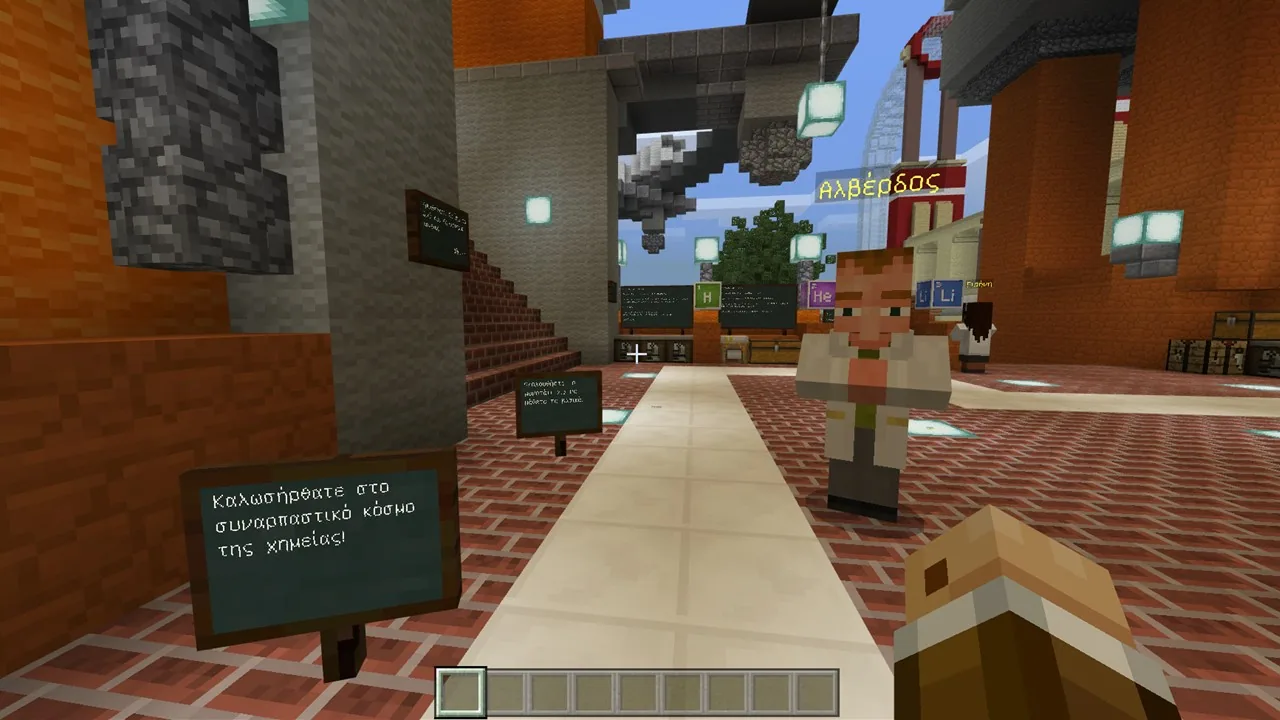
How can specialized chemistry tools be used to build elements, synthesize compounds, and conduct scientific tests?
Overview
Understanding chemical processes requires hands-on exploration of how elements combine and react. This lesson introduces learners to fundamental scientific tools in Minecraft, allowing them to construct elements, combine them into compounds, and conduct safe virtual experiments.
Students work through an interactive tutorial using the Element Constructor, Compound Creator, Lab Table, and Material Reducer. After studying the complete periodic table display, learners use the dedicated testing area to craft specialized items like balloons, super fertilizer, and ice bombs before designing their own customized chemistry laboratories.
Learning objectives
By the end of this lesson students will be able to:
- Operate the Element Constructor, Compound Creator, Lab Table, and Material Reducer to manipulate virtual chemical materials.
- Investigate the arrangement of chemical elements by examining the in-game periodic table.
- Synthesize and test functional products including balloons, ice bombs, and super fertilizer using recipe directions.
- Design and build an organized, customized laboratory space to support scientific work.
Blocks and items used in this lesson
 Element Constructor
 Compound Creator
 Lab Table
 Material Reducer
 Ice Bomb
 Super Fertilizer
 Balloon
 Item Frame
Key vocabulary
- Element Constructor
- A chemistry workstation used to build elements by adjusting subatomic particles.
- Compound Creator
- A specialized station used to combine different elements into chemical compounds.
- Lab Table
- A workstation used to combine elements and compounds to produce chemical reactions and items.
- Material Reducer
- A device that reduces environmental blocks down into their base chemical elements.
Before class
Lesson sequence
- Workstation Tutorial
Direct students to enter the tutorial area and read the in-game guidance. Learners practice operating all four primary stations: the Element Constructor, Compound Creator, Lab Table, and Material Reducer.
- Periodic Table Study
Have students locate and inspect the full periodic table display. Learners observe the element blocks and consult the translated List of Elements and Isotopes to connect in-game blocks with real chemistry concepts.
- Testing Area Experiments
Guide students to the testing zone, which contains crafting tables and detailed instructions displayed in item frames. Students combine materials to produce ice bombs, super fertilizer, and balloons, then observe their effects in the designated test area.
- Custom Lab Construction
Allow students to choose an available open space to construct their own chemistry laboratory. Learners install workstations and arrange the layout to suit their personal experimental workflow.
Assessment: success criteria
- Demonstrate proper use of the Element Constructor, Compound Creator, Lab Table, and Material Reducer.
- Synthesize at least one working item such as an ice bomb, super fertilizer, or balloon in the testing area.
- Locate specific chemical elements within the periodic table exhibit.
- Construct a personalized chemistry lab layout using the provided building spaces.
Differentiation
Have students work in pairs and consult the item frame directions and Greek Lab Journal to follow exact crafting recipes.
Ask advanced learners to produce all three featured test items and systematically organize their custom lab with designated production zones for each station.
Knowledge check
5 questions to check understanding after the lesson. Tap an answer to see if it is right; the score appears at the end.
1Which device is used to break down standard blocks into their component chemical elements?
Answer: B. The Material Reducer is designed specifically to decompose blocks into base chemical elements.
2What exhibit in the world allows students to view every available element block together?
Answer: A. The world features a complete periodic table showcasing the individual element blocks.
3Which of the following items are created and tested in the experimentation area?
Answer: C. The lesson source explicitly lists ice bombs, balloons, and super fertilizer as products made in the testing area.
4What update was made to the item frames in version 1.1?
Answer: A. Version 1.1 updated the item frames to provide more detailed crafting instructions.
5After completing experiments, what creative project do students undertake in the world?
Answer: A. The guiding ideas state that students build their own chemistry lab in customizable spaces.
Resources
- Lesson package (.zip)Everything the author attached to this lesson in one download.
- Ημερολόγιον Εργαστηρίου ΧημείαςΤο Ημερολόγιο Εργαστηρίου Χημείας στα Ελληνικά.
- Χημικά στοιχεία του MinecraftΠίνακας με τα χημικά στοιχεία και τα ισότοπα του Minecraft.
Frequently Asked Questions
What language are the instructions and resources provided in for this world?
This world and its accompanying resources, including the Lab Journal and List of Elements and Isotopes, are fully translated into Greek by Vasilios Varvarigos.
What additions were introduced in the 1.1 update of this world?
The 1.1 release adds three new crafting tables to the testing area and updates the item frames with clearer, more detailed crafting directions.
Adapted from World of Chemistry Greek 1.1 by Vasilios Varvarigos on Minecraft Education, last updated Jul 21, 2025. This classroom version, the timings and the quiz were written by 9Minecraft Education.





































