- Type
- Lesson plan
- Subject
- History & Social Studies
- Topics
- Government and Politics
- Grade
- Primary (Grades 3-5)
- Ages
- Ages 9-14
- Duration
- 1 hour
- Level
- Beginner
- Skills
- CitizenshipCommunication
What happens in a community when people have a say in how things are run?
Overview
Living in a community requires balancing individual desires with the needs of the wider group. This lesson invites upper elementary and middle school learners to investigate how democratic practices such as voting, compromise, and shared responsibility help sustain fairness and protect the common good.
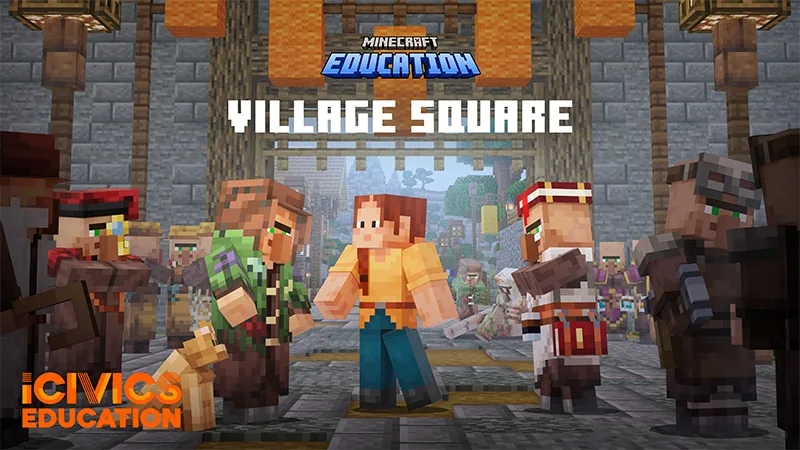
Using the Village Square world, students navigate civic dilemmas and gather perspectives while logging observations on their Challenge Notetaker. After resolving town issues together, learners reflect on their decisions through small-group discussions, news broadcasts, or drafting a community charter.
Learning objectives
By the end of this lesson students will be able to:
- Explain how groups reach decisions using voting and compromise.
- Analyze multiple viewpoints in an argument to determine a fair community solution.
- Evaluate the positive and negative effects individual actions have on others in a shared space.
Blocks and items used in this lesson


Key vocabulary
- Compromise
- An agreement reached when different sides each give up part of what they want.
- Common Good
- Something that benefits all or most members of a community rather than just a few individuals.
- Charter
- A written set of foundational rules, agreements, or rights accepted by a community.
- Democracy
- A system where community members use their voices and participate in making decisions.
Before class
Lesson sequence
Suggested timing: about 60 minutes in total.
- Warm-up & Civic Concepts10 min
Introduce the essential question and review key civic terms including compromise, voting, and the common good. Discuss a familiar school or classroom rule and ask learners to consider whom the rule benefits and why groups require agreed-upon guidelines.
- Explore Village Square25 min
Launch the Village Square world. Students explore the settlement, meet local residents, and investigate the civic challenges presented across the town.
Learners record conflicting viewpoints and track potential solutions on their Challenge Notetaker as they decide how to resolve each issue.
- Hear Ye, Hear Ye Village Council15 min
Organize students into small groups of 3 to 4, ideally using odd numbers to prevent voting ties. Groups conduct a round-robin brainstorm where each member shares one idea before anyone speaks twice, using sentence starters to propose and vote on final community solutions.
- Reporting & Reflection10 min
Wrap up the lesson by having students share their findings. Learners may complete written reflection questions, draft guidelines for a Class Charter, or record a short Cube City News audio or video summary explaining how democracy helped solve town challenges.
Video
Assessment: success criteria
- Student accurately identifies conflicting viewpoints on the Challenge Notetaker during gameplay.
- Student actively participates in group deliberation using sentence frames or round-robin sharing.
- Student explains how a proposed solution protects the common good rather than only one individual's interest.
- Student reflects in writing, audio, or video on the value of participation and shared agreements in a community.
Differentiation
Provide multilingual and emerging learners with pre-written sentence frames and the Cube City News speaking model to structure their oral or recorded reflections.
Challenge advanced students to write an argument analyzing specific situations where a single decision-maker might be more appropriate than a group vote.
Knowledge check
5 questions to check understanding after the lesson. Tap an answer to see if it is right; the score appears at the end.
1What is the primary purpose of reaching a compromise during a community dispute?
Answer: B. Compromise means finding a shared solution where competing sides each give up part of what they want to reach agreement.
2Why does the lesson suggest forming village council groups with odd numbers of students?
Answer: C. The source notes that odd-numbered groups are ideal for voting because they help prevent tied decisions.
3What tool do students use to record perspectives and civic challenges while exploring Village Square?
Answer: A. The teacher guide directs students to play Village Square while completing the Challenge Notetaker.
4In the 'Hear Ye, Hear Ye' council activity, what is the rule for the Round Robin technique?
Answer: C. The Round Robin brainstorming technique requires each student to share one thought before anyone is allowed to speak twice.
5What is the main role of a community charter as explored in the lesson?
Answer: A. A charter establishes foundational rules and shared commitments that guide the community toward fairness and the common good.
Resources
- Lesson package (.zip)Everything the author attached to this lesson in one download.
- Lesson PlanFull lesson plan for teaching with Village Square in your classroom.
- Extension PackClassroom PPT presentation for classroom instruction.
- Standards (US)Standards Alignment Document (US)
- Standards (UK)Standards Alignment Document (UK)
- Standards (CAN)Standards Alignment Document (CAN)
- Standards (AUS)Standards Alignment Document (AUS)
- Lesson worldOpens the world page in Minecraft Education (sign-in with a school account may be needed).
Part of the Civics and Citizenship curriculum
This is lesson 8 of 9 in Civics and Citizenship.
- LatinExplorers 2: A Hispanic Heritage Journey
- Active Citizen
- LatinExplorers: A Hispanic Heritage Journey
- Lessons in Good Trouble
- Peace Builders
- Stranger in Crimwell Village
- The Investigators
- Village Square
- Who is Dr. MLK Jr.?
Frequently Asked Questions
How much instructional time is required to deliver Village Square?
The core lesson is structured for 1 hour, but the materials can be extended across up to three class periods to accommodate the various post-gameplay writing, council, and charter activities.
What options exist for students who prefer speaking over written responses?
Teachers can use the Cube City News option, allowing students to record a brief audio or video summary using provided speaking frames instead of submitting written responses.
Adapted from Village Square by Minecraft Education on Minecraft Education, last updated Nov 16, 2026. This classroom version, the timings and the quiz were written by 9Minecraft Education.