- Type
- Lesson plan
- Ages
- Ages 6-13
- Duration
- 30 min
- Level
- Beginner
How do business owners keep track of inventory, sales, and costs to ensure their business makes a profit?
Overview
Running a successful retail business requires balancing inventory, managing daily operating costs, and keeping careful financial records. In this lesson, students explore foundational economic concepts such as barter trade, revenue, and net profit by stepping into the role of a store manager serving an active community.
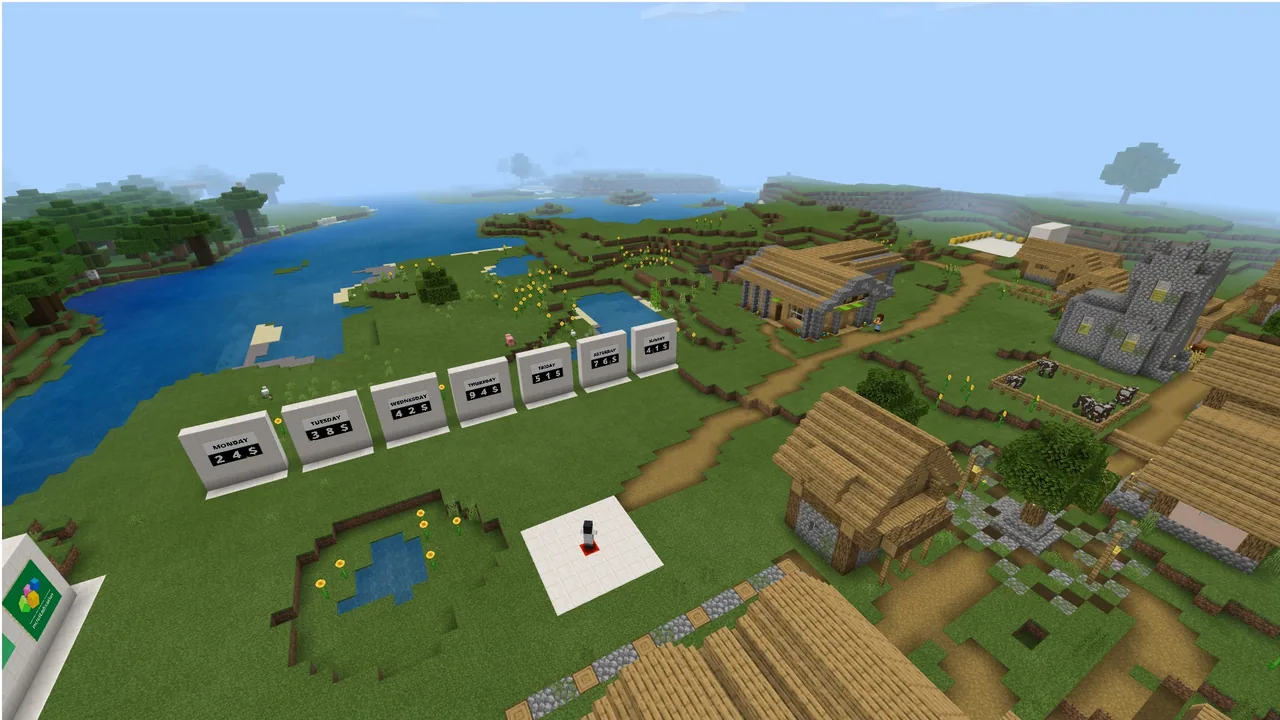
Working individually in a dedicated Minecraft world, each learner barters with villagers to replenish store stock each day, visits the village elder to advance time and record daily sales figures, and documents their figures in a printable ledger. At the end of the in-game week, students complete the merchant test to verify their mathematical calculations against randomized game data.
Learning objectives
By the end of this lesson students will be able to:
- Barter with villagers to acquire missing shop inventory each day.
- Record daily store sales figures into a financial ledger.
- Calculate total sales and net profit by subtracting operating expenses from revenue.
- Compare personal ledger calculations against the final in-game merchant test results.
Blocks and items used in this lesson


Key vocabulary
- Barter
- Trading goods or services directly for other goods without exchanging money.
- Turnover
- The total amount of money taken in from sales over a specific time period.
- Operating Cost
- The regular expenses required to keep a store open and running each day.
- Net Profit
- The money remaining from total sales after subtracting all operating costs.
Before class
Lesson sequence
Suggested timing: about 30 minutes in total.
- Introduction to Commerce and Barter5 min
Introduce the lesson by discussing how businesses operate. Explain key terminology including turnover, operating costs, and profit, and contrast modern currency transactions with historical barter systems where goods were traded directly.
- Weekly Shop Operation15 min
Students log into their individual worlds and begin the seven-day simulation. For each day, students must:
- Identify the missing stock items and visit the village to barter for replacements.
- Deliver the procured items to the shopkeeper so sales can proceed.
- Speak to the elder in the center of the village to advance to the next day and receive the daily sales report.
- Write the daily revenue figures directly onto their ledger worksheet.
- The Merchant Test and Reflection10 min
After completing seven in-game days, learners take the ten-question merchant test. Students calculate total sales, weekend earnings, and net profit using daily costs, then compare their worksheet calculations with the correct answers revealed on screen.
Assessment: success criteria
- The student accurately logs daily sales across all seven simulated days in their ledger.
- The student computes total sales and weekend turnover correctly using addition within 1000.
- The student calculates net profit by subtracting total weekly operating costs from gross revenue.
- The student self-evaluates calculation accuracy using the in-game merchant test feedback.
Differentiation
Provide learners with a 100s chart or base-ten blocks to assist with regrouping when adding daily sales totals.
Have fast finishers replay the world to tackle a new set of randomized numbers or compute average daily sales.
Knowledge check
5 questions to check understanding after the lesson. Tap an answer to see if it is right; the score appears at the end.
1What method must players use to acquire missing store items in the village?
Answer: B. The lesson requires players to head into the village and barter directly for the missing goods.
2Which character advances the in-game day and provides the daily sales total?
Answer: A. Visiting the elder in the village center advances the time to the next day and reveals the sales figure.
3Where do students record their daily store earnings during the simulation?
Answer: C. Students write down their sales numbers in their printable ledger worksheet.
4How is net profit determined at the end of the week?
Answer: C. Net profit is calculated by taking total revenue and subtracting operating expenses.
5What happens if a student replays the activity from the beginning?
Answer: B. The tasks remain consistent but the numbers are randomly generated each time the world is played.
Resources
- Lesson package (.zip)Everything the author attached to this lesson in one download.
- The LedgerPDF worksheet
Frequently Asked Questions
Can students collaborate in the same world during this activity?
No, this lesson is designed as a single-player experience so each student can independently manage their shop inventory, record their own ledger data, and test their arithmetic skills.
Are the numbers on the final merchant test the same for every student?
No, the world randomly generates sales numbers on every playthrough, meaning each student works with different figures and must rely on their own calculations.
Adapted from The Shop Owner by Maros Zvolensky on Minecraft Education, last updated Dec 9, 2022. This classroom version, the timings and the quiz were written by 9Minecraft Education.