- Type
- Lesson plan
- Subject
- Art, Music & Design
- Topics
- Art and Design
- Ages
- Ages 8-13
- Includes
- Quiz: 5 questions
How can we design an original superhero and communicate their identity and abilities through interactive character dialogue?
Overview
In this Art and Design project, students explore character development by creating original superheroes rather than merely studying established comic book figures. Learners brainstorm essential character elements, such as unique abilities, backstories, equipment, and personal identities, to understand how character traits define a hero.
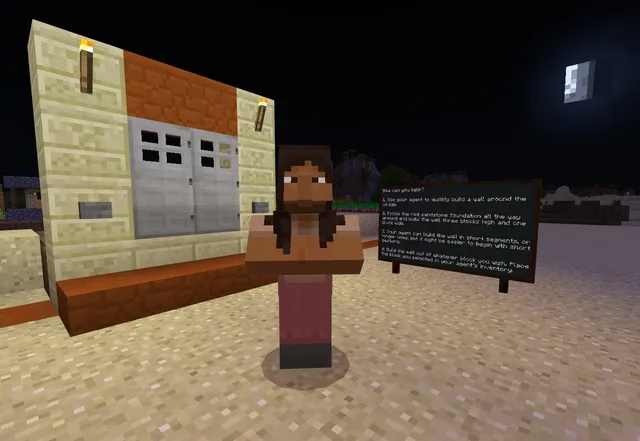
Using a shared Minecraft world, students bring their concepts to life as interactive non-player characters (NPCs). They program their NPCs using buttons and the /say command to answer questions about their identity and powers, then interact with and interview each other's characters across a shared class timeline.
Learning objectives
By the end of this lesson students will be able to:
- Identify key characteristics, gadgets, and abilities that define a superhero.
- Design an original superhero identity with unique powers and background details.
- Configure a non-player character (NPC) in Minecraft to represent an original superhero.
- Program NPC dialogue buttons using the /say command to answer specific interview questions.
Key vocabulary
- NPC (Non-Player Character)
- An in-game character that is not controlled by a human player and can be programmed to speak or run commands.
- /say command
- A Minecraft command that prints a specified message to the chat screen.
- Timeline
- An organized sequence of characters or events used to display and explore information.
Before class
Lesson sequence
- Superhero Concept Brainstorming
Guide the class through analyzing superhero traits using familiar examples like Iron Man, Batman, and Superman. Have students brainstorm their own original hero, answering questions about their name, powers, origin, gadgets, and costume.
- Creating the Superhero NPC
Students join the teacher's shared world and place an NPC to serve as their 3D virtual superhero. Learners customize the appearance of their character to fit their hero's design.
- Programming Dialogue with Commands
Students configure their NPC settings by adding buttons and programming them with the /say command. Each NPC must be able to answer key interview prompts, including 'Who are you?' and 'What special powers do you have?'
- Timeline Exploration and Peer Interviews
Learners walk through the shared world along the populated timeline, interacting with their peers' superhero NPCs. Students read the stories, trigger the command dialogue, and learn about the diverse characters created by the class.
Assessment: success criteria
- Student creates an original superhero concept with defined powers and identity traits.
- Student successfully places and customizes an NPC in the shared world.
- Student programs NPC buttons using the /say command to answer designated questions.
- Student explores the class timeline and interacts with peer NPCs to read their character stories.
Differentiation
Provide written syntax templates for the /say command and pre-drafted response sentences for students to insert into their NPC dialogue buttons.
Challenge students to add additional dialogue buttons answering in-depth questions about their superhero's gadgets, vehicles, danger senses, or origin story.
Knowledge check
5 questions to check understanding after the lesson. Tap an answer to see if it is right; the score appears at the end.
1What Minecraft feature do students use to represent their superhero in the shared world?
Answer: B. The activity instructs students to make an NPC to represent their superhero.
2Which command is used to program the superhero NPC to speak to players?
Answer: A. The source specifies using the /say command alongside buttons so the superhero answers questions.
3What type of Minecraft world setting does the teacher prepare for this activity?
Answer: C. The lesson states that the teacher will have the world set up for the class as a shared world.
4Which of these is one of the required questions students must program their NPC to answer?
Answer: D. The student instructions specifically list 'Who are You?' and 'What special powers do you have?' as required answers.
5What do students do once all the NPCs are placed and programmed on the timeline?
Answer: B. Once the timeline is populated, students are instructed to read the stories of all the NPCs and get acquainted.
Frequently Asked Questions
Is there a specific world file I need to download to run this lesson?
No, this lesson does not require a downloadable template. You can host any standard shared multiplayer world where students have permission to place and edit NPCs.
Which age groups and subjects are best suited for this project?
This activity is designed for students aged 8-10 and 11-13 within Art and Design, focusing on creativity, collaboration, and critical thinking.
How do students make the NPC respond when clicked?
Students open the NPC settings, create dialogue buttons, and bind the /say command to each button so the NPC sends text into the class chat when pressed.
Adapted from SUPERHEROES by haslindah syarifuddin on Minecraft Education, last updated Mar 16, 2019. This classroom version, the timings and the quiz were written by 9Minecraft Education.