- Type
- Lesson plan
- Subject
- Science
- Ages
- Ages 14+
- Duration
- 45 min
- Level
- Intermediate
How does using chemical elements as navigational coordinates deepen our understanding of the periodic table?
Overview
Reviewing the periodic table often relies on memorization drills that leave students disconnected from the actual layout and organization of chemical elements. This lesson turns element identification into an active strategy game where partners locate ships hidden across the grid, reinforcing their familiarity with chemical symbols, element names, and periodic groups through repeated peer communication.
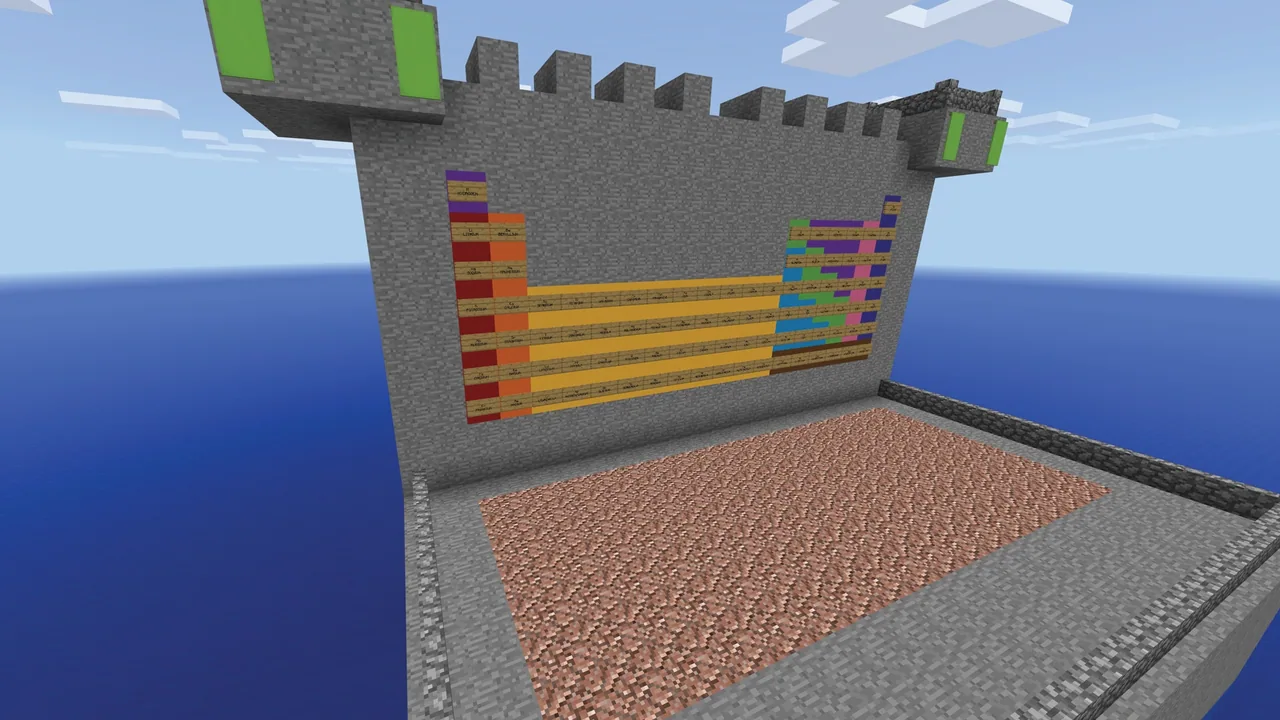
Using a dedicated Minecraft Education world containing two large periodic table game boards, students join either the green or orange team. Each player builds a fleet on their home board following in-game guidelines, then heads over to their opponent's board to uncover targets with a pickaxe by calling out element names rather than traditional coordinates.
Learning objectives
By the end of this lesson students will be able to:
- Identify the positions of specific chemical elements across the periodic table grid.
- Name individual elements accurately when targeting opponent coordinates.
- Recognize element groups and trends across the game board during play.
- Collaborate with a partner to apply periodic table knowledge in a competitive gameplay setting.
Blocks and items used in this lesson


Key vocabulary
- Periodic Table
- A tabular arrangement of chemical elements organized by their atomic properties and structure.
- Element Groups
- Vertical columns on the periodic table containing elements that share similar chemical behaviors.
- Coordinates
- A set of values or positions used to pinpoint a specific location on a grid or map.
Before class
Lesson sequence
Suggested timing: about 45 minutes in total.
- Briefing and Team Selection10 min
Introduce the activity and divide students into pairs. Have each partner choose their team color—either green or orange—and access their assigned game board. Direct students to read the in-game rule displays before taking their ship blocks.
- Fleet Construction10 min
Students position their ships on their home board according to the world rules. Remind players to keep their placements hidden from their partner to ensure fair gameplay.
- Targeting and Discovery20 min
Players swap over to view the opponent's board. Taking turns, students announce target locations using chemical element names instead of standard grid letters or numbers, then use their pickaxe to strike the corresponding block and discover whether a ship is hidden there.
- Review and Reset5 min
Once a fleet is uncovered, partners review any unfamiliar elements encountered during the round. Because the world file can be reloaded easily, teachers can restart the world for additional practice rounds or quick revision sessions.
Assessment: success criteria
- Student accurately identifies and names elements instead of relying on generic row and column numbers.
- Student successfully places and uncovers ships according to the established game rules.
- Student demonstrates improved recall of element locations and element groups during gameplay.
Differentiation
Allow students to refer to a standard reference periodic table chart while finding and calling out element names on the board.
Require players to state the element group or specific chemical properties before they can mine a chosen block on the opponent board.
Knowledge check
5 questions to check understanding after the lesson. Tap an answer to see if it is right; the score appears at the end.
1What two team colors do players choose between in this lesson world?
Answer: B. The source specifies that students choose either the green or orange team.
2What tool do students use to reveal ships on their opponent's board?
Answer: A. According to the student activities, learners use a pickaxe to discover the other student's ships.
3What should students call out instead of traditional grid coordinates to target ships?
Answer: C. The instructions state that instead of speaking about ship positions, students should use the elements of the periodic table.
4How many game boards are provided in the downloadable world?
Answer: B. The guiding ideas explain that in this world you can find two boards, one for each student.
5Why is this world especially suitable for repeated periodic table revision?
Answer: C. The source notes you can play again and again by reloading or uploading the world, making it ideal for review.
Resources
- Lesson package (.zip)Everything the author attached to this lesson in one download.
- Mundo en españolMundo de la lección en español
Frequently Asked Questions
Can students replay the game after finishing a round?
Yes. The world file can be reset or reloaded repeatedly, allowing pairs to play multiple rounds and encounter different element positions each time.
What language support is noted in the source materials?
The original source lists supporting files with a world provided in Spanish (Mundo en español), though the gameplay mechanics remain straightforward across classrooms.
Adapted from Sink the periodic table by Leticia Ahumada on Minecraft Education, last updated Jul 21, 2025. This classroom version, the timings and the quiz were written by 9Minecraft Education.