- Type
- Lesson plan
- Subject
- Math
- Topics
- Math & Economics
- Ages
- Ages 11-18
- Includes
- Quiz: 5 questions
How can we design fair experiments in Minecraft to test randomness and determine the probabilities of different mob variants?
Overview
Probability helps us understand chance, sample variability, and the difference between theoretical models and real-world outcomes. In this lesson, students investigate how randomness behaves through statistical testing, data collection, and controlled sampling.
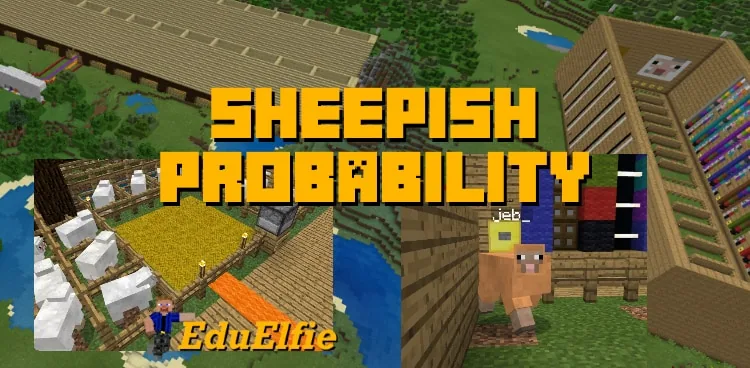
Using Minecraft as a simulation environment, learners test whether in-game dispensers function as genuine random generators, use sheep breeding trials to deduce the color of an unknown parent, and build their own fair sampling apparatus to measure animal and villager variants.
Learning objectives
By the end of this lesson students will be able to:
- Compare the experimental output of a Minecraft dispenser to a standard random number generator.
- Predict the color of a mystery sheep by conducting a limited number of breeding trials.
- Design and build a fair Minecraft experiment to collect sample data on mob variants.
- Analyze sample data to explain the difference between theoretical and experimental probability.
- Evaluate how sample variation and outliers influence data measures such as range, mean, and median.
Blocks and items used in this lesson


Key vocabulary
- Theoretical Probability
- The calculated likelihood of an event occurring based on all possible equal outcomes.
- Experimental Probability
- The ratio of the number of times an outcome occurs to the total number of trials conducted.
- Fair Experiment
- An investigation where test conditions are controlled so that each trial has an unbiased outcome.
- Sample
- A subset of data collected from a larger population to observe trends and proportions.
- Outlier
- An individual data value that differs significantly from other observations in a dataset.
Before class
Lesson sequence
- Dispenser Randomness Test
Have students load a dispenser with different colored items to act as a random color generator. Students activate the dispenser repeatedly, record their outcomes, and compare the distribution against trials run on an external random number generator.
- Mystery Sheep Breeding
Present students with a mystery sheep color problem. Working within a restricted number of breeding attempts, students must carefully plan and execute crosses to gather evidence and deduce the hidden sheep color from the offspring.
- Fair Mob Experiment Design
Working collaboratively, students design and construct a controlled testing area in Minecraft. Students generate repeated samples of villagers or selected animals—such as horses, llamas, parrots, or sheep—to determine the experimental probabilities of different variants.
- Data Analysis and Discussion
Students compile their sample results and calculate proportions, means, medians, and ranges. Bring the class together to compare results across groups, identify outliers, and discuss whether the Minecraft mechanics produce genuinely fair results.
Assessment: success criteria
- Student data tables show accurate recording of dispenser trials alongside random number generator comparisons.
- Breeding experiment logs demonstrate logical deduction of the mystery sheep color based on trial limits.
- Constructed mob testing station reflects a fair, unbiased experimental setup.
- Student explanations clearly distinguish between theoretical probability and experimental results, noting sample variation and outliers.
Differentiation
Provide students with a pre-formatted tally sheet to record dispenser drops and sheep offspring colors during their trials.
Challenge students to test multiple animal species, such as comparing the variant distributions of llamas, parrots, and horses.
Knowledge check
5 questions to check understanding after the lesson. Tap an answer to see if it is right; the score appears at the end.
1What tool are students asked to compare against the Minecraft dispenser to test randomness?
Answer: B. Activity 1 asks students to compare dispenser results to an experiment using a random number generator.
2What constraint do students face while trying to identify the mystery sheep's color?
Answer: A. The source specifies that students have a limited number of experiments to complete while determining the mystery sheep color.
3Which of the following mobs is explicitly mentioned as an option for the student-designed experiment?
Answer: C. The source lists villagers, horses, llamas, sheep, and parrots as mob options for Activity 3.
4What key mathematical comparison are students expected to explore through these activities?
Answer: C. The performance expectations state that students explore the difference between theoretical and experimental probability.
5What statistical effect are students asked to examine regarding individual data values?
Answer: A. The learning objectives include investigating the effect of individual data values, including outliers, on the range, mean, and median.
Frequently Asked Questions
Do I need to download a custom world file to run this lesson?
No, this lesson does not require a downloadable world. Students can build dispenser setups and breeding pens in any standard creative world.
Which mobs can students choose for their custom probability experiments?
Students can design experiments to test the probabilities of different villager professions or varieties of horses, llamas, parrots, and sheep.
Adapted from Sheepish Probability by Stephen Elford on Minecraft Education, last updated Oct 2, 2018. This classroom version, the timings and the quiz were written by 9Minecraft Education.