
- Type
- Lesson plan
- Subject
- Science
- Topics
- Science
- Grade
- Primary (Grades 3-5)Middle school (Grades 6-8)High school (Grades 9-12)Adults & educators (Higher education and teacher learning)
- Ages
- Ages 8+
- Duration
- More than 3 hours
- Level
- Beginner
How can we apply principles of simple machines to build a resettable eight-step chain reaction in Minecraft?
Overview
A Rube Goldberg machine uses a chain reaction to carry out a simple task in an indirect, complicated way, named after the political cartoonist who illustrated such devices. In this science project, students explore how simple machines—including levers, pulleys, inclined planes, wedges, wheels, and screws—can be modeled to pass energy from one stage to the next.
Using a hosted multiplayer void world divided for up to eight groups, learners collaborate to sketch blueprints, establish team norms, and construct contraptions with at least eight cause-and-effect steps. Students utilize gravity, block interactions, and mob behaviors while learning to test destructive elements safely and ensure their final build can be reset and demonstrated repeatedly.
Learning objectives
By the end of this lesson students will be able to:
- Identify and model different simple machines within a Minecraft build.
- Sketch and plan an eight-step chain reaction consisting of four causes and four effects.
- Construct a collaborative contraption that successfully triggers a final event such as fireworks.
- Establish group norms and log iterative design changes, failures, and successes.
- Design the machine so that it can be completely reset for repeated demonstrations.
Blocks and items used in this lesson


Key vocabulary
- Rube Goldberg Machine
- A contraption designed to perform a simple task through an indirect, complicated chain reaction.
- Simple Machine
- A basic mechanical device used to alter motion or force, such as a lever, pulley, wedge, wheel, screw, or inclined plane.
- Cause and Effect
- A relationship where an initial action directly produces a subsequent outcome.
- Reset
- The process of returning a contraption to its starting position so it can function again.
Before class
Lesson sequence
Suggested timing: about 190 minutes in total.
- Introduction and Group Norms30 min
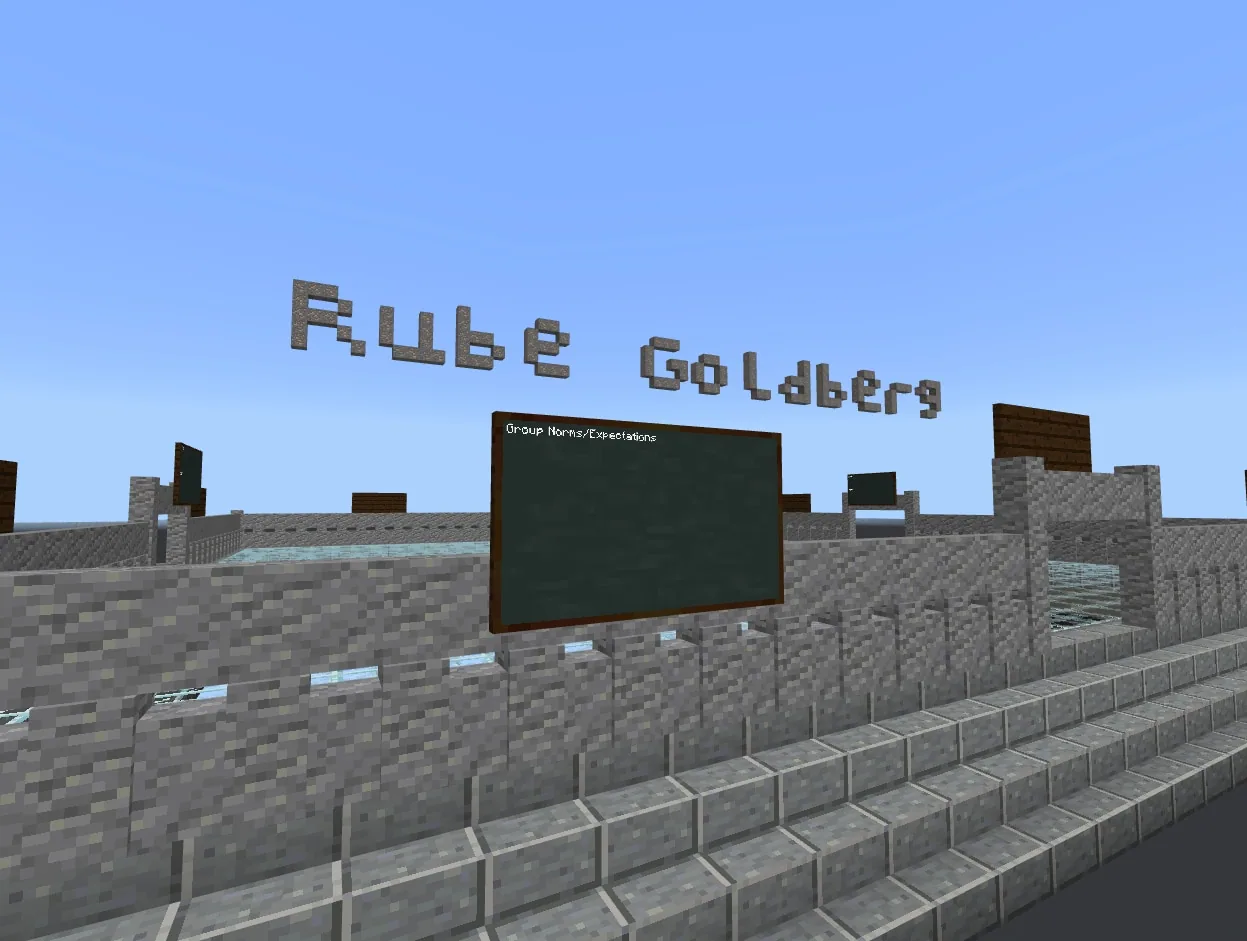
Introduce Rube Goldberg as a political cartoonist who drew complex contraptions to accomplish simple objectives. Review the class charter emphasizing respect. Have each group enter their designated area in the void world and document their team norms on their assigned board.
- Research and Blueprinting40 min
Students investigate simple machines (pulleys, levers, wedges, wheels, inclined planes, and screws) and brainstorm an eight-step sequence consisting of at least four causes and four effects. Each team sketches their blueprint on paper before placing blocks in the shared world.
- Construction and Testing90 min
Teams construct their contraptions, taking advantage of vertical height and gravity. Students may incorporate mob behaviors and various block interactions. Any hazardous mechanics involving water or TNT must be tested in a separate single-player world before implementation. Daily progress, design changes, and unexpected results are logged.
- Demonstration and Resetting30 min
Each team demonstrates their machine running through its eight steps to trigger the final target, such as launching fireworks. Groups then reset their contraption back to its starting state to prove it can run more than once.
Assessment: success criteria
- The contraption includes a minimum of eight distinct steps (four causes and four effects).
- The build successfully models simple machines or mechanical block interactions.
- The machine can be reset and executed more than once without rebuilding from scratch.
- The final action successfully triggers the target task, such as fireworks.
- The team documented their group norms on their board and recorded their design progress.
Differentiation
Provide students with a basic cause-and-effect starter example, such as a minecart triggering a pressure plate to push a piston.
Challenge advanced teams to integrate mob behaviors as triggers or combine multiple simple machine designs into a single step.
Knowledge check
5 questions to check understanding after the lesson. Tap an answer to see if it is right; the score appears at the end.
1What original profession inspired the concept of Rube Goldberg machines?
Answer: A. Rube Goldberg was a political cartoonist who drew illustrations showing simple tasks performed in convoluted ways.
2How many total steps are required as the baseline goal for the Minecraft contraption?
Answer: C. The lesson specifies brainstorming and building an achievable goal of eight or more steps.
3Where must students experiment with potentially destructive elements like water or TNT?
Answer: B. To prevent accidental griefing or destruction, testing for hazardous elements must happen in a separate world.
4What is an important requirement for the completed machine after it finishes running?
Answer: C. The instructions state that students should be able to reset their build so the contraption can be seen in action again.
5What recommended final action can signify the successful end of the eight-step chain reaction?
Answer: B. The project guide lists an achievable end goal of having eight steps activate fireworks.
Resources
- Lesson package (.zip)Everything the author attached to this lesson in one download.
- Simple Machine MEE ExplorationOptional but a great introduction to see the mechanics of a simple machine demonstrated within a Minecraft: Education Edition environment.
Frequently Asked Questions
How many groups can build in the host world at the same time?
The host world is configured to provide designated building sections for up to eight student groups simultaneously.
What counts as a cause and an effect in the machine?
A cause is an initiating action and an effect is the resulting trigger; for instance, a minecart rolling down a rail (cause) that triggers a piston to push another cart (effect) counts as one pair.
Where do students keep track of their team agreements?
Each section of the void world includes a board where groups are required to write and document their own group norms.
Adapted from Rube Goldberg Group Build by Andy Knueven on Minecraft Education, last updated Jun 3, 2025. This classroom version, the timings and the quiz were written by 9Minecraft Education.






































