- Type
- Lesson plan
- Grade
- Primary (Grades 3-5)
- Ages
- Ages 8-10
- Duration
- about 1.7 hours (suggested)
- Skills
- Creativity
- Includes
- Quiz: 5 questionsLesson files
How do writers use plot structure and believable exaggeration to turn real experiences into engaging stories?
Overview
This lesson explores the essential ingredients of narrative writing through the lens of Roald Dahl's Boy, focusing on the famous chapter 'The Great Mouse Plot'. Students investigate how an author structures a narrative arc—moving from the opening problem through rising tension to the climax and resolution—while exploring the craft of believable exaggeration.
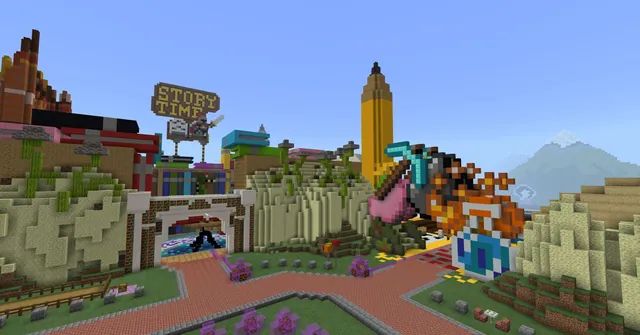
After mapping out story arcs and planning an exaggerated event from their own lives through storyboarding, students move into Minecraft Education. In the build extension, learners design and build a personal, memorable school experience, translating their autobiographical memories into a shared spatial environment.
Learning objectives
By the end of this lesson students will be able to:
- Identify the five stages of plot: start, problem, build-up, climax, and resolution.
- Examine how Roald Dahl used exaggeration to elevate real-life events in The Great Mouse Plot.
- Draft a storyboard of a personal autobiographical event featuring a believable exaggeration.
- Recreate a memorable moment from personal school experience in Minecraft Education.
Blocks and items used in this lesson


Key vocabulary
- Plot
- The planned sequence of events that forms the structure of a story.
- Climax
- The most intense, dramatic, or decisive point in a story.
- Exaggeration
- Stretching the truth to make a description or event more dramatic while keeping it believable.
- Autobiography
- An account of a person's life written by that person.
- Resolution
- The final part of a story where the main problem is concluded or settled.
Before class
Lesson sequence
Suggested timing: about 100 minutes in total.
- Warm-up: The Story Cake15 min
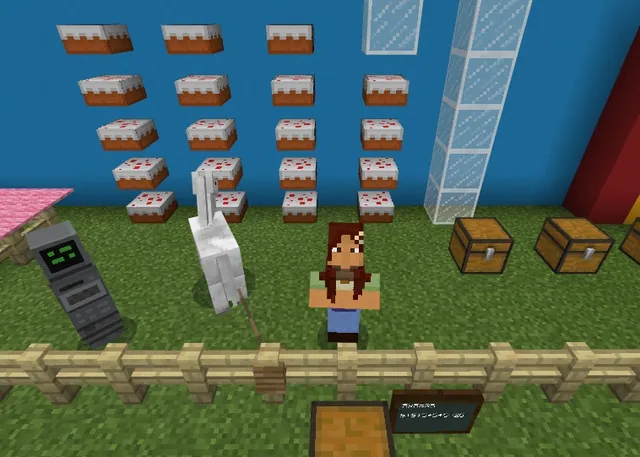
Draw a large cake on the board and ask students to imagine baking a 'story cake'. Invite them to suggest essential ingredients, such as characters, suspense, comedy, conflict, and truth.
Connect these ingredients to the five key stages of a story arc: START – PROBLEM – BUILD UP – CLIMAX – RESOLUTION.
- Group Discussion: Exaggeration in Dahl's Writing15 min
Recap the events of The Great Mouse Plot. In small groups, have students discuss:
- Which parts of the story seem exaggerated?
- What was Mrs Pratchett likely like in real life?
- Did the boys truly believe they had killed her?
- Did she really watch the caning, and could these events still be believable?
- Plot Mapping Activity20 min
Distribute large sheets of paper to student groups. Have each group draw a continuous line showing the rise and fall of tension in The Great Mouse Plot.
Students annotate the line by writing or sketching the story events at matching points along the arc, explaining to one another how each event fits the plot structure.
- Independent Storyboarding: Personal Autobiography20 min
Ask students to select a real event from their own lives (such as a birthday, getting into trouble at school, meeting a new sibling, or making a discovery). Have them plan a storyboard for this event.
Instruct students to exaggerate one element to make it entertaining, while keeping the scenario realistic and believable.
- Minecraft Build Extension30 min
Share a brief, memorable schooling moment from your own life to spark ideas. Instruct students to launch Minecraft Education and construct a scene recreating a memorable moment from their school years.
Encourage them to reflect on the setting, characters, and key dramatic focus of their memory as they build.
Assessment: success criteria
- Identifies and sequences the five core plot stages accurately on a plot line.
- Participates in textual discussion distinguishing between factual truth and narrative exaggeration.
- Completes a storyboard containing a clear personal event enhanced with a believable exaggeration.
- Constructs a Minecraft build that clearly represents a real-life schooling memory.
Differentiation
Provide a pre-printed plot diagram with labeled boxes for start, problem, build-up, climax, and resolution to assist with storyboarding.
Ask students to annotate their Minecraft build with signs identifying which specific build elements represent reality and which represent exaggeration.
Knowledge check
5 questions to check understanding after the lesson. Tap an answer to see if it is right; the score appears at the end.
1Which sequence correctly lists the five stages of a plot introduced in the lesson?
Answer: A. The lesson specifically defines the plot structure as START – PROBLEM – BUILD UP – CLIMAX – RESOLUTION.
2What drawing exercise is used on the board to brainstorm story ingredients?
Answer: B. The teacher draws a cake on the board to have students imagine adding ingredients required for a story.
3When adding exaggeration to an autobiographical story, what must students keep in mind?
Answer: C. The lesson states that the exaggerated part must still be believable and something that could realistically occur.
4What are students tasked with recreating in the Minecraft extension activity?
Answer: D. The extension prompts students to recreate a memorable moment from their years in school in Minecraft.
5How do student groups visually display the narrative progression of The Great Mouse Plot on paper?
Answer: B. Groups map the story by drawing a line that represents the ups and downs of the narrative plot.
Resources
Frequently Asked Questions
Do I need a custom Minecraft world template for this lesson?
No custom world download is required. Students can build their memorable school scene in any standard, flat, or creative Minecraft world.
What background reading is needed before starting?
Students should be familiar with 'The Great Mouse Plot' from Roald Dahl's book Boy, as the group discussion and plot-mapping exercises directly reference this text.
Adapted from Roald Dahl's Boy - The Great Mouse Plot by Minecraft Education on Minecraft Education, last updated Dec 19, 2022. This classroom version, the timings and the quiz were written by 9Minecraft Education.