How can renewable energy systems be modeled to demonstrate the conversion of natural energy into usable electrical power?
Overview
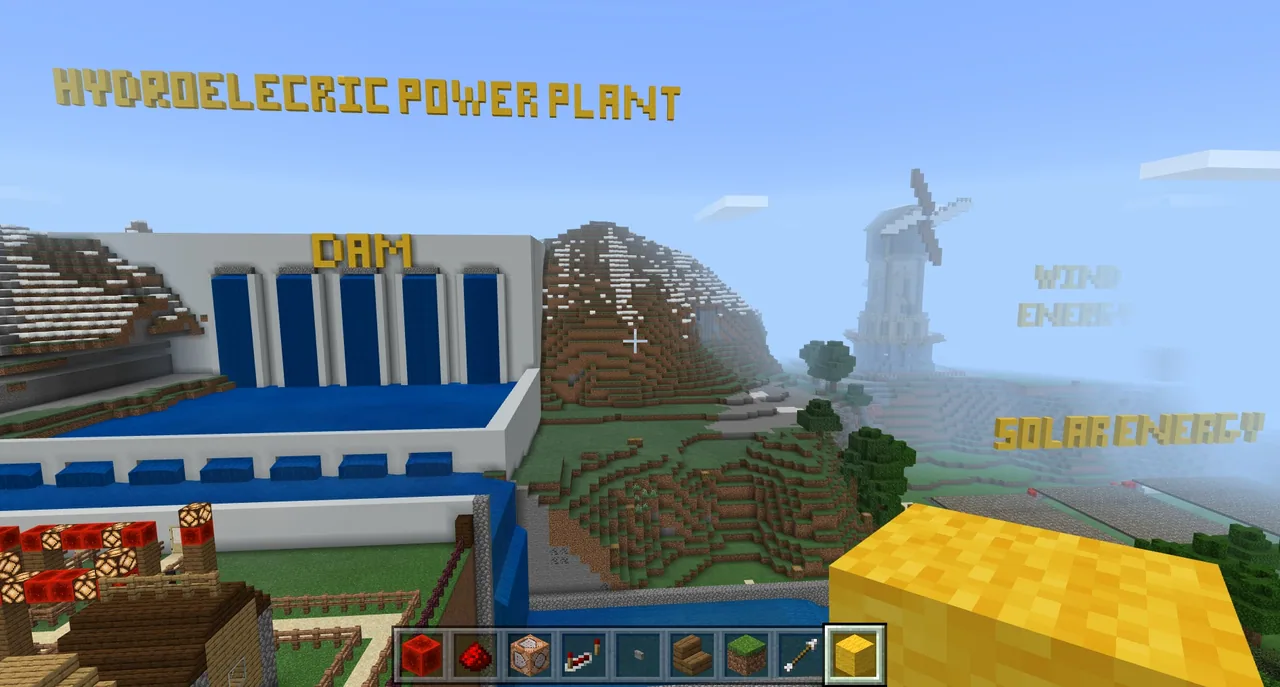
Students examine the role of renewable energy sources, exploring why alternative power is necessary and how natural forces convert into usable electricity. The lesson highlights that the Sun drives almost all terrestrial energy systems, with notable exceptions such as geothermal, nuclear, and tidal energy. Learners analyze energy transformations across multiple forms, including kinetic, gravitational potential, chemical, and internal energy, while applying core mathematical formulas to evaluate system efficiency. Working in small groups, learners first draft their conversion mechanisms on graph paper to establish appropriate scaling. They then translate these structural plans into Minecraft, building functional models of energy conversion systems. In-game features such as the camera, portfolio, and book and quill allow students to document each transitional phase from natural resource to electrical output.Learning objectives
By the end of this lesson students will be able to:
- Explain the need, characteristics, and advantages of renewable energy sources.
- Calculate kinetic energy, gravitational potential energy, and percentage efficiency using established formulas.
- Identify energy conversions across kinetic, potential, chemical, elastic, nuclear, and internal forms.
- Design and construct a scaled renewable energy conversion system inside Minecraft.
Blocks and items used in this lesson


Key vocabulary
- Kinetic Energy
- The energy an object possesses due to its motion, calculated using the formula kinetic energy = ½mv².
- Gravitational Potential Energy
- Stored energy resulting from an object's position or elevation, calculated using potential energy = mgΔh.
- Efficiency
- The percentage of energy input that is successfully turned into useful output: (useful energy output / energy input) × 100%.
- Renewable Energy
- Energy obtained from natural sources that replenish naturally, most of which originate from the Sun.
Before class
Lesson sequence
- Energy Concepts and Direct Instruction
Introduce the advantages and characteristics of renewable energy. Review the slide deck on work, energy, and power, clarifying that the Sun powers nearly all resources except geothermal, nuclear, and tidal systems.
Introduce the core formulas: kinetic energy = ½mv², gravitational potential energy = mgΔh, and efficiency % = (useful energy output / energy input) × 100%.
- Worksheet Analysis and Calculations
Distribute the Renewable Energy Sources Worksheet. Have students work through the problem sets, identifying energy types and calculating kinetic energy, potential energy, and system efficiencies.
- Graph Paper System Design
Organize students into small groups. Instruct each group to draft their energy conversion system on graph paper, planning their layout to determine the scale and types of blocks they will use in Minecraft.
- Minecraft Conversion System Build
Groups open Minecraft and construct their energy conversion system using an appropriate scale based on their paper schematics. If necessary, demonstrate basic block placement and world navigation.
Students ensure their model demonstrates a clear conversion path, such as potential energy converting to kinetic energy, then mechanical energy, and finally electrical energy.
- Documentation and Energy Tracking
Students document their finished models using screenshots, the in-game camera, portfolio, and the book and quill to explain the energy transformations occurring at each step of their system.
Assessment: success criteria
- Accurate completion of all calculation and conceptual questions on the supplied worksheet.
- Clear demonstration of an energy conversion sequence (e.g., potential to kinetic to mechanical to electrical) within the Minecraft build.
- Proper application of the kinetic energy, potential energy, and efficiency equations.
- Documentation of the built model using the camera, portfolio, book and quill, or screenshots.
Differentiation
Demonstrate block placement directly in Minecraft and provide guided templates for tracing conversion steps.
Have students design and construct full working models of complex facilities like hydroelectric, thermal, or nuclear power stations.
Knowledge check
5 questions to check understanding after the lesson. Tap an answer to see if it is right; the score appears at the end.
1Which of the following energy sources does NOT originate from the Sun?
Answer: C. The Sun provides energy for all resources except geothermal, nuclear, and tidal sources.
2What is the correct mathematical formula for calculating gravitational potential energy?
Answer: B. Gravitational potential energy is calculated as mass multiplied by gravity and change in height (mgΔh).
3What planning activity should student groups complete before placing blocks in Minecraft?
Answer: A. Drawing the system on graph paper helps students plan their scale and determine block placement before building.
4Which expression correctly determines the efficiency percentage of an energy system?
Answer: D. Efficiency is calculated by dividing useful energy output by total energy input and multiplying by 100%.
5Which sequence correctly illustrates an energy conversion chain described in the lesson?
Answer: C. The lesson outlines potential energy turning into kinetic energy, then mechanical energy, and ultimately electrical energy.
Resources
- Lesson package (.zip)Everything the author attached to this lesson in one download.
- Renewable Energy Sources: mcworld fileRenewable Energy Sources: mcworld file
- Renewable Energy Sources Worksheet: Microsoft word fileRenewable Energy Sources Worksheet for students: Microsoft word file
Frequently Asked Questions
How do students record and turn in their work from Minecraft?
Students can use in-game documentation tools such as the camera, portfolio, and book and quill, or take screenshots of their completed builds to present alongside their finished worksheets.
What should be done if students are new to Minecraft controls?
Teachers can provide a short live demonstration on how to create a world, navigate the interface, and place blocks before releasing students to work in their groups.
What files and resources are needed to conduct this lesson?
The lesson uses the Renewable Energy Sources .mcworld file, the Renewable Energy Sources Worksheet document, a presentation on work, energy, and power, and sheets of graph paper.
Adapted from Renewable Energy Sources by Vilas Bhagwat on Minecraft Education, last updated Jul 14, 2022. This classroom version, the timings and the quiz were written by 9Minecraft Education.