- Type
- Lesson plan
- Subject
- Computer Science & Coding
- Topics
- Computer Science
- Grade
- Primary (Grades 3-5)
- Ages
- Ages 8-10
What shared attributes define quadrilaterals, and how can we distinguish different types like squares, rectangles, and rhombuses?
Overview
This geometry lesson introduces learners to the properties of quadrilaterals. By examining four-sided shapes, students discover how common attributes unite figures such as squares, rectangles, rhombuses, and parallelograms under one broad geometric category.
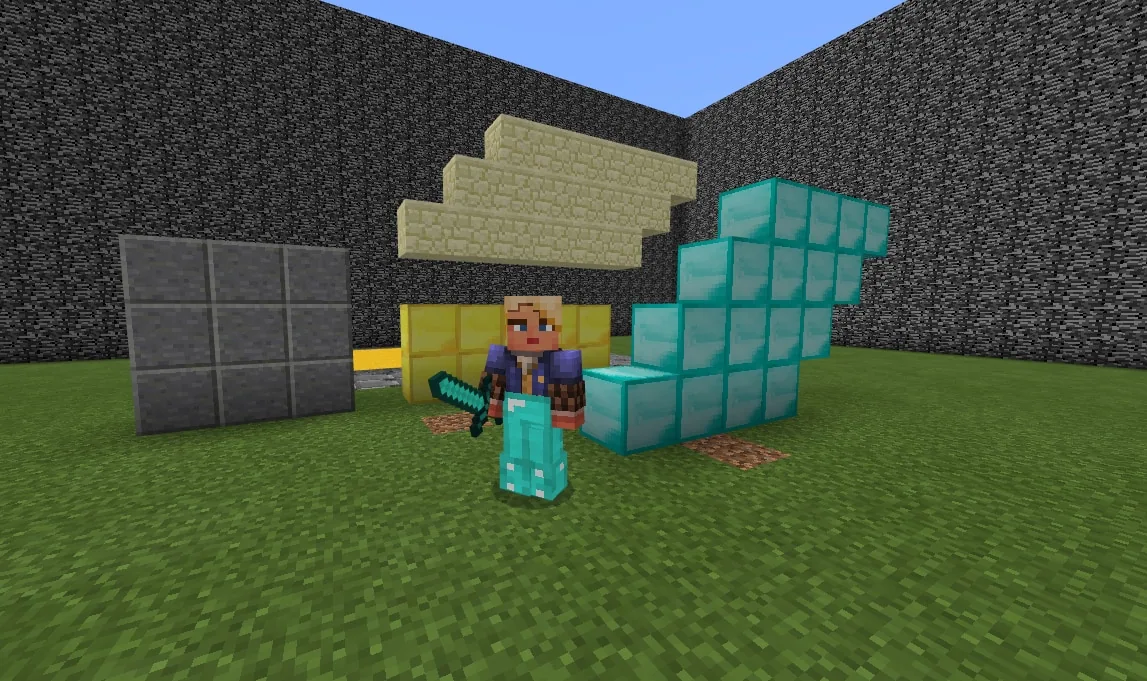
Using Minecraft, students represent their understanding by constructing individual quadrilateral models in a shared arena. After reviewing peer creations and documenting their findings, the class engages in a team-based Capture the Flag mini-game played directly on their math battlefield.
Learning objectives
By the end of this lesson students will be able to:
- Define a quadrilateral as a four-lined shape and identify specific subcategories.
- Build one to three distinct, freestanding math models of quadrilaterals in Minecraft.
- Peer review at least three classmates' math models against quadrilateral definitions.
- Document mathematical models using pictures inside student portfolios.
Blocks and items used in this lesson


Key vocabulary
- Quadrilateral
- A geometric shape made of four lines or sides.
- Square
- A quadrilateral that shares attributes with rectangles and rhombuses.
- Rectangle
- A category of quadrilateral with four sides and specific angle attributes.
- Rhombus
- A four-sided shape belonging to the quadrilateral family.
- Parallelogram
- A quadrilateral category with opposite sides that run parallel.
Before class
Lesson sequence
- Opening Slideshow and Concept Unveiling
Present the slideshow showing various four-sided shapes while students take notes in math notebooks. Guide the discussion toward the core definition that any four-lined shape is a quadrilateral.
- Building the Math Battlefield
Students log into the world, select either the Gold Team or Purple Team skin, and enter the arena. Each learner builds one to three quadrilateral models, ensuring that individual structures do not touch.
- Peer Review and Portfolios
Learners examine and evaluate at least three math models constructed by their peers. Students capture pictures of their builds to place inside their portfolios.
- Capture the Flag Match
The teacher activates the game button, teleporting players to their team locker rooms to choose characters. Teams enter the arena and attempt to win by breaking every block of the opponent's flag.
- Debrief and Wrap-Up
Conclude the lesson by reviewing student observations, comparing definitions, and addressing the provided reflection questions.
Assessment: success criteria
- Student accurately defines quadrilaterals, squares, rectangles, rhombuses, and parallelograms.
- Student successfully compares and contrasts the attributes of different quadrilaterals.
- Student constructs one to three separate quadrilateral models that do not touch adjacent builds.
- Student reviews at least three peer models and records build photos in a portfolio.
Differentiation
Provide graph paper and the supporting shape guides so students can sketch four-lined figures before placing blocks in the world.
Have students recreate an alternative quadrilateral design based on peer work or construct examples of four-sided shapes that do not fit standard subcategories.
Knowledge check
5 questions to check understanding after the lesson. Tap an answer to see if it is right; the score appears at the end.
1What is the primary definition of a quadrilateral presented in the lesson?
Answer: B. The lesson introduces a quadrilateral as a four-lined shape during the slideshow.
2How many math models is each student expected to build on the arena map?
Answer: C. The building instructions state that each student should create one to three math models.
3What specific rule must students follow regarding the placement of their models?
Answer: B. The activity rules specify that student models should not touch.
4How many peer models must each student review before the mini-game starts?
Answer: C. The peer review directions require each student to review at least three math models.
5How does a team secure victory in the Capture the Flag game?
Answer: D. The first team to destroy all blocks of the opponent's flag wins the game.
Resources
- Lesson package (.zip)Everything the author attached to this lesson in one download.
- How to play Capture the FlagInstructions on how to play the Capture the Flag Minecraft mini-game.
- Portfolio ExampleExample of how students' portfolio with look.
- Square
- Rhombus
- Parallelogram
- Rectangle
- Opening Slideshow
- Worksheet
- Lesson worldOpens the world page in Minecraft Education (sign-in with a school account may be needed).
Frequently Asked Questions
Which teams do students choose between in this lesson?
Players select either the Gold Team or the Purple Team and wear their chosen team's skin before teleporting into the arena.
What materials are needed for the offline opening phase?
The teacher needs the opening slideshow file, whiteboard, markers, and math notebooks or graph paper with pencils for students.
How does the game signal that a match has ended?
Once all flag blocks are broken, a message announces the winning team and players are eliminated to complete the round.
Adapted from Quadrilateral Capture the Flag by Minecraft Education on Minecraft Education, last updated Sep 15, 2023. This classroom version, the timings and the quiz were written by 9Minecraft Education.